It was around 10:30 at night. Sadiq, a university student, was sitting with his friend Rakib at a busy tea stall in Dhaka. Finishing his last sip of tea, Rakib exclaimed,
— “Bro, today’s horoscope says a big change is coming to my life! That’s why I’m taking it easy and skipping my exam prep for now.“
Sadiq smiled and replied,
— “Stop believing in this nonsense! Honestly, your hard work will decide your future—not the stars.“
Rakib shook his head and said, “There’s some logic in what you say, but you know, my mother has believed in horoscopes since I was a kid. It’s tough to go against her!”
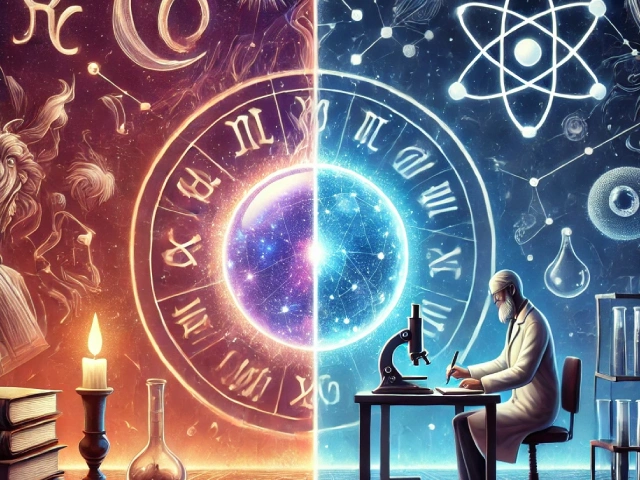
Like Rakib, millions of people read horoscopes every day, believing the positions of planets and stars will change their lives. But from a scientific perspective, is astrology truly credible, or is it just cosmic deception?
The Secret Behind Horoscope Popularity
People by nature don’t like uncertainty. That’s why they are drawn to predictions—to know what will happen in life, whether they’ll succeed or not. Astrologers exploit this vulnerability.
Psychologists say there’s a mental tendency called the “Barnum Effect”, where people perceive broadly applicable statements as specially true for themselves. For example, “You are a creative person, but sometimes doubt your own abilities”—almost anyone can relate to this. Astrology takes full advantage of this technique.
World-renowned physicist Carl Sagan once said,
“Astrology is essentially a business built on human curiosity and uncertainty.”
The question remains, if it’s false, why have people believed in it for generations?
Astrology in the Eyes of Science
In empirical science, every theory must be tested. Predictions made by astrology don’t regularly come true. In 1985, researchers Shawn and Barens compared the lives of 2,000 people with the positions of the planets and found no correlation whatsoever.
A survey by the National Science Foundation in 2005 found that 42% of Americans believe astrology is scientific!
Nobel-winning physicist Richard Feynman once said,
“Science is a process to seek truth, while astrology is a distorted reflection of truth.”
Why Isn’t It Science?
Firstly, science is founded on experimentation and reproducibility. Astrological predictions aren’t repeatedly proven true. Secondly, science requires a causal relationship to prove anything. There’s no scientific explanation for how the positions of planets and stars could affect individual lives. Thirdly, different astrologers often give different predictions for the same person—which is scientifically impossible.
So why do people still believe? Sociologists say it’s a blend of belief and culture. People love to believe in fate because it makes them feel less responsible for their own lives.
Famed science writer Neil deGrasse Tyson says,
“If horoscopes were real, all Capricorns would get a job on the same day, and lose that job on the same day.”
But why do even educated people sometimes believe in astrology? Psychologist Daniel Kahneman explains,
“People are driven more by emotion than by logic.”
In conclusion, it’s crucial to break free from cosmic deception. In the age of science, how rational is it to cling to superstition and astrology? Personal beliefs are an individual choice, but we must promote science-based education. As young Sadiq once said, “I will shape my own future—not the stars!” We, too, should choose reality, because real change comes through hard work and scientific thinking—not by the positions of planets and stars. Verify information and break free from superstition.