Since this morning, Shafik has been sitting at his research table. This talented physics student from the University of Dhaka is engrossed in a new research paper. Scattered on the table are numerous notes, some books, and a few graphs. At this moment, his friend Rajib walks over, places a laptop on the table, and says, “At this rate, you’ll never finish your research. Use digital tools!” Shafik looks surprised—what exactly are digital tools?
It’s not just Shafik—many young scientists in Bangladesh have the same question. But times have changed. Now, it’s essential to use digital tools to advance in research. With young researchers in mind, here’s an overview of some globally popular digital tools and their significance.
Evernote is a highly effective tool for writing and note management. It’s unparalleled for safely and systematically storing all kinds of research notes, images, and web links. Dr. Arifuzzaman, a lecturer at North South University, says, “After I started using Evernote, my research work became much easier. I no longer have to search everywhere for information.”
On the other hand, Notion is a multifunctional platform for researchers. With it, managing research databases, planning, and team collaboration becomes very easy. Young researcher Tania from Jahangirnagar University shares, “Notion has made our team’s work more dynamic. Since the research tasks are clear and well-organized, everyone understands their roles easily.”
Obsidian has grown popular for managing personal information using markdown. It lets you visualize and present ideas, making complex research much simpler. Microsoft’s OneNote is a versatile digital notebook that is widely used by scientists for note-taking and organization.
For creating presentations, there are modern tools like Gamma, Infogram, Piktochart, and Prezi. These make research data visually appealing and easy to understand. In graphic design, tools such as Canva, Pixlr, Fotor, and the AI-powered Midjourney are extremely popular, helping to create research posters or share results on social media.
For video creation and editing, researchers use CapCut, Descript, and VEED.io to present key research topics through short videos. Editing audio and video also makes it possible to create research-related podcasts.
To make research easier, specialized tools like ResearchPal, Review-it, and Undermind have been developed. These AI-powered tools are highly effective for everything from manuscript reviewing to finding information. In coding, tools like GitHub Copilot, Replit AI, Tabnine, Codeium, and Cursor support the development of research software.
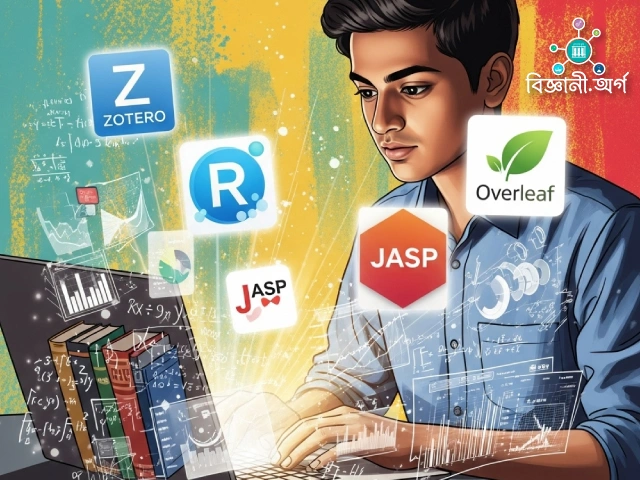
Finally, world-renowned software for data analysis includes SPSS, Tableau, Power BI, R, NVivo, and Python. These tools have become indispensable for scientists for data analysis, graphical presentations, and precise interpretation of research data.
Young researcher Ruma from the University of Dhaka says, “The use of digital tools has accelerated our research process. Our goal now is to adapt to technology and unlock new horizons in research.”
Now is the time for young researchers to bring a new dimension to research by embracing technology.
Websites of the mentioned digital tools:
- Evernote
- Notion
- Obsidian
- OneNote
- Gamma
- Infogram
- Piktochart
- Prezi
- Canva
- Pixlr
- Fotor
- Midjourney
- CapCut
- Descript
- VEED.io
- ResearchPal
- Review-it
- Undermind
- GitHub Copilot
- Replit AI
- Tabnine
- Codeium
- Cursor
- SPSS
- Tableau
- Power BI
- R
- NVivo
- Python