Dr. Mahdy Rahman Chowdhury, Associate Professor in the Department of Electrical and Computer Engineering at North South University, has won the Galileo Galilei Medal at the ICO conference. Read the article to learn more details.
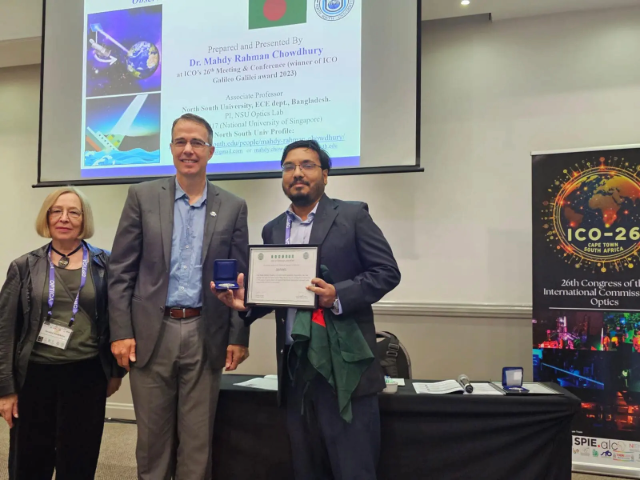
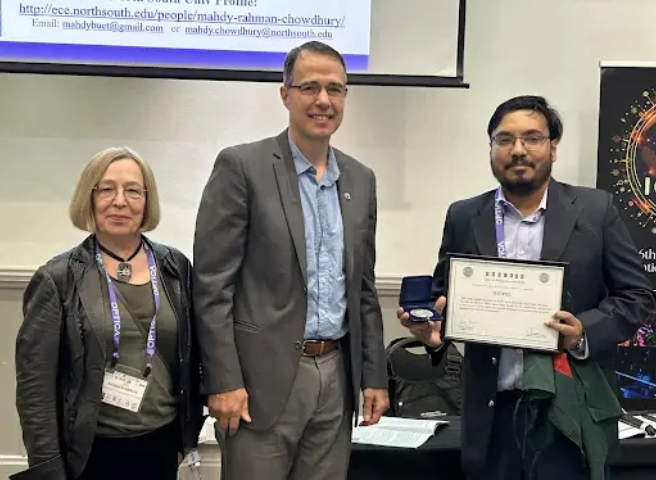
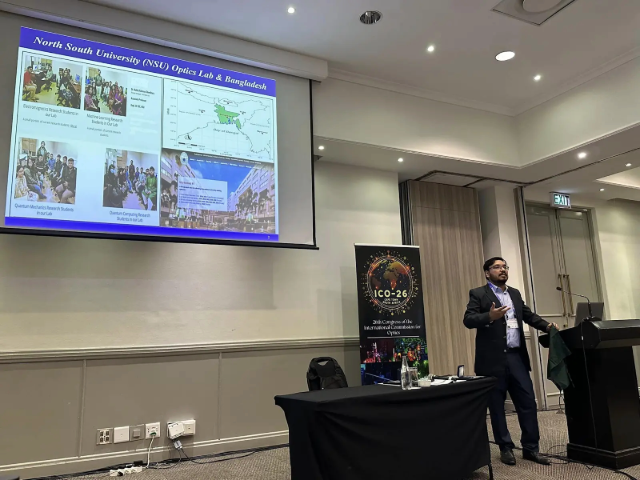
Dr. Mahdy Rahman Chowdhury, Associate Professor in the Department of Electrical and Computer Engineering at North South University, was awarded the Galileo Galilei Medal at the ICO Conference in 2023. He received this prestigious award at the five-day conference held in Cape Town, South Africa, on October 24. This honor was bestowed upon him in recognition of his groundbreaking contributions to optics and quantum manipulation. As the first Bangladeshi representing South Asia, he delivered a plenary lecture on his research in the presence of Nobel laureates at the conference.
After completing his undergraduate studies in Electrical Engineering from BUET, he earned his PhD in Optics and Photonics from the National University of Singapore in 2017. After joining North South University in 2017, he has published more than 52 influential research articles and established the NSU Optics Lab in 2018 with funding from The World Academy of Sciences. His research excellence has enabled many students to earn PhD and Master’s scholarships at institutions like Cornell, Johns Hopkins, and UC San Diego. Among his notable achievements are the UGC Gold Medal (2018) and the NSU Research Excellence Awards (2021 and 2023).
Each year, only one scientist is honored with this prestigious award for outstanding contributions to the field of optics. By achieving this recognition, Dr. Mahdy has brought great pride to Bangladesh and set a milestone of inspiration for future generations of scientists.
On behalf of Biggani.org, we extend our heartfelt congratulations and best wishes to Dr. Mahdy. He truly is a role model for our younger generation.
Congratulations to Dr. Mahdy Rahman Chowdhury for Receiving the Galileo Galilei Medal!
Associate Professor of Electrical and Computer Engineering Department of North South University. Mahdi Rahman Chowdhury won the Galileo Galilei medal at the ICO conference. Read the article and know the details.
Dr Mahdy Rahman Chowdhury, Associate Professor of Electrical and Computer Engineering at North South University, has been awarded the 2023 Galileo Galilei Medal at the 26th International Commission for Optics (ICO) Conference. He received this award on 24th October in the 5-day extended ICO Conference held in Cape Town, South Africa. Recognised for his pioneering work in optical and quantum mechanical manipulation, Dr Mahdy is the first Bangladeshi to receive this honour. Representing South Asia, he delivered an invited plenary lecture on optical and quantum manipulation to a distinguished audience, including Nobel laureates.
Dr Mahdy, an alumnus of Bangladesh University of Engineering and Technology (BUET), earned his PhD in optics and photonics from the National University of Singapore in 2017. With his joining NSU in 2017, Dr. Mahdy has contributed significantly to optics and photonics, publishing over 52 high-impact research papers and establishing NSU’s Optics Lab in 2018, a cutting-edge facility funded by The World Academy of Sciences. His commitment to research excellence has enabled numerous students to earn PhD and master’s scholarships at esteemed universities such as Cornell, Johns Hopkins, and UC San Diego. His achievements have been far-stretched with prestigious commendations like the UGC Gold Medal Award (2018) and the NSU Research Excellence Awards in 2021 and 2023.
This award, presented annually to a single scientist, celebrates outstanding contributions to optics. Dr. Mahdy joins an illustrious list of past recipients, representing Bangladesh in one of the highest academic acclamation platforms. His achievement highlights Bangladesh’s scientific contributions on the global stage and inspires future generations of Bangladeshi scientists.
We, on behalf of Biggani.org, convey our heartiest congratulations and best wishes to Dr. Mahdy. He indeed is a role model to our younger generations.