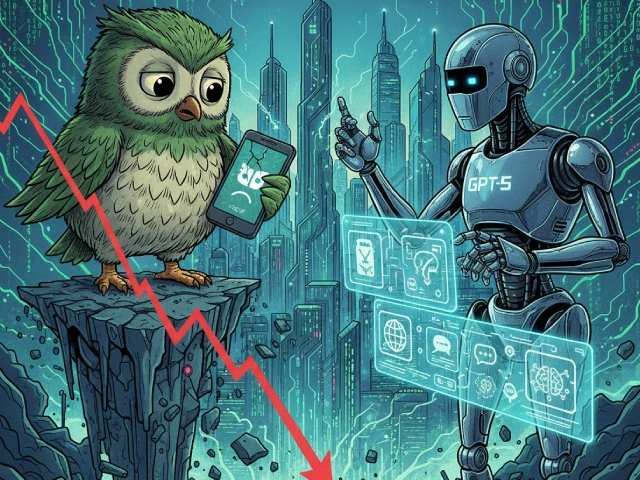
In today’s tech market, a company soaring in the skies today can come crashing down tomorrow—it sounds dramatic, but it’s now more normal than ever. Last week, this was exactly what happened to the world-renowned language learning platform Duolingo.
The week started out bright. They announced stellar quarterly results: a surge in new subscribers, profits exceeding expectations, and lower costs thanks to AI integration. Investor confidence soared, driving the stock price up by 30%. Everything was going great—until another major event shook the tech world.
OpenAI unveiled its new AI model, GPT-5. In just a few lines of instruction, it created a fully functional language learning app out of thin air. It even had flashcards, a progress tracker, and a fun cheese-and-mouse game to teach vocabulary. The result? Within hours, investors realized—what took Duolingo years to build, anyone could now make in just minutes. The share price quickly dropped by half, and the week ended with even deeper losses.
Within this lies an invaluable lesson for technology entrepreneurs in Bangladesh. Many startups here are emerging in fields like e-learning, e-commerce, fintech, or healthcare. But if the core technology behind a product or service is easily replicable—especially with the help of AI—competition will arrive in no time. Just like Duolingo, you might suddenly be jolted by the market.
In Bangladesh, we often hear—“Our product idea is very unique.” But the question is, is that uniqueness technologically protected? Or could someone use a few AI tools to create a similar or even better version in no time? As clearly stated in Duolingo’s annual report—new technology can rapidly outpace existing brands—this risk equally applies to our local startups.
Another important point: AI is a double-edged sword. A major reason for Duolingo’s success was its savvy use of AI—from conversation features for learners, to reducing costs, to enhancing user experience. But in someone else’s hands, that same AI turned into a threat for them. For Bangladeshi companies embracing AI, it’s important to remember—as much as it can give you a competitive edge, it can also empower your competitors with the same capabilities.
We can also see another economic aspect here. On Wall Street, AI infrastructure or hardware companies are now in higher demand than pure software companies. That’s because building data centers, manufacturing chips, or creating large AI servers isn’t possible through mere “vibe coding.” If Bangladesh wants to stay in the AI race long-term, the focus should be not just on app development, but also on investing in infrastructure, high-performance computing, and building proprietary datasets.
Finally, whether it’s language learning or acquiring any skill—no matter how advanced technology gets—the human touch is hard to fully replace. Even if Duolingo faces stiff competition, a French teacher—whether online or in person—can tailor lessons to a student’s unique needs, which no generic app can do. Herein lies the opportunity for Bangladeshi entrepreneurs—to blend technology with human service and create something that can’t be easily replaced.