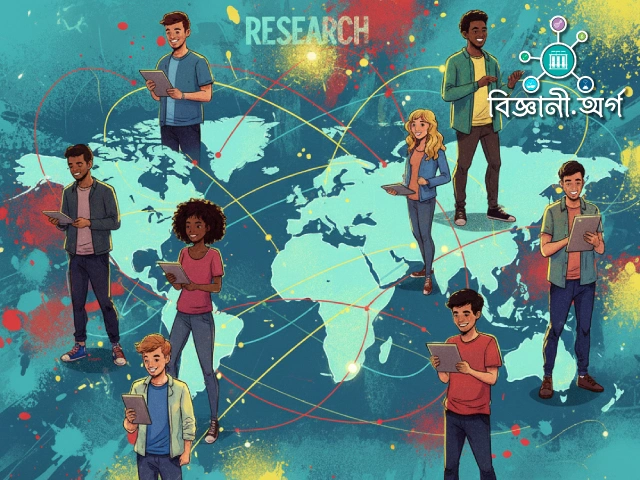
Today, international research is a reality unhindered by national borders. Every attempt to create new knowledge is now intrinsically linked with cross-border collaboration. But the question is—how can a young researcher become part of this global network? Recently, several researchers shared their experiences at a seminar of Japan’s JST Plus Alpha Series. Their stories were not only relevant and inspiring for Japanese researchers but also for young scientists in Bangladesh.
Professor Erika Kawakami from RIKEN Institute, a quantum computing researcher, shared that networks are built around the core subject of research itself. While studying and researching at different universities in Europe and Japan, she often bravely reached out to unfamiliar people via email or connected with speakers ahead of international conferences—demonstrating a proactive mindset. Sometimes she didn’t get a response, but other times those contacts laid the foundation for collaborative research. According to her, sincerity and curiosity towards research are the true strengths that open unknown doors.
On the other hand, Professor Hiroko Terazawa of Tsukuba University emphasized the importance of befriending oneself before building an international network. Her advice was full of encouragement for young people losing confidence. At the start of their research careers, many feel inadequate, yet networking begins with accepting oneself. Instead of hiding her weaknesses, interacting with others naturally helped her form lasting scientific friendships. In her words, “Networking isn’t about connecting with famous people, but rather maintaining relationships with those you naturally get along with.”
Yuko Suda, a representative of JST based in Washington, shed light on the American context. She observed that the research environment in the US is inherently international. Funding, human resources, and diverse career paths have always expanded this network. However, in recent years, geopolitical tensions—especially the Russia–Ukraine war—have created new boundaries for collaboration. Many American institutions are now hesitant to undertake joint projects with researchers from Russia or China. This experience is being mirrored not only in America, but also in countries across Europe and Asia, posing new challenges for international research networks.
This discussion holds special significance for Bangladesh. Young researchers here often don’t get the opportunity to study abroad or attend conferences. Many believe that building an international network isn’t possible without going abroad. However, the discussion revealed that it’s possible to create networks even without leaving home. Courageously sending an email, sharing research questions, or being active in online conferences—all are effective steps. The key is genuine enthusiasm for research and a mindset of continuous learning.
Yet, this is not only a matter of personal initiative; it’s important at the policy level too. The global landscape is changing rapidly. On one hand, technological collaboration is becoming a tool of international politics; on the other, research partnerships are being limited on the grounds of national security. If research institutions in Bangladesh truly want to join the international network, a strategic stance is necessary. In other words, it’s crucial to clearly determine which countries or institutions long-term collaboration will be established with.
A major lesson here for young researchers is that international networking isn’t just about scientific skill, but also a practice in diplomacy and interpersonal communication. A Bangladeshi student interested in research might not yet have the chance to make big discoveries in a lab. But they can dare to ask questions to foreign researchers, participate in conference discussions, or join scientific conversations via social media. In this way, global collaboration stories are born from small steps.
Finally, the most important aspect of this discussion is its guidance for the next generation. Twenty-first century science is not a solitary journey. The friendships and collaborations that cross borders are the true resources of today’s research. If young people in Bangladesh start seeing themselves as partners in these global conversations, science will contribute not just to their personal lives, but also to national progress.
Source: This article is based on remarks from an event by the Japan Science and Technology Agency