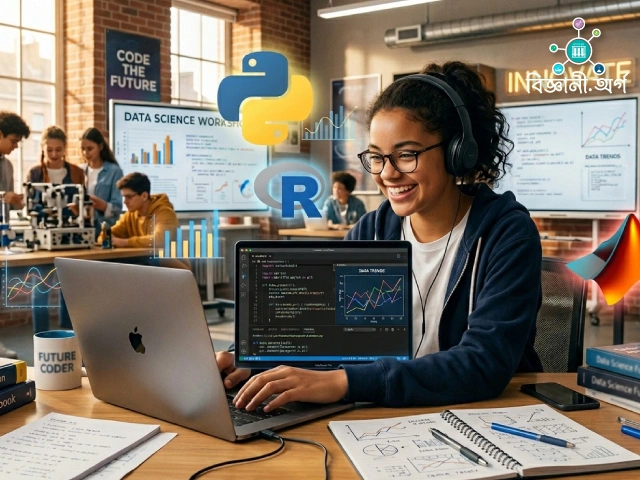
When an eighth-grader sits in a school lab and sees “Hello World” appear for the first time on an old computer monitor, an unfamiliar yet profound feeling quietly stirs within—can I really “create” something myself? From that tiny moment begins a much larger journey, where science and technology step off the pages of textbooks and walk hand in hand. Along the way, students soon realize that knowing formulas and equations is no longer enough; modern science now requires befriending software, code, and tools. That’s why learning software today is not a luxury, but an essential part of preparing to be a future scientist.
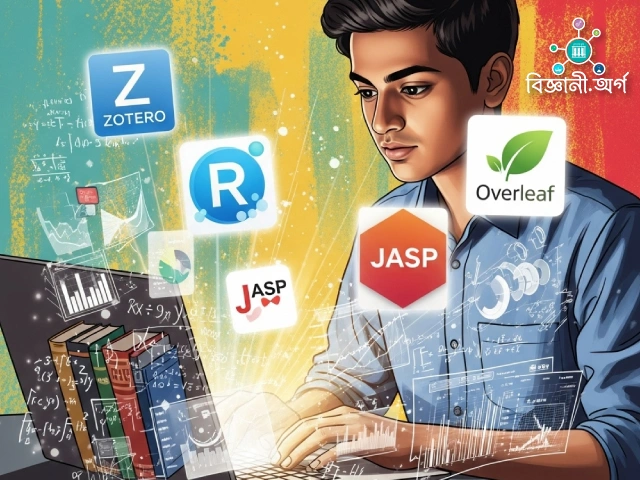
There was a time when science meant a world of white coats, test tubes, and microscopes. Now, another continent has joined that kingdom—the computer screen. Today, physicists, biologists, economists, even agricultural scientists carry code as their companion. Because nature hands us mountains of data every day which can no longer be measured and calculated by hand. Here is where tools and software like Matlab, R, and Python step in. These aren’t mysterious gadgets, but the essential instruments of the modern scientific mind.
Take Matlab, for instance. Many people think it’s just for engineers. But in reality, Matlab is a friend that can make even the hardest equations come alive as images. Whether it’s the oscillation of waves or the movement of robots—everything trembles before your eyes as graphs. Suddenly, the jungle of mathematical symbols becomes vivid. If a student befriends Matlab, they will learn that math is nothing to fear; it’s like a playground where you can make your own rules.
The world of R is a bit different. It tells stories with numbers. School results, regional rainfall, or the spread of disease—all of these are raw materials for R. R turns these raw numbers into stories we see in the colorful world of charts. If a Bangladeshi student learns R, they’ll be able to understand the problems of their own society in the language of numbers. Science then is no longer something distant or foreign—it becomes a story of one’s own neighborhood.
And Python? It’s almost the poet of the software world—simple, flexible, and powerful. With Python, you can analyze images, recognize sounds, even create artificial intelligence. Today, everyone from Google to NASA uses Python. But your own journey with it can begin right at a small desk at home. When you write just a few lines of code and see the computer doing calculations on its own, you’ll feel—I am truly creating something. That feeling is what shapes the scientists of tomorrow.
Learning software is not about “learning to click,” but about learning a new way to think. Writing code forces you to break down problems into smaller parts, and to think through solutions step by step. This habit sharpens your mind. You don’t just search for answers, you learn how to form the very questions. The gap between school lessons and real-life challenges begins to vanish with software as the bridge.
This skill is even more crucial in the context of Bangladesh. Our country is full of talented students, but opportunities are often lacking. Learning software and tools helps bridge that gap—at least a little. Thanks to the internet, you can now take courses from any university in the world, download open-source software, and participate in international projects. All you need is a computer and relentless curiosity. That’s why learning software is not just about technology, it’s about leaving doors open for yourself.
Writings like this book, or lessons of this kind, make you mentally stronger. You learn to understand that you are not just someone inside an exam sheet—you are a global student. Today if you create a small program in Python, tomorrow that same skill might take you to an international science competition. This builds a sense of self-respect that no marksheet can give.
This is where the real challenges of science and learning come together. Often, we see ourselves memorizing lessons without truly understanding them. Software opens the door to “understanding.” Instead of just writing down a formula, you can graph it, change its behavior, and compare outcomes. Then learning is no longer pressure, it becomes exploration.
When authors or speakers say, “The future belongs to data,” it doesn’t mean only computer engineers will survive. It means anyone who understands the language of data will thrive. A biologist will know Python, a physicist will know R. This multidimensional identity is the sign of the modern scientist.
In the end, remember—learning software is not a race, it’s a long journey. At first you’ll make mistakes, your code won’t work, you’ll feel frustrated. But that’s exactly where real learning begins. Every mistake becomes your teacher; every night spent debugging matures you. One day, when you look back, you’ll realize these very tools gave you the map for unknown journeys.
So for the teenager thinking today, “Can I really do it?”—the answer is simple: Yes, you can, if you just start. Matlab, R, and Python are not monsters; they are friends who will teach you how to think. Keep your laptop next to your schoolbook, your code next to your notebook. Because today, science is not just written on paper—it’s written on keyboards. And whoever learns this language will know how to speak to the future.