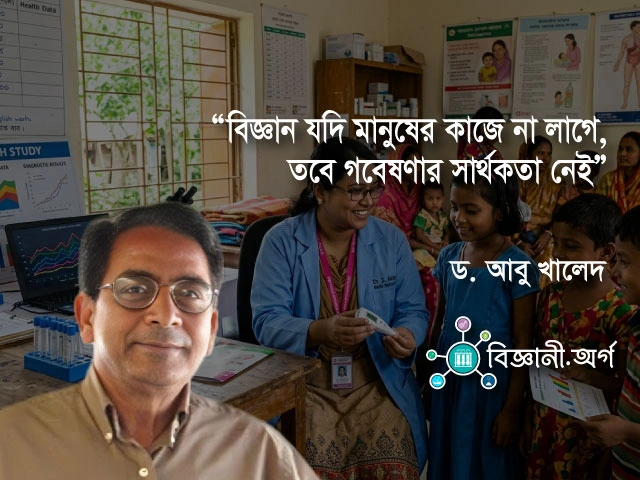
We often measure the success of scientific research by the number of published papers, the journals in which they appear, or how many patents are granted. But for Dr. Abu Khaled, the true value of research lies elsewhere. In his words, “If science does not serve humanity, then research loses its purpose.” This single sentence encapsulates his entire philosophy of research. He believes that science is meaningful only when its outcomes directly improve people’s quality of life.
Dr. Khaled’s own career is a real-life example of this philosophy. Despite having access to advanced laboratories, modern equipment, and opportunities for international publications, he has time and again turned his focus to the real problems faced in countries like Bangladesh. His use of the BIA method at icddr,b for diagnosing dehydration in children is a testament to this. It is not just a scientific innovation; it has become an effective tool in reducing the risk of child mortality in the field.
Many research projects remain confined within the walls of laboratories. New theories are formulated, new methods are discovered, but they are never applied in real life. Dr. Abu Khaled sees this as a type of “scientist isolationism”—where research becomes detached from society. In his view, this isolation is even more dangerous in developing nations, as here, the quality of people’s lives depends directly on scientific solutions.
He believes that the practical aspect must be kept in mind from the very beginning of research. For example, when developing a new technology, one must consider: Is it possible to produce this at low cost? Will it work in rural environments without electricity? Can local health workers use it easily? Without answers to these questions, even the most advanced technology will remain confined to a limited sphere.
According to Dr. Khaled, international research collaboration becomes meaningful only when it connects with local realities. Thinking about Bangladesh’s issues from a foreign lab is important, but it is equally vital to test those solutions within the country. His work shows that, as a scientist, he is not content with simply generating knowledge—ensuring its application is his true goal.
This perspective is especially relevant for young researchers. Many young scientists today focus more on publishing in international journals or pursuing higher academic degrees. Dr. Abu Khaled’s message is that while these achievements are certainly important, one must also pay attention to the challenges facing one’s own country and society. From choosing a research topic to applying the results, it is essential at every step to keep the benefit to people in mind.
In a country like Bangladesh, where health, nutrition, and public health remain major challenges, practical science is the greatest need. Dr. Abu Khaled’s philosophy reminds us that science is not just about the pursuit of knowledge—it is a powerful means for human welfare. If research does not touch people’s lives, it remains limited to paper and theory. But when science truly serves humanity, it becomes an effective tool for changing society.
Read Dr. Khaled’s full interview: