Adiba is a university student, and whenever she needs to do research for her studies, she always uses various search engines like Google and Yahoo. In the beginning, she wasn’t very familiar with these tools, so it used to take her a long time to find things online using Google. Later on, she learned search engine techniques from her university senior, Mahir. Mahir taught her how to use search engines to find what she was looking for more easily. Over time, after learning these skills from Mahir, she became fairly proficient at searching. Nowadays, the web search engines Adiba uses most often include Google, with Yahoo, DuckDuckGo, and Microsoft Bing as alternatives. Despite her improved skills, lately it’s taking her quite a while to find things using these traditional search engines.
What is a Search Engine?
A search engine is a special type of platform or online system that lets users easily find various kinds of information on the internet. These platforms primarily use “search engine” technology, which creates and displays a list of websites, documents, images, videos, and other content scattered across the internet, showing a summary or the first few lines of these websites. This helps internet users quickly locate their desired websites from the list. However, this process is not simple. To do this, the search engine (also called a search bot) needs to crawl across different websites on the internet, identify what’s on them, and tag or keyword them appropriately so they can be easily found. Technologists call this process indexing.

How Did Search Engines Begin?
In the 1990s, as internet use started to spread and countless websites and different types of information began to appear online, there arose a need for a way to locate specific information. That’s when the first search engines made their debut—Archie in 1990, followed by Veronica around 1992. Both were developed by students and were the only way to search for something at the time.
Later, Yahoo! brought its commercial search engine to the market in 1995, and Google followed in 1998. Yahoo mainly maintained large online directories by manually categorizing websites into various topics, making it easy to find a relevant site. But at first, employees had to manually visit and list these websites in the directories, which was a labor-intensive process. As more and more websites appeared every day, it quickly became a challenge that was hard for people to keep up with.
To solve this problem, Archie introduced the first search engine algorithm to simplify the process, followed by further advancements in technology from WebCrawler in 1994. But Google’s Larry and Sergey, with their PageRank algorithm, could do this automatically and quickly—and since then, it has become the world’s most-used search engine.
– “Do you know how many search requests Google receives each day?” Mahir asked Adiba.
– No idea, how many could it be?
– Try to guess! said Mahir.
– Hmm… maybe several million!
– Not even close. You’ll be surprised to hear that Google gets about 8.5 billion search requests every day. That’s 850 crore! Or to put it differently, there are about 100,000 search requests every second. Imagine—the scale is enormous!” said Mahir. (Source: https://seo.ai/blog/how-many-people-use-google).
Besides Google, here are some other search engines:
- Yahoo: A popular search engine launched in 1994.
- Lycos: Launched in 1994 at Carnegie Mellon University, it created a massive index.
- In 1995, a few contemporaries started: Excite, AltaVista, Inktomi.
- Baidu: China’s leading search engine, launched in 2000.
- Bing: Microsoft’s search engine, launched in 2009.
- DuckDuckGo: Began in 2008, widely known for prioritizing personal data protection.
- Other search engines include: AOL, Naver, Ask.com, Ecosia, Yandex, and more.
The Application of Artificial Intelligence in Search Engines
Adiba from our story noticed that traditional search engines are no longer working as well as they used to. Often, she needs to look up a lot of things for her studies, but if it takes too long, she gets scolded by her father. To solve this problem, she called Mahir.
– “Brother, online searches are taking a lot of time. Is there anything I can do to understand things more quickly?” Adiba asked Mahir.
– Mahir: “What’s the problem?”
– Suppose I want to know what an amphibian is and get some examples. If I search online, Google gives me a huge list, and I have to check each entry to see if the information I need is there. So many open tabs, such hassle! Although I can usually find it from Google’s list, I still have to look for it, right? – said Adiba
– Have you used an artificial intelligence-powered search engine? Mahir asked.
– Adiba: What’s that?
– That’s a new kind of search engine that uses artificial intelligence algorithms. It searches various websites for you and summarizes the answer.
After that, Adiba tried using some AI-powered search engines and was truly amazed. They quickly found her desired answers, so her father no longer accused her of just wasting time online instead of studying.
After further research, she realized that these AI-powered search engines actually understand what users are looking for, and can provide more detailed and relevant information. This capability comes from a technology called NLP (Natural Language Processing).
Computers’ Ability to Understand Language: NLP
To give instructions or commands to a computer, we use programming languages and write code. NLP, or Natural Language Processing, is a technology that allows computers to understand human language directly. In other words, no coding is needed—the computer can comprehend our spoken or written language. For example, when we use Google Voice or Apple’s Siri on our phones and give voice instructions, they understand via NLP technology. Although the direct use of artificial intelligence only started recently, NLP itself is an old technology with work dating back to World War II. Two of the most prominent researchers in the field are Noam Chomsky and John McCarthy, who worked on this around 1957. Work is also underway for our mother tongue; several dedicated technologists are working on it.
- BNLP: A natural language processing toolkit specifically designed for the Bengali language.
- BanglaBERT: A pre-trained language model for Bangla, similar to BERT.
- BanglaT5: A model for natural language generation tasks in Bangla.
- Bangla Word2Vec: Implementations using skip-gram approach for word embeddings.
How Does NLP Work?
When we write or say something, we might express the same idea in many different ways. No matter how we put it, the computer can understand it through NLP technology. NLP allows the computer to grasp the meaning, context, syntax, and semantics of our language.
It helps computers interpret human language, enabling parsing, semantic interpretation, and even translation to other formats or languages. With NLP, computers can not only understand but also generate human-like text.
- Voice-activated GPS systems
- Digital assistants
- Speech-to-text dictation
- Virtual assistants like Alexa, Siri, etc.
Today, most NLP work uses machine learning and deep learning methods. These approaches analyze vast amounts of language data (text, voice, or writing) to give machines a human-like understanding of language.
Below is a list of some AI-powered search engines:
- Bing: Microsoft’s Bing search engine has gained massive popularity as a competitor to Google. It’s especially good at multimedia searches and visual results, using OpenAI’s ChatGPT technology.
- Baidu: China’s most popular search engine, Baidu, now features integrated artificial intelligence. It specializes in searching in Chinese and delivering customized results to Chinese users.
- Perplexity AI: This AI-powered search engine launched in 2022 and quickly became widely talked about. Its current market value is close to one billion dollars. It is possibly the best AI-powered search engine available.
- Gemini: Google is also in the game, not wanting to lag behind in this new type of search engine. Google has introduced its own AI-powered search engine.
- Other new types of AI-powered search engines include: https://komo.ai/, https://yep.com/, https://www.phind.com/, https://you.com/
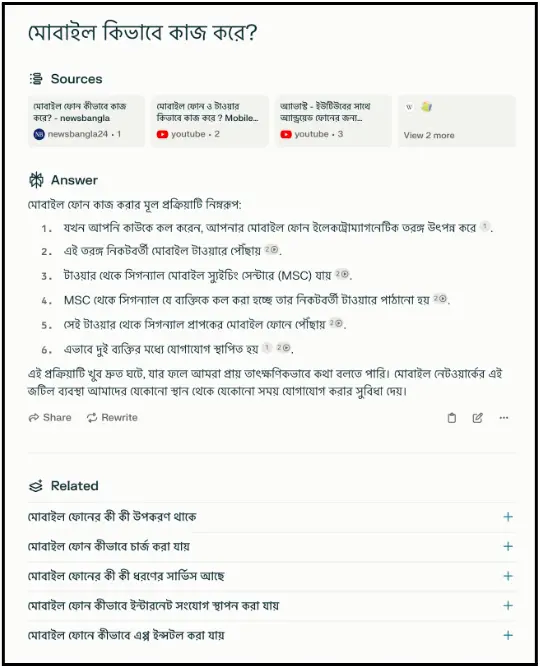
Image: Here, a search for “how does a mobile phone work” was run on the AI-powered search engine Perplexity. Even if you just type “how does a mobile work,” it understands that the user wants to know about mobile phones. It provides several references at the top, then gives a clear explanation, and finally offers a list of related questions that the user might want to search next. This way, artificial intelligence provides users with a smooth and enjoyable search experience.
Mahir encouraged Adiba to try these new types of search engines. Adiba started using them and especially liked Perplexity. It enabled her to find information very easily. What she liked most was that it provided a concise summary along with links to relevant websites.
Artificial intelligence is dramatically transforming different aspects of our lives, and search engines are no exception. Traditional search engines, which have long been our main way to find information online, now face competition from these advanced AI systems. These new technologies provide not only more accurate results, but also a whole new way to interact with information.
Artificial intelligence has opened a new frontier in information searching. Rather than relying solely on user input, AI can anticipate user needs based on their behavior, preferences, and previous searches.
Advantages of AI-Powered Search Engines:
These new types of search engines offer several distinct advantages.
- Personalized Results: Artificial intelligence can provide personalized results based on users’ previous searches and usage. It understands user behavior and customizes answers accordingly, making them more relevant and effective. For example, someone frequently searching for recipes will get different results than someone looking for technical AI information.
- Linguistic Diversity: Since AI can understand multiple languages, it can provide information in any language, not just English. AI can analyze and present data in various languages—a major challenge for conventional search engines.
- Accuracy and Efficiency: AI search engines are improving accuracy and efficiency in information retrieval day by day, saving users time and effort.
- Predictive Search: Predictive or anticipatory search means AI can offer suggestions even before you fully type your question. These suggestions are based on user search history, trending topics, and even the time of day. This not only saves time but helps users find information that regular search engines might miss.
- Voice Search: Since AI uses NLP to understand spoken language, voice search is becoming increasingly popular. New systems like Google Assistant, Siri, and Alexa allow users to search by simply speaking—especially convenient for those unfamiliar with technology or who find typing difficult.
- Speed and Efficiency: AI-powered search engines are much faster than traditional ones, providing real-time or instant results with remarkable speed. As a result, AI can deliver up-to-the-moment news and updates even faster than before.
Adiba, eager to learn more about artificial intelligence, called Mahir again.
– Brother, I’ve learned so much about artificial intelligence. But what about its future?
– “Are you wondering how it might be used in the future?” Mahir replied with a question.
– “Yes, exactly.”
– Mahir said, “Actually, it’s hard to say. But what can be said is that a unique feature of artificial intelligence is its ability to quickly learn from new data. As a result, its answers to search queries will gradually become smarter as more data is added.”
– That’s good news, said Adiba.
– Time will tell if it’s good or bad. But one thing is clear—it’s going to transform our future tremendously. Adiba, someday I won’t be speaking on the phone; it’ll be my brain-powered artificial intelligence talking to you.
– Oh, brother, stop it. You’re scaring me. Am I really talking to Mahir?
– Who knows! Mahir said, and hung up the phone.
Adiba sat there in amazement, thinking about it.
The Challenges of Artificial Intelligence
Despite all the advantages of artificial intelligence, there are also quite a few challenges. For example,
- Privacy: Artificial intelligence collects user data and delivers results accordingly, which can pose a threat to user privacy.
- Transparency: The decision-making process in AI is not always transparent, which can lead to distrust among users.
- Dependence on Technology: Since AI is now used in many areas of our lives, there’s a risk of over-reliance on technology. Users may become less skilled at independently finding information, which could erode critical thinking skills.
- Misinformation: The data used to train AI often contains errors. Wikipedia and social media user data are widely used for AI training; it’s undeniable that these sources contain numerous inaccuracies. A study found that about 3% of Wikipedia data is incorrect, 25% of social media information is inaccurate, and in the health sector, the error rate rises to 41%. (Source: https://www.manageengine.com/analytics-plus/it-analytics-blogs/human-errors-in-analytics.html). These inaccuracies are repeatedly used by AI and create a compounding cycle of errors. In the future, this could result in so much erroneous information being spread throughout AI systems that correcting them becomes impossible.
- Biased Information: Since AI relies heavily on English language content and English-centric websites, there is a significant amount of bias in the information it provides. This is a notable weakness of AI-powered search engines.
- Ethical Concerns: Artificial intelligence lacks moral judgment, making it unable to determine what information should or should not be provided. For example, sensitive content may easily reach underage users, or dangerous information about making destructive weapons might fall into the wrong hands. This poses risks for social welfare and security.
The Future of This Technology
In the future, AI-powered search engines may be combined with new technologies like augmented reality (AR) and virtual reality (VR). This would allow house hunters, for example, to take virtual tours instantly. For languages lacking large online databases, AI could translate information from other languages, offering better service to those language communities. In the future, language barriers will cease to be obstacles for anyone.
Conclusion
Not only Adiba—but countless users like her—are now shifting from traditional web search to AI-powered web searches. This new evolution in search engines is becoming essential in our daily lives. Artificial intelligence and the addition of other new technologies will make search engines even more advanced and effective in the future.
References:
2. https://bn.martech.zone/acronym/nlp/
3. https://bn.shaip.com/blog/difference-between-nlp-nlu-and-nlg/
4. https://www.linkedin.com/pulse/nlp-tanveer-shawn-cht-mnlp