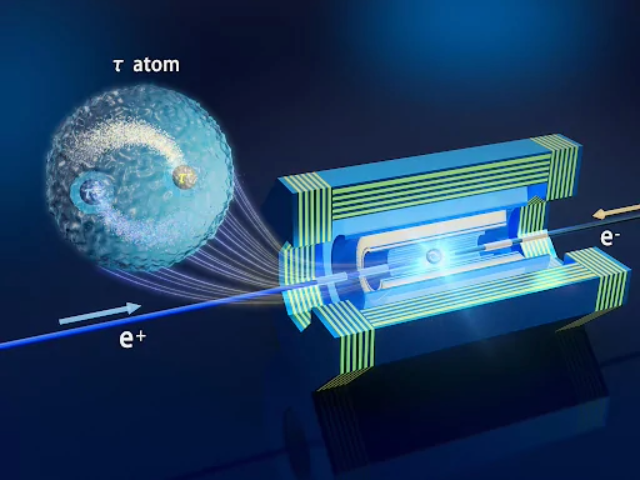
Recently, an astonishing discovery in quantum physics points us toward an atomic structure even simpler than hydrogen! Imagine—here, only electrons and their antiparticles interact through pure electromagnetic forces. This discovery could bring major changes to our understanding of quantum field theory, as well as quantum mechanics and fundamental physics. Especially, the new method for identifying Taunium promises to revolutionize particle physics measurement in an unprecedented way.

Once, hydrogen was considered the simplest atom in nature, composed with great simplicity—a single electron and a single proton. However, as research has advanced, scientists have found even simpler atoms formed from structureless electrons (e-) and heavier leptons such as the muon (μ-) or tauon (τ-) and their antiparticles. These atoms are bound only by electromagnetic interactions, resulting in an atomic structure even simpler than hydrogen’s. This discovery may provide a new perspective on complex topics like quantum field theory, fundamental symmetry, and gravity.
So far, only two atoms have been observed to exhibit purely electromagnetic interaction. One is the electron-positron bound state, discovered in 1951, and the other is the electron-antimuon bound state, discovered in 1960. For nearly six decades since then, no other such atom has been found. However, researchers believe that such atoms might be discovered in cosmic rays or high-energy colliders.
Recently, a new atom named Taunium has been detected, composed of a tauon and its antiparticle. Taunium’s Bohr radius is only 30.4 femtometers, which is just one 1,741st that of hydrogen. This means Taunium could play an effective role in the detailed analysis of quantum field theory and electrodynamics of the microscopic world.
A recent study titled “Novel method for identifying the heaviest QED atom,” published in the journal Science Bulletin, introduces a new technique for detecting Taunium. The research notes that by collecting 1.5 attobarns (ab-1) of data at an electron-positron collider, it is possible to determine the presence of Taunium. From this data, those particle events can be selected where there are no energy-carrying neutrinos, leading to a strong 5σ-level observation that would serve as definitive proof for the existence of Taunium.
The study further mentions that using this same dataset, the precision of tau lepton mass measurement could be improved to 1 keV, which is twice as accurate as current experiments. This will support testing the electroweak theory and addressing important physics questions like lepton flavor universality.
An important goal of China’s Super Tau-Charm Facility (STCF) and Russia’s Super Charm-Tau Factory (SCTF) is to discover heavy atoms like Taunium and to measure the tau lepton mass with high precision. Discoveries like these will be instrumental in unraveling the mysteries of the micro world and deepening our understanding of this field.