News Desk, Biggani Org | [email protected]
Life is colorful. The red glow of sunrise, the deep blue sky, the yellow flower hidden among green leaves—these sights fill our hearts with joy. But have you ever wondered, how do we actually see these colors? What is color, really? Why is the sky blue, why are leaves green on a sunny afternoon, and why do they appear reddish at sunset?
To find the answers to these questions, today we’ll dive into the science of color. In this article, we’ll learn how color is created, how our eyes recognize color, how technology utilizes color, and how far-reaching the psychological effects of color truly are.
🔬 What is Color?
Color is essentially a property of light or radiation. We know that visible light is a part of the electromagnetic spectrum, with a wavelength ranging roughly from 380 to 750 nanometers (nm). Light of each specific wavelength is perceived differently by our eyes — and this is what we see as color.
For example:
- Violet: 380–450 nm
- Blue: 450–500 nm
- Green: 500–570 nm
- Yellow: 570–590 nm
- Orange: 590–620 nm
- Red: 620–750 nm
When light strikes an object, the object absorbs some specific wavelengths and reflects others. The reflected part of this light reaches our eyes—so we perceive the object as being that color.
👁️ How Do Our Eyes Recognize Color?
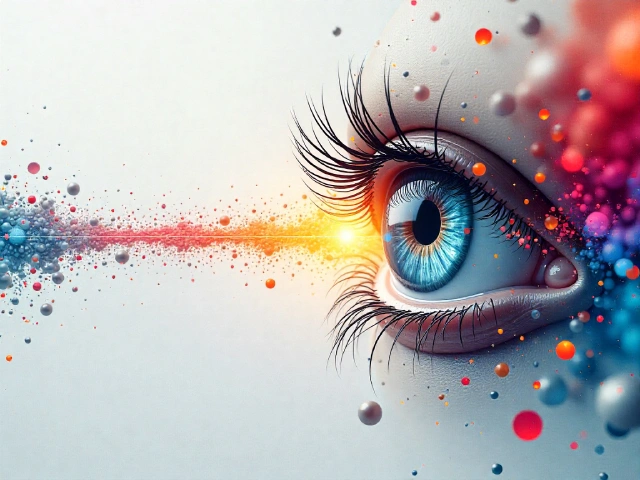
The human eye has two main types of photoreceptor cells — Rods and Cones. Rod cells work in low-light but don’t recognize color. The actual task of color recognition is handled by the cone cells. There are mainly three types of cone cells in the human eye:
- One type sensitive to red wavelengths
- One type sensitive to green
- The other to blue
These three types of cells are activated by different wavelengths of light and send signals to the brain. The brain analyzes these signals to recognize color.
Here’s a surprising fact:
Our brain actually “creates” color! The color we see isn’t just about the wavelength of light—it’s the result of a joint effort between the eye’s cells and the brain.
🌈 Color Mixing and Primary Colors
There are two main methods of color mixing:
- Additive Mixing:
- Involves working with light.
- Primary colors: Red, Green, Blue (RGB).
- When these three are mixed together, they produce white light.
- TVs, computer monitors, projectors all use this method.
- Subtractive Mixing:
- Uses pigments, dyes or paint.
- Primary colors: Cyan, Magenta, Yellow.
- This method is used in printing and painting.
🧠 Color and Psychology: How Does Color Affect Our Minds?
Color can influence our emotions, moods, and even physical responses. For example:
- Red: Symbol of excitement, energy, love, and alertness.
- Blue: Represents calmness, trustworthiness, and stability.
- Green: Natural, balanced, soothing.
- Yellow: Joy, freshness, brightness—but in excess can also represent irritation.
- Black: Seriousness, power, mourning, or elegance.
- White: Purity, simplicity, and peace.
Science shows that using green or blue colors on hospital walls can reduce a patient’s mental stress. And using red or orange in food packaging can intensify hunger.
🏭 Use of Color in Technology
In today’s digital world, the use of color is not just about visual comfort, but also about communication and business strategy.
- UI/UX Design: The correct use of color in website and app design enhances user experience.
- Branding: Colors used in a company’s logo carry their identity and psychological message (e.g. Facebook = blue; Coca-Cola = red).
- AI & Computer Vision: Color information plays a major role in analyzing images and videos.
One documentary analysis found that bluish photos on Instagram get more likes, as they feel more soothing to the eye.
👨🔬 Color Blindness and Inability to Recognize Color
Worldwide, over 300 million people cannot recognize color or can only partially do so. This is called Color Blindness or Color Vision Deficiency. In most cases, it is hereditary.
The most common form is the inability to distinguish between red and green. This can make it difficult to understand traffic lights or to identify certain fruits.
But nowadays, thanks to technology, apps and glasses are available that make it easier for color-blind people to perceive colors.
🧪 The History of Color in Science
Research on color has been ongoing since ancient times.
- Isaac Newton was the first to prove that white light splits into seven colors through a prism.
- Johann Wolfgang von Goethe provided theoretical explanations on the psychological effects and influence of color.
- In modern times, chemistry and optics have revolutionized the production and use of color — for example, synthetic dyes or LED lights.
🛰️ Color in Space Exploration!
We see images of various planets and galaxies, which display a fascinating array of colors. But in reality, many of these colors are created by scientists using ‘false color’—so that we can visualize information from invisible wavelengths as well.
Here, color is not just about beauty—it’s also a tool for analysis. By converting infrared or ultraviolet light into different colors, we can understand the structure, temperature, or composition of a planet.
🎨 Looking Towards the Future
The future of color is opening many new doors in technology and life:
- Nanotechnology: Materials are being developed that use color to control light.
- AR/VR (Augmented Reality / Virtual Reality): Perfect color rendering makes user experiences more realistic.
- Smart copper materials: Which can indicate temperature or chemical environment by changing color.
📌 Conclusion
Color is not just a sensory perception—it’s a marvel of science. Light, waves, eyes, psychology, technology—all these together create our colorful world. Behind each color is a story, a science.
So, the next time you see a red rose or gaze up at the blue sky, remember—it’s not just the beauty of nature, but also a manifestation of scientific wonder.
If you want more fun science facts and explanations, read and share biggani.org regularly. To share your thoughts and opinions, write to [email protected].