It’s midnight. The room is dark. Only the blue light from the phone casts a glow on the wall. Samia had promised herself she wouldn’t go on social media tonight. She has a class presentation tomorrow. So, a good night’s sleep is essential.
But suddenly—ting!
Samia thinks, “Let me just check for a second, then I’ll put it away.”
But an hour slips away before she even notices. Suddenly, she wonders—is she using her phone, or is her phone using her?
Current Reality
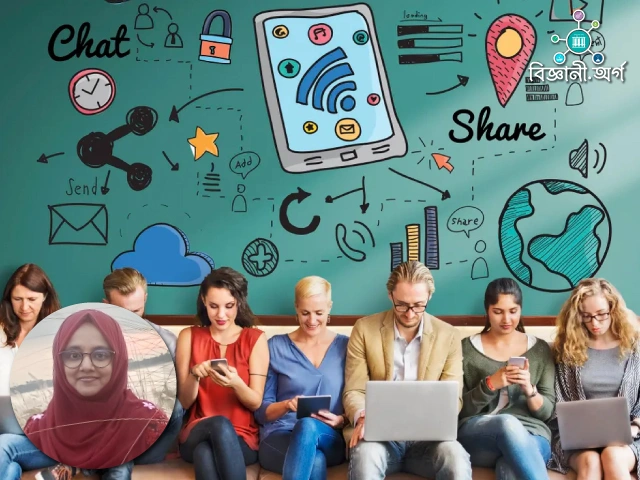
Social media has become an integral part of our daily lives in today’s world. Platforms like YouTube, Instagram, TikTok, or Twitter are not just for communication; they are powerful tools for information, entertainment, and expressing opinions.
How Social Media Controls Us
Social media platforms use complex algorithms that show content based on users’ preferences, interests, and past behavior.
The main goal of these algorithms is to capture user attention. Research shows that seeing similar content repeatedly can influence users’ thoughts and perspectives.
In addition, a psychological process known as the “dopamine loop” is connected to social media use. When users receive likes, comments, or notifications, dopamine is released in the brain. This creates a feeling of pleasure and encourages users to return to social media again and again.
As a result, it can gradually become a habit.
How We Can Control Social Media
On the other hand, social media is a technological tool—the ultimate control lies in the user’s hands.
The user can decide for themselves—
- How much time to spend on social media
- Which content to follow
- Which information to accept
When used properly, social media can play an important role in gaining knowledge, education, research, career development, and raising social awareness.
For example, many students now have access to online courses, research information, and international networking opportunities via social media. Various educational platforms and academic networks are now easily accessible to all.
Balance Is the Key
The reality is that social media does not control us by itself; however, its design and algorithms can influence our behavior.
At the same time, as conscious users, we ourselves can decide how much and in what way we use it.
Conclusion
Social media is a powerful part of modern life, shaping the way we think, behave, and spend our time. But it’s not a one-way street. Rather, there’s an ongoing interplay between user and technology.
Algorithms may capture our attention, but with awareness, self-control, and proper use, we can establish ultimate control.
So, the question—“Does social media control us?”—the answer depends on our usage patterns and level of awareness. It’s not technology, but user decisions that determine who’s truly in control.
Hasna Banu.
Islamic University, Kushtia
Department of Political Science & Public Administration
Writer interested in education, governance, and human development