Dr. Mashiur Rahman sits in a quiet office in Singapore, in front of his computer screen. On the screen appear the faces of more than a hundred remote participants—enthusiastic students and young researchers from all over Bangladesh, all connected for an online discussion. Today, Mashiur Rahman wants to share his experiences and advice with them, on the topic of preparing for higher education abroad and the use of artificial intelligence in that process. Before beginning the discussion, he thanks the organizer, Mahbub bhai, and checks if everyone can hear him clearly. Some have forgotten to mute their microphones, and when some stray conversations pop up unexpectedly, he smiles kindly and says, “Everyone, please keep your microphones muted.” After this friendly, light-hearted moment, he shares his screen. He says, today’s presentation will be a bit different—“My screen might look a little unusual; I’m not sure if anyone has ever presented this way before.” A sense of curiosity immediately fills the environment. Everyone present realizes this won’t be a typical slide presentation—today he’ll show some things hands-on.
Background:
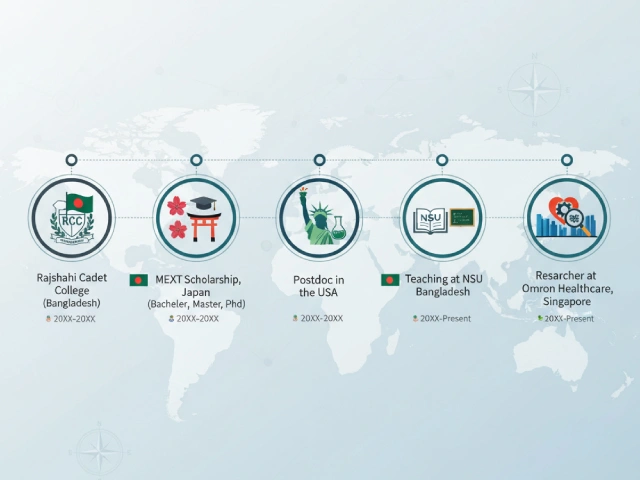
Mashiur Rahman is from Bangladesh. After completing high school at Rajshahi Cadet College, he won the prestigious Japanese Monbukagakusho (abbreviated as MEXT) scholarship, where he completed his bachelor’s, master’s, and PhD studies. Following his long academic journey in Japan, he spent some time doing postdoctoral research at Marshall University in the United States. After this diverse academic path at home and abroad, he returned to Bangladesh for a while to teach at North South University, drawn by the love of his homeland. Currently, Dr. Mashiur works in the research and development division of a leading medical device company called Omron in Singapore. His main focus is healthcare—he explores how to use the latest innovations in data science and artificial intelligence to improve disease diagnosis and treatment. “I am not a data scientist myself,” he says in his modest tone, “but I apply the knowledge gained by data scientists, especially thinking about how we can use AI to improve healthcare.” He kept his introduction brief and moved on to the main discussion.
Dr. Mashiur first wanted to clarify what he meant by artificial intelligence. Since there are so many differing opinions on this topic, clearing up misconceptions was necessary. In his words, “By AI, I mean giving computers or machines the ability to think, learn, make decisions, and solve problems like humans—that’s what artificial intelligence is.” However, he immediately warns that AI does not actually think independently like humans. Essentially, it’s a computer program loaded with a vast amount of data and knowledge provided by people. AI analyzes that knowledge base through machine learning technologies and searches for solutions to our questions or problems. Dr. Mashiur gave a brilliant analogy: “Just like we can do small calculations on our own but need a computer’s help for complex calculations involving millions of numbers—AI is a tool like that. It can help us accomplish enormous tasks that are difficult for an individual person alone.” He emphasized that AI should be regarded purely as a tool, nothing more. Reiterating his point, he reminded everyone: “AI is just a helpful tool.” In other words, there’s no point relying on this machine as if it were magic; it is only as useful as the person using it properly.
After providing this clear understanding of artificial intelligence, Dr. Mashiur proceeded to the main topic: preparing for higher education abroad. Right at the start, he raised an essential question, which is often overlooked by eager applicants—why do you want to study abroad? “Many believe things will automatically be better if you go abroad,” he noted, “but that’s not always true.” Mashiur reminded everyone that first you must ask yourself: why do I want higher education, what do I want to study, and where do I want to study? Without having clear goals, you risk losing your way after arriving overseas. He quoted the immortal words of the philosopher Socrates: “Know yourself.” Knowing yourself means having a clear idea about your interests, strengths and weaknesses, and goals. If you don’t do this self-reflection before pursuing higher education, you might end up disheartened later. “Just as we look at ourselves in the mirror, it’s just as important to see ourselves in our own mind as well,” Mashiur explained. He suggested that these topics could be discussed in a separate session, but the focus of that day’s discussion was on the next steps.
Required Preparation:
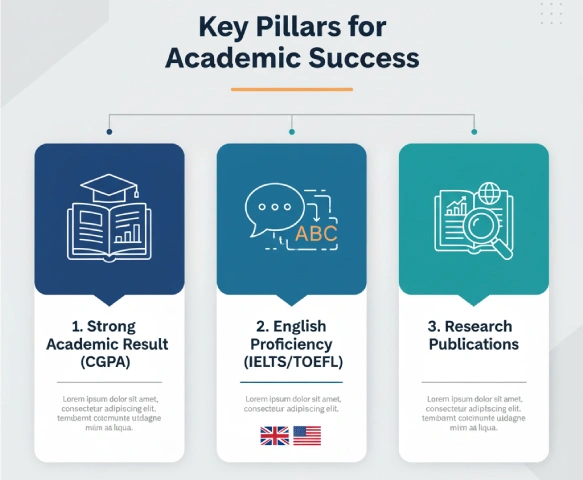
After deciding why you want to study, what are the prerequisites for higher education abroad? Dr. Mashiur repeatedly emphasized three fundamental pillars upon which your preparation must stand. He said, “For higher education, these three things are extremely important.” He put special stress on fulfilling these three conditions—
(1) Good Academic Results:
Your undergraduate CGPA should be as close to 4.0 as possible. According to Mashiur’s advice, the better your results are, the higher your chances of getting into foreign universities and winning scholarships. So, aiming for near-perfect results (almost 4.0) is critical. Some students take this stage too lightly, but later on, when they are applying abroad, poor grades can become a major obstacle.
(2) Proficiency in English:
If you want to study abroad, you must be able to prove your language skills. Exams like TOEFL, IELTS, GRE—whichever you take—require a high score. In Dr. Mashiur’s opinion, we often don’t give enough importance to English proficiency, but it is an essential skill for establishing yourself in the academic world abroad. So, make sure to prepare well in advance and secure a good score on TOEFL/IELTS.
(3) Research Experience:
Thirdly—and possibly the most neglected but most important—is experience with research publication. Mashiur Rahman strongly asserts, “Finish your undergraduate degree with at least two research papers in hand”—this should be your goal. In fact, publishing research papers is no longer just part of PhD work; even at the undergraduate level, students all over the world publish their work in conferences or journals to strengthen their application packets. In the Bangladeshi context, this idea is relatively new, so he wanted to raise awareness about it. Many bright students complete their undergraduate degrees without any research papers, which puts them at a disadvantage when applying for scholarships abroad. Dr. Mashiur says, “We all focus on GPA and TOEFL, but are quite negligent about research papers. This can’t go on.” His appeal: anyone serious about studying abroad should aim to publish at least two high-quality research articles. If you can publish in your university’s journal or a seminar, great; if possible, also try submitting to international conferences or journals.
At this point, Dr. Mashiur mentioned a valuable opportunity that he was aware of coming up soon. Some expatriate Bangladeshi professors in Japan are organizing an online conference; the submission deadline for papers is approaching on the 22nd, and anyone can present their research papers there free of charge. He believes this is a fantastic opportunity for young researchers, as the work will be published online and will count as academic activity for the student. Mashiur shared this information to encourage students—those who have nearly completed research projects should take advantage of opportunities like this while they still can.
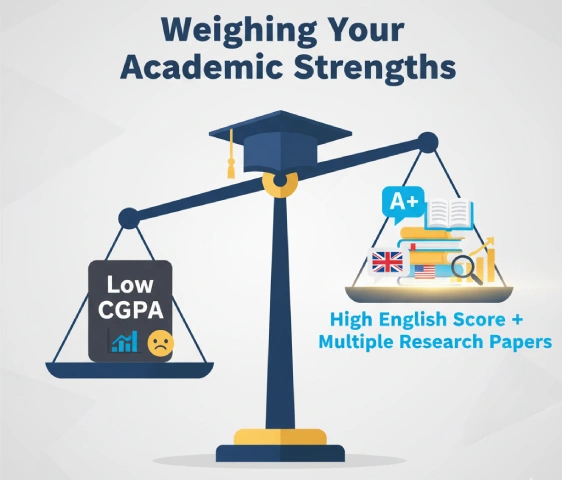
Dr. Mashiur recognizes that even meeting these three primary conditions is a tough challenge for many. He doesn’t hide from reality; rather, he points out possible solutions. For example, if someone fails to achieve a good CGPA, they should not despair. Instead, they must play their other “cards” even more strongly. He explained: suppose someone’s CGPA is below 3.0, but they still want to go abroad to study. In that case, they must achieve an outstanding English test score, and instead of just two, try to publish four, five, or even more research papers. Showing strong research work can make up for weak grades to a large extent. Mashiur reassures that even if your academic results are one or two points lower, there’s no reason to be disheartened: “You may have a poor result, but no need to be upset about it—you can cover that up with research papers.” He even used a card game analogy, imagining the three pillars as three cards: if one card is weak, you have to try to win the hand with the other two.
Challenges and the Role of AI: Having discussed the required qualifications and preparations, he moved on to the next major questions: “Okay, you’ve decided to study abroad and you’re preparing— but which country, which university, and in which lab or under which professor will you study?” Choosing the country, university, and research laboratory are actually the three biggest decisions on the path to higher education. In Mashiur’s experience, it is precisely at this point that most students in Bangladesh are most uncertain. Many don’t know who to seek advice from, so they rely on what’s familiar. In Dhaka’s Farmgate area, there are numerous educational consulting offices and coaching centers, some of which claim to offer admission and scholarship guidance for studying abroad. Others run to “big brothers” or seniors for advice. Dr. Mashiur cautioned against these traditional methods. The problem is, individuals or agencies might only be able to provide information about a handful of countries or universities, with limited coverage.
Instead, Mashiur pointed toward a new direction for the twenty-first century: using AI for assistance. He made it clear: “Just use AI—ChatGPT or any other tool. AI possesses a database that the consulting companies in Farmgate don’t have—and neither do I.” It’s true: by trawling vast online databases, artificial intelligence can instantly tell you which countries offer good opportunities to study a particular subject, and which university or lab is doing research that matches your interests. Today, Dr. Mashiur was eager to demonstrate this hands-on. However, he repeatedly reminded everyone: no matter how knowledgeable AI may seem, you must know how to ask the right questions first. And before you can ask those questions appropriately, you need to provide some initial information about yourself. Mashiur’s advice is that no matter what you want to find out, first help the AI understand your profile. In other words, “First, tell the AI who you are: you’re a student from Bangladesh, your CGPA, the subject you want to study.” If you let AI know your context, it can tailor its advice. Otherwise, it will just give generic answers, which may not be right for you. So, to use artificial intelligence for finding universities or professors abroad, the first step is to briefly explain your own profile and needs. Once you do this, the AI can serve as a kind of personal advisor.
At the same time, Dr. Mashiur cautioned everyone about the principles of using advice from artificial intelligence. AI might give you an answer or a list very quickly—but you cannot rely 100% on its result. Instead, you should take what AI provides, act on it, and make your own final decisions. He gave an example: suppose, with AI’s help, you find the names of some suitable professors whose research matches your interests. Now, your task is to contact them. Many may simply copy-paste the same email template generated by AI and send it to all professors. Mashiur emphasized that you must not do this. “Copy-pasting won’t work,” he warned plainly. Sending mechanical, generic applications greatly reduces your chances of getting a reply. So, what should you do instead? For each professor, you need to do your homework and write a personalized letter. Mashiur said, “When you write to professors or universities abroad, you need to tailor your messages according to their profile. Sending the same thing to everyone is not acceptable.” He instructed everyone to at least look up each selected professor’s prior published papers and mention their work in your emails. This proves that you’ve truly read and appreciated their work, which professors always value. AI can be a fantastic aid here—it can help you draft an email or organize the main points—but you must compose the final message in your own way. Take the AI’s draft and carefully revise it, adding your own language and feelings to perfect it. Dr. Mashiur again reminded everyone that AI is only a tool; the responsibility for the real work is yours.
At this point, several participants began to raise their responses and questions. Mashiur had reassured everyone that anyone with questions should feel free to ask—he would try to answer as best he could. One student, Mishuk Shahriar, asked if their department’s results are typically not very high (perhaps because of strict grading or other limitations), what should they do if they can’t get a good CGPA? Another (who wished to remain anonymous) wrote in the chat, “My CGPA is below 3. Is there anything I can do?” In response to these questions, Dr. Mashiur took a moment and explained patiently: No, things won’t always go perfectly. But that’s no reason to quit. Once again, he referred to the three pillars—results, English proficiency, and research. If you are lacking in one area, you need to shine extra brightly in the other two. If results are low, you must demonstrate that you are outstanding in other ways and can compensate for the shortfall. He said, “Even if your result is below 3, you can maybe write 5-10 papers. That will prove that you are more capable than your exam performance shows.” And in English, you must aim for nearly a full mark in IELTS/TOEFL—if you work hard, you can achieve top scores, and that should be your goal. With these examples, he rekindled hope in distressed students. In conclusion he said, “Bad results can happen to anyone, but it’s nothing to be frustrated about. There are ways to compensate for it—by developing other strengths.” Students seemed to breathe a sigh of relief at such heartfelt, candid answers from Mashiur. If you know how to overcome obstacles, there’s nothing to fear!
At this stage, a participant asked another specific question regarding Japan’s “MEXT” scholarship. The questioner, Nusrat Jahan, wanted to know if she could still apply for MEXT if her results weren’t up to the mark. Dr. Mashiur responded with a detailed answer based on his own experience. He himself studied in Japan under the Monbukagakusho/MEXT scholarship; so he knows it is a highly competitive merit-based scholarship. In Bangladesh, candidates are typically first screened by the Ministry of Education, which can be called a government channel. If your results are weak, it can be tough to make the shortlist as there may be a CGPA cut-off. However, there is another MEXT pathway—a non-government channel, which means applying directly by contacting Japanese universities or professors. This is sometimes called the “university recommendation” route. This option is comparatively more flexible; if a professor is impressed by your profile, they can nominate you through their department, so you don’t need the ministry’s shortlist. But for this, your profile must be strong enough to impress the professor. Mashiur also advised that if you want to study in Japan, beyond English, gaining some proficiency in Japanese is beneficial. At least a Japanese Language Proficiency Test (JLPT) certificate will add weight to your application. It demonstrates your interest in the language and culture and your readiness to adapt. Ultimately, he stressed the same point: if one of the three pillars is weak, you must make up for it with the other two—or, if possible, all three! For competitive scholarships like MEXT, this principle is even truer: “the stronger, the better.”
By now, almost every aspect—from fixing your study abroad goals to the details of preparation—had been discussed. The summary of Dr. Mashiur’s first session was this: know yourself, set clear goals; strengthen your profile through results, language, and research; use AI as your companion for gathering information and planning, but always keep your own judgment active. Participants listened attentively and took many notes. Mashiur saw from their expressions that although the flood of information was perhaps heavy, they had not lost interest. Rather, many felt inspired by the thorough guidance. He promised to share the PDF presentation file he had prepared with everyone at the end of the session, so they could refer to these points later.
Session Break / Start of Second Part
Now in the second part, Dr. Mashiur turned to the promised “hands-on” demonstration. The goal of this section was to teach students how to ask questions or give commands to artificial intelligence properly. He said, “When we instruct AI, the text we write is called a prompt.” He also gave a simple explanation of the English word ‘prompt’: the description or question we type to give the AI work instructions, that’s a prompt. But you can’t just write anything—the art of writing a good prompt is itself a skill. Mashiur explained that the quality of the AI’s answer largely depends on how you ask the question. That’s why “prompt engineering” has become a new in-demand skill worldwide. He joked, “If you ask a good question, you get a good answer,” and this is especially true with AI.
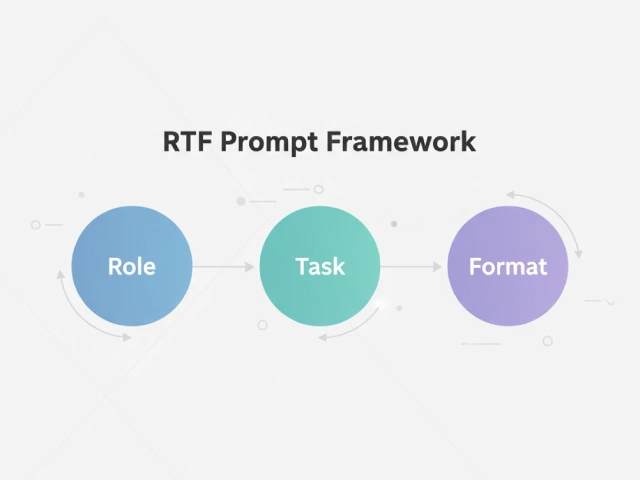
In this section, Dr. Mashiur taught a few well-known prompt-design techniques. His favorite method is the RTF framework—an abbreviation for three English words:
Role, Task, Format.
He explained that this means you should make three things clear to the AI:
(1) What role or character it should assume (Role),
(2) What specific task you want it to do (Task), and
(3) In what format you want the result delivered (Format). If a prompt clearly specifies these three elements, the AI can understand exactly what is needed.
As an example, Mashiur imagined a fun situation: suppose you’re planning a trip to Europe and need a travel itinerary. If you just ask in a general way, AI might give some generic suggestions. But using the RTF method, you would say—“Act as a professional trip planner” (that sets the Role, and the AI now considers itself your travel guide), then write, “Design a detailed to-do list for traveling in Europe” (this is your requested Task), and then add, “Present the list in bullet points” (this determines the Format—you want it organized in bullet points). The entire instruction can be called a good prompt—nothing is vague. You’ve specified what the AI should do, and how, clearly. Mashiur shared that he personally uses the RTF framework extensively and finds it very effective. Some may wonder—does AI really need that much detail? In his experience, yes, it does. “If you mention the role upfront, AI performs much better,” he commented. Just as people think according to the role they are in, AI also answers better when it knows its role. And if it knows the desired format, it shapes its answer accordingly, so you’re more likely to get what you want.
Beyond RTF, Dr. Mashiur also mentioned several other prompt frameworks so participants understood there are many strategies worldwide. CLEAR, TAG, PACT, SAID, TRACE, APPROACH—he named and briefly alluded to each, giving a sense of how they work. At first, listeners may have been surprised by so many options, but Mashiur explained that the main idea is the same: tell the AI exactly what you want as clearly and structurally as possible. He also gave examples: in the CLEAR framework, you ensure your instruction is Concise, Logical, Engaging, Actionable, and Responsible—meaning your question should be designed so the AI can give a productive answer. TAG reminds you that your question should specify the Task (what to do), Action (steps to take), and Goal (ultimate aim). PACT stands for Prompt’s Purpose, Action, Context, and Tailoring (customized to the given situation). SAID includes Situation, Action, Impact, and Detail. TRACE adds Task, Request, Action, Context, and Example for even more detailed prompts. There’s even a complex framework called APPROACH, where you consider Audience, Purpose, Priorities, Result, Openness, Assumptions, Concerns, and Help. Though these sound heavy, Dr. Mashiur reassured everyone that there’s no need to memorize all of this in a day. He just wanted to show that interacting with AI is itself a kind of research—knowing a few strategies helps you get better results. The most important takeaway, however, was this: if you follow a simple rule like RTF, you’ll get the information or advice you need from AI in most general cases. The other frameworks come in handy for new situations, but RTF is enough to get started.