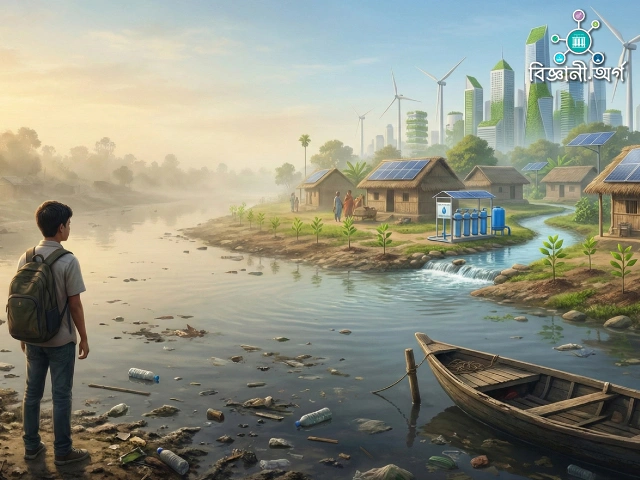
As dawn breaks, a boy walks through a riverside village. The river of his childhood is no longer the same—its water is murky, and the bed is coated in a dark layer. He doesn’t know what “industrial pollution” is, or what “carbon footprint” means. All he knows is, his father’s small boat no longer floats as well, and the fish are much harder to catch than before. Nature seems to be slowly slipping away from him. And amidst that distance, a question arises in his mind—if humans can carve a city out of mountains, why can’t they save a river?
This isn’t just one village’s question—this question is etched in the eyes of every city, every river, every child in Bangladesh. Breathing in Dhaka’s air has become a luxury. According to a recent World Health Organization report, Dhaka’s air pollution ranks among the world’s most hazardous cities, with more than ten thousand premature deaths each year caused by toxic air alone. The World Bank says that environmental pollution costs Bangladesh nearly 4 percent of its GDP. These numbers may seem heavy, but behind them are ruined lungs, parched land, and lost futures.
It is exactly here that a quiet rebellion called sustainable technology is born. It’s not just the protest of environmentalists—it’s a new oath taken by engineers. Is technology merely about building big factories, or is its purpose to keep people alive? In search of an answer, innovations are being born today in labs in Boston, workshops in Tokyo, and smart cities in Singapore: technologies that generate electricity from sunlight, purify water using bacteria, and break down plastic with enzymes. Modern science no longer dreams only of power—it dreams of survival.
If we turn the pages of history, we see that engineering began as a way to make life easier for humans, but eventually that very convenience became difficult for the world. The Industrial Revolution brought light to humanity, but darkness accumulated in the sky. Now is the time to correct those mistakes. Albert Einstein said, we cannot solve our problems with the same thinking we used when we created them. Sustainable technology is the name of that new way of thinking—where responsibility is joined with skill.
For a country like Bangladesh, this concept is no longer a fashion, but a strategy for survival. Sea levels are rising, rivers are swallowing villages, and concrete is consuming cities. According to the United Nations, by 2050, nearly fifteen million people in Bangladesh could become climate refugees. In this reality, if technology ignores the environment, then development is just another name for destruction. But if technology becomes nature’s friend, it can be our greatest tool of hope.
Today, some young engineers in Bangladesh are working on solar energy in remote areas, some are building affordable water purification devices, and others are thinking of ways to generate fuel from waste. These may seem like small initiatives, but in reality, they are the blueprints of the future world. Today, Singapore meets a large portion of its needs by recycling water, the Netherlands farms beneath the sea, and Germany sources much of its electricity from renewables. These are not just wealthy countries—they are visionary countries.
Sustainable technology is not just about planting trees; it means creating machines that use less electricity, building homes that stay cool in the heat on their own, and designing cities where people and the sky do not merely tolerate one another, but love each other. This love is not just a line from a poem; it is written into mathematical formulas, engineering blueprints, and lines of code.
If you’re a student, you might be wondering, what can I do? Once again, it’s that question that feels small in the face of big dreams. But every major technological breakthrough began with a little discomfort. No matter where you study, the environment around you can become your laboratory. Testing river water, calculating electricity consumption, imagining new uses for plastic—these are all science. And this very science will one day turn you into a responsible global citizen.
Marie Curie unraveled the mysteries of radioactivity for the benefit of humanity, Charles Darwin sought to understand nature—not to dominate it—and Abdus Salam believed that science is the path to freedom for developing nations. Today, that path has taken a new turn, a turn called sustainable development. Here, a scientist is not just a discoverer, but also a protector.
Late at night, as you turn the pages of your books, you might wonder—can I really change anything one day? This very question sets you apart. Because those who question are the ones who find answers. The world today is tired, the air is heavy, the rivers are sick. Yet the world still believes in people. And you are one of those people.
Maybe one day you’ll work in a great lab, or maybe you’ll transform many things from a small village. The place doesn’t matter—it’s your perspective that counts. Remember, if engineering is your hand, environment should be your heart. Without both together, development is just movement, not a destination.
The world today does not ask much from you. It seeks only responsibility. It wants a generation that will use technology not to conquer the earth, but to live with it. And it is there, quietly, that the history of tomorrow is born.