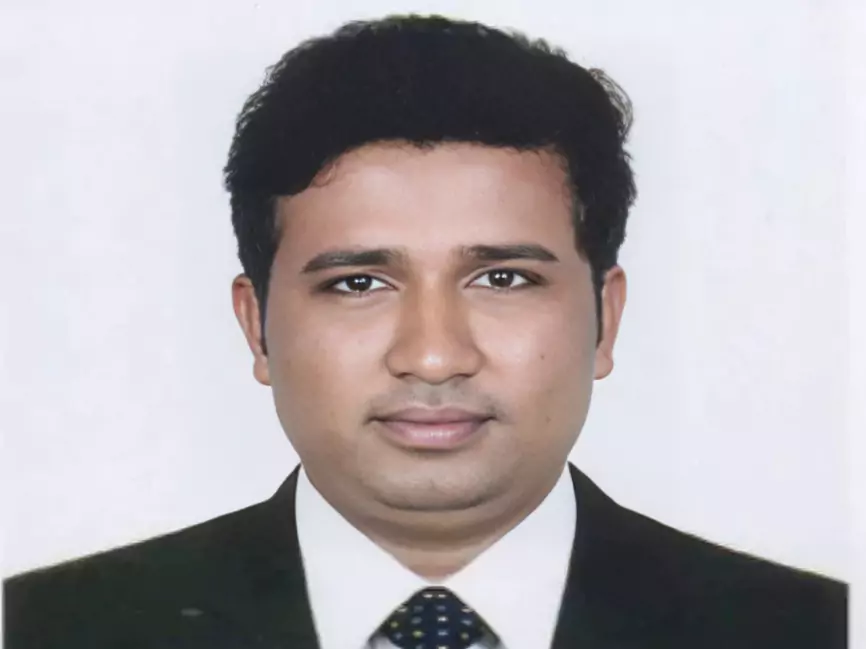
Recently, we interviewed distinguished researcher Bijoy Chandra Ghosh. He is currently working at the Bangladesh Council of Scientific and Industrial Research (BCSIR), Rajshahi Research Laboratory, and his primary research areas are solar energy and environmental chemistry. In this interview, he elaborated on the subjects of his research and discussed several important aspects of his field. This area of research is highly significant for environmental conservation and the increased use of affordable energy. Read the full interview to learn more.
Could you tell us about yourself?
I am Bijoy Chandra Ghosh, and I completed my B.Sc & M.Sc in the Department of Chemistry at Comilla University. In January 2023, I joined the Housing and Building Research Institute under the Ministry of Housing and Public Works as a Research Assistant, and later that same year, I joined the Bangladesh Council of Scientific and Industrial Research (BCSIR) under the Ministry of Science and Technology as a Scientific Officer. Currently, I am working at BCSIR Rajshahi Research Laboratory, focusing on research in solar energy and environmental chemistry. So far, I have published a total of 10 research articles on these topics in internationally recognized peer-reviewed scientific journals (Scopus/SCI/SCIE Indexed).
What is the subject of your research?
As part of my ongoing research, I am working on Thin Film Solar Cells and also conducting research on the low-cost production of Crystalline Nanocellulose (CNC) from waste biomass (agro-waste). Using this CNC, I am developing nanocomposites for industrial wastewater treatment.
How do your research efforts benefit us, or how might they benefit us in the future?
My research mainly focuses on:
1. Enhancing the efficiency of solar panels and making them more accessible to the public by utilizing solar energy as an alternative to burning fossil fuels (burning these fossil fuels emits excessive carbon, causing global warming and depleting the ozone layer in the troposphere, which lets harmful UV rays reach Earth and leads to various diseases including skin cancer in animals and humans).
2. Additionally, due to the rapid and continuous rise of industrialization and urbanization, environmental pollution—especially water pollution—is increasing. Nanocomposites made from crystalline nanocellulose will play a role in treating industrial wastewater and help maintain a beautiful and sustainable environment. Advanced and emerging countries are already quite ahead in this area of research.
Would you like to share any special experiences related to your research?
With the motto “My Village My City” in mind, my goal is to make solar panels more efficient and accessible to illuminate villages just like cities. Additionally, observing the negative effects of unplanned industrialization and urbanization causing the loss of Bangladesh’s natural resources motivated me to research the production of nanocomposites from nanocellulose.
What qualities do you think a scientist should have?
Patience, strong dedication, focus, and an indomitable will are essential to becoming a successful researcher. Also, staying close to an experienced researcher, especially in the early days of a research career, can help one progress further.
Do you have any messages or advice for young students in Bangladesh who want to work in science?
Science is a blend of curiosity and perseverance. Always ask questions, embrace challenges, learn from failures, and never stop trying. Make good use of technology, verify the authenticity of information, and work on improving yourself. Stay steadfast in your contribution to advancing scientific research in Bangladesh.
Your Email : [email protected]
Your LinkedIn : https://www.linkedin.com/in/bijoyghoscou22?utm_source=share&utm_campaign=share_via&utm_content=profile&utm_medium=android_app
Your Website, Research Link : https://www.researchgate.net/profile/Bijoy-Chandra-Ghos/research
On behalf of Biggani Org, we extend our heartfelt congratulations to Bijoy Chandra Ghosh for his continued success. His journey is inspiring new perspectives and enthusiasm among us all, and his work will remain a source of inspiration for future generations. We hope his research and development activities continue to achieve even greater success in the future and open up new horizons in science and technology.
Interview with Vijay Chandra Ghosh: Modern research in solar energy and environmental chemistry!
Could you tell us about yourself?
I am Bijoy Chandra Ghosh, a graduate with a B.Sc and M.Sc in Chemistry from the University of Comilla. In January 2023, I joined the Housing and Building Research Institute under the Ministry of Housing and Public Works as a Research Assistant. Later that year, I joined the Bangladesh Council of Scientific and Industrial Research (BCSIR) under the Ministry of Science and Technology as a Scientific Officer. Currently, I am working at BCSIR’s Rajshahi Research Center, focusing on solar energy and environmental chemistry. To date, I have published a total of 10 research articles in internationally recognized peer-reviewed scientific journals (Scopus/SCI/SCIE Indexed).
What is your research area?
In continuation of my current research activities, I am working on Thin Film Solar Cells. Additionally, I am researching the low-cost production of Crystalline Nanocellulose (CNC) from waste biomass (agro-waste) to develop nanocomposites for industrial wastewater treatment.
How does your research benefit us or how will it benefit us in the future?
My research primarily focuses on:
- Enhancing the efficiency of solar panels by utilizing solar energy as an alternative to burning fossil fuels. Burning fossil fuels releases excessive carbon emissions, contributing to global warming and depleting the ozone layer in the troposphere, leading to the entry of harmful UV rays that cause various health issues, including skin cancer in humans and animals. By making solar panels more efficient and affordable, we aim to make solar energy accessible to the general public.
- Creating nanocomposites from Crystalline Nanocellulose to treat industrial wastewater, which can help mitigate the environmental pollution caused by rapid industrialization and urbanization, particularly water pollution, while also promoting a sustainable environment. Many advanced and developing countries are already ahead in such research.
Do you have any unique experiences related to your research that you would like to share?
Inspired by the idea of “My Village, My City,” I am working to make solar panels more efficient and accessible to illuminate rural areas like urban ones. Additionally, observing the depletion of Bangladesh’s natural resources due to unplanned industrialization and urbanization has motivated me to explore the production of nanocomposites from nanocellulose as a solution.
What qualities do you think are essential for a scientist?
Patience, dedication, focus, and an unyielding drive are essential to becoming a successful researcher. Moreover, in the early stages of a research career, staying close to an experienced researcher can greatly help in progressing forward.
Do you have any message or advice for young students in Bangladesh who want to work in science?
You must be hardworking and ambitious, read many research papers, and study the biographies of successful scientists. There’s no hiding in research; sometimes, you may not get the desired results, but that doesn’t mean the research was unsuccessful. Even negative results contribute to research, as someone else may later build upon your process. Therefore, be honest in both your research and personal life.
On behalf of Biggani Org, we extend our heartfelt congratulations to Vijay Chandra Ghosh for his growing success. His journey is creating new perspectives and enthusiasm among all of us and his work will continue to inspire future generations. We hope that his research and development activities will achieve greater success in the future and open new horizons in the field of science and technology.