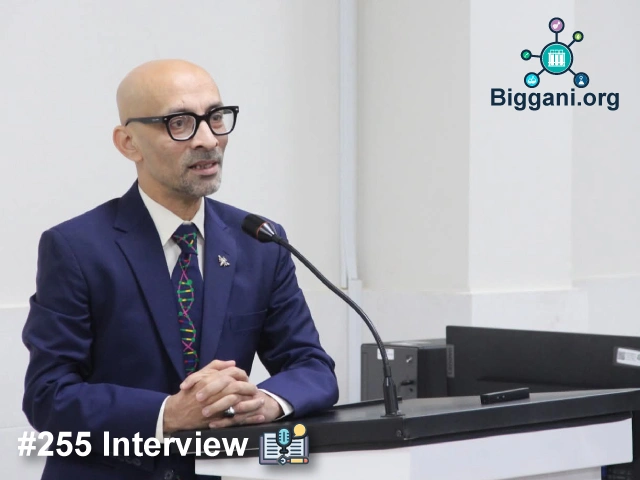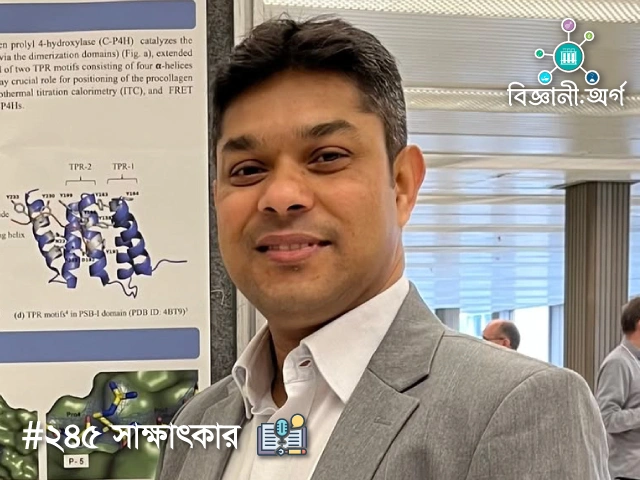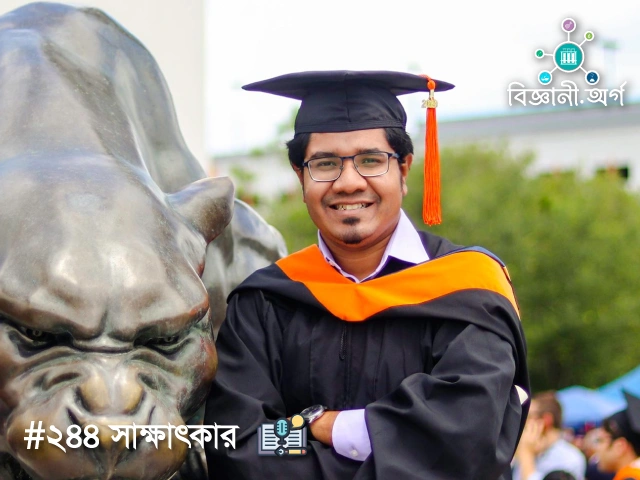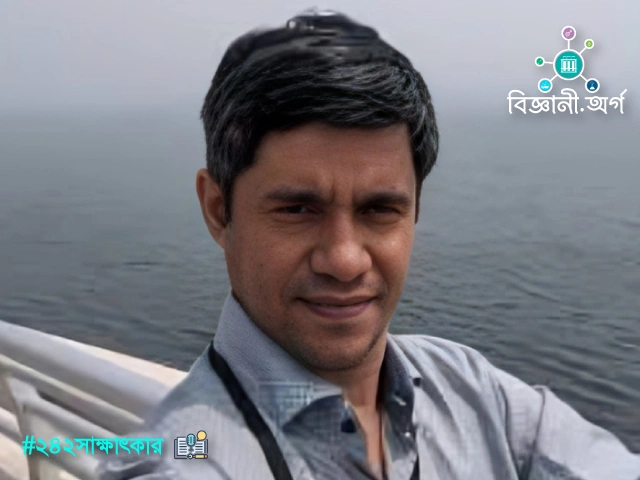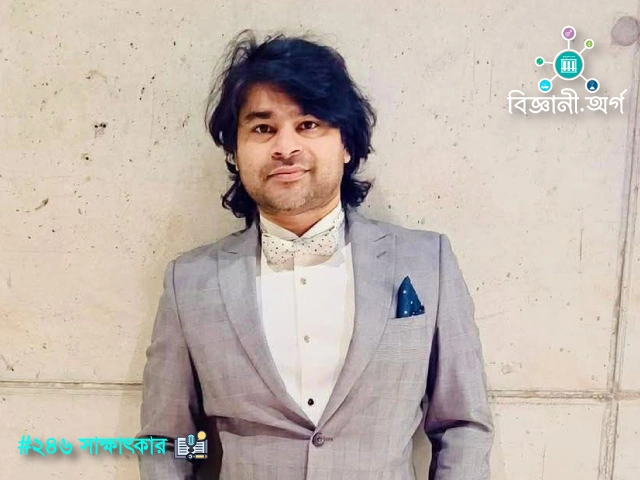
The boy from Dhaka’s BAF Shaheen School, who fell in love with technology while listening to fighter jets roar above—now teaches at multiple European universities on how a mobile app or even a simple alarm can transform how people live their lives. Dr. Mohammad Sanaul Haque—behavioral scientist and sustainable digital technology researcher—shares his research, philosophy on life, and his message to young people in an interview with Biggani.org.
A boy, studying in class five or six. Born and raised in Dhaka. Once, his uncle from Belgium came to visit, bringing with him a Walkman—those small devices from Philips or Sony where you could listen to cassettes. Around the same time, an uncle working as an engineer in Saudi Arabia gifted him a video game. While his peers were busy playing, this boy would wonder in between video gaming—how was this device actually made? How do batteries connect? How could such a small thing bring so much joy? The seed of understanding the invisible bridge between people and technology was sown then.
The boy’s name is Mohammad Sanaul Haque. Today, he is Dr. Sanaul Haque—a researcher in behavioral science and sustainable digital technology at LUT University (Finland), and Adjunct Assistant Professor at Jönköping University, Sweden. In the Biggani.org interview “Digital Innovation: Human Behavior and Health,” he discussed his research world, personal experiences, and thoughts for the young generation in Bangladesh. Presenters were Zakia Khatun Taki—a regular Biggani.org volunteer—and assistant presenter and coordinator Hasnabanu Mumu.
From Walkman to Laboratory: A Curious Boy’s Journey
Dr. Sanaul Haque’s path to research wasn’t out of professional obligation, but stemmed from childhood fascination. In his own words: “I came to this research not because of my profession, but from my childhood interests.”
While studying at BAF Shaheen School, fighter jets and commercial planes would fly over every day—the airport and airforce base being right next door. The sights and sounds of machines and technology fascinated him from childhood. Soon, he began experimenting on his own—building motors, making small robots, running science experiments. Gradually, this became his passion, the driving force of his life.
The Schoolhouse in London: Encountering a New World
Right after his HSC, Sanaul Haque set off for London. He completed a BSc (Honors) in Engineering from the University of East London and a Master’s in Telecommunication Engineering from Queen Mary University of London. His experience with education in London left a deep mark on his life—not just academically, but in understanding people and the wider world.
He explained that the greatest strength of London’s education system is its practical nature. It’s not just about writing answers in exams; you need to apply theory in practice, and carry out engineering projects hands-on. There were challenges, too: a new country, new culture, living alone without family—the first year or two were difficult. But those hard times taught him how to interact with people from various cultures, understand different perspectives, and become socially confident.
He emphasized, however, that going abroad for studies isn’t mandatory for everyone. “Decide according to your circumstances. Higher education is available at home, too. But yes, going to a new place brings new knowledge, new lessons, and new experiences.” He noted that, for example, a former head of state of Nepal studied medicine at Mymensingh Medical College in Bangladesh—a reminder that education’s quality can’t be judged solely by country.
The Difference Between Education at Home and Abroad: An Honest Observation
Dr. Sanaul Haque offered thoughtful insights about the differences between education in Bangladesh and abroad. He observed that in South and Southeast Asia, education puts excessive emphasis on theory. Getting good marks in exams seems to be the only goal, leaving practical education neglected.
He cited his own experience. When studying at Notre Dame College, only about fifteen to twenty-five percent of marks in science subjects were allocated to practical classes. Naturally, students focused more on theoretical exams. But simply memorizing definitions often leaves them disconnected from real life—the question of real relevance often goes unanswered.
Yet he is reluctant to blame anyone. In developing countries like Bangladesh, with huge student numbers, limited budgets, and university infrastructure constraints, it’s truly challenging to create an ideal system. On the other hand, while universities abroad may have more technological resources, they also lack certain things—like the variety of food at home or the warmth of familiar people. In his words, “Every place has its pros and cons. You must decide for yourself which thing is more important to your life.”
At the Heart of Research: When an App Changes Eating Habits
The crux of Dr. Sanaul Haque’s research revolves around a simple but powerful question: Can technology change human behavior? And if so, can those changes really improve health and quality of life?
To answer this question, he has worked across several interdisciplinary fields. Three main ideas repeatedly come up in his discussions:
Persuasive Technology—technology that motivates people to do certain things. For example, when mobile companies entice customers with special offers, that’s also a kind of persuasive technology—though for business purposes. Dr. Sanaul Haque wants to use these same methods for people’s physical and mental well-being.
Gamification—using elements of games to make people more interested in an activity. For instance, if you walk after meals for a month, reward yourself with a prize—that’s a simple example of gamification. Points, badges, levels—these game elements can make study or health routines more engaging.
Nudging—gently pushing people in the right direction rather than forcing them, so they make good decisions themselves. For example, if your morning phone alarm doesn’t just wake you up but also says, “Wake up at 6 am, brush your teeth, go for a walk for half an hour”—that’s a small nudge, which over the long term, helps build habits.
One excellent practical application of his PhD research was developing a mobile app that helped people avoid junk food and walk more. He noted that now, we go to restaurants and eat burgers and pizza, check in on Facebook, but never think about how unhealthy these foods are for our bodies. His app used psychological theory to encourage people to avoid unhealthy food and increase physical activity. The results were positive—participants lost weight and felt more mentally active.
Preventive Healthcare: Becoming Aware Before Sickness Strikes
Asked about the future of digital healthcare, Dr. Sanaul Haque emphasized preventive medicine. The core idea—protect yourself before you get sick. You have self-control within you, and technology can assist in strengthening that ability.
He offered a simple but profound observation: “When we were small, our parents took care of us. Over time, everyone builds their own life and becomes busy. Then, you are the only one who can take yourself forward. At that time, technology can become your guide—helping you change your behavior.”
If medical devices, software services, mobile apps, etc. are used positively, they can help protect our bodies. Whether you have a disease or not—everything begins with awareness. “Health is the foundation of all happiness—we all know this. So we must take charge of protecting our own health.”
Breaking Free from Overthinking: A Teenage Girl’s Question, a Researcher’s Answer
A moving moment came in the interview when host Zakia Khatun Taki—herself a teenager—asked a personal question. She wanted to know how to manage overthinking, particularly during exams when it becomes most intense.
Dr. Sanaul Haque responded with great empathy. He admitted that everyone experiences this problem, including himself. His suggestions were multifaceted:
Firstly, being involved in social activities like Biggani.org—this helps divert the mind. He himself was involved in such activities during school and college.
Secondly, breaking study material into small parts and reading a little each day—“moving steadily like a tortoise.” Doing this takes away the last-minute exam stress. He joked that before his own final exams, he used to play games—because he’d already prepared in advance.
Thirdly, do what you love—be it gardening, watching movies, or having positive conversations with friends. But these conversations should be uplifting—talking about travel, beautiful moments, ways to stay healthy. Talking about negative matters only makes the mind heavier. In his words, “Use technology to make yourself happy, not to complicate things.”
Artificial Scarcity: An Innovative Self-Improvement Strategy
One of the most intriguing parts of the interview was when Dr. Sanaul Haque explained the concept of “artificial scarcity.” In psychology, this term is often used in economics—like storing oil to create an artificial crisis and sell at a higher price. But the same idea can be used positively in personal life.
Suppose after eating, you usually sit and scroll Facebook—which is unhealthy and a major cause of indigestion. Now, if you create an environment where there’s nowhere to sit—move the chairs, or arrange for standing work—then you are forced to stand or walk. That’s artificial scarcity—accepting small discomforts now for long-term gain.
According to the World Health Organization (WHO), bodies need to move every forty to forty-five minutes—otherwise, health suffers.
He shared a great example from his own life. In Europe, he used to have a diesel car, which was costly and environmentally harmful. He stopped using it and started cycling instead. As a result, he saved in three ways—insurance fees, road tax, and fuel costs. The money saved, he donates to social causes. “Every small step can change the world,” he said.
In this context, he mentioned another important concept from psychology—the idea of “reward and punishment,” which also relates to reinforcement learning in artificial intelligence. Set yourself a goal—not sitting after meals for a month; if you succeed, reward yourself. Increase your goal step by step—one month, three months, six months, a year. Scientific research shows that it takes at least three months for behavior change to become permanent.
Self-Regulated Learning: Becoming Your Own Teacher
Dr. Sanaul Haque described his current work at Jönköping University of Sweden, where he has developed an AI-based tool to improve students’ learning skills. The underlying principle is called self-regulated learning—how you manage and guide your own learning.
There are three steps: first, set your own goals; then work towards those goals; and finally, look back—what mistakes did you make, what did you learn, how can you do better. This method can be used not just in academics but also in careers and personal life.
Simultaneously, as project manager and co-lead researcher from LUT, he’s working on an Erasmus project with Ireland’s South East Technological University (SETU). There too, learning is made into a journey using gamification—submit work every week, earn points, collect badges, and progress step by step.
Environment and Technology: Using ChatGPT Also Emits Carbon
An important part of the interview saw Dr. Sanaul Haque speak on the environmental impact of technology—a topic many ignore or are unaware of.
“Did you know that when you use ChatGPT for ten or thirty minutes, it emits a surprisingly large amount of carbon and uses a huge amount of energy?” he said.
Not just ChatGPT—Google Gemini, social media, all digital services consume power and produce carbon. In a recent research paper published in Japan, their team showed that social media usage also results in significant carbon emissions.
He compared the planet to the human body—“If you get gangrene in your hand, your whole body suffers. Dhaka’s air pollution is just like that—it’s not just Dhaka’s problem, it’s the world’s problem.” No country is isolated, because there’s just one atmosphere on Earth.
Drawing on his software industry experience, he suggested that one solution is writing efficient code. If a software developer can write concise, effective code, software uses less power, takes up less server space, and lowers carbon emissions overall. Similarly, as everyday users, if we cut down on unnecessary tech use—finish a ten-minute job in two, with the same output—we contribute to saving the planet.
Research and Love: Lessons from Rabindranath Tagore
Asked what needs to change to improve Bangladesh’s research climate, Dr. Sanaul Haque offered a striking comparison. He said that Rabindranath Tagore could write poetry, novels, and songs because he never had to worry about basic necessities. Born into a landowning family, Tagore had no worries about food, clothes, or shelter, which allowed him to focus entirely on creativity.
The same is true for research. Without basic needs met, it’s hard to focus on research. This brings up the issue of research funding. The USA provides the most research funding—and because of this, it leads technological innovation. In a developing country like Bangladesh, funding is limited, and that’s a big challenge.
But in his view, even more important than funding is passion for research. “Doing research is like falling in love. Without that deep pull towards research, arranging everything else doesn’t help.” He recalled an incident at University College London (UCL)—where a researcher sold his house to fund his work. How many have that level of commitment?
His message to the young: “If you already have this kind of passion, go ahead. If not, develop it. It’s your responsibility—for the next generation.”
Social Connectivity: When Technology Becomes Medicine for the Mind
At one point in the interview, Biggani.org’s founder and editor Dr. Mashiur Rahman joined. Dr. Sanaul Haque welcomed him and said that joining this meeting was his best moment of the day—because today was overcast and gloomy, there was no sunshine, he didn’t get vitamin D, nor did he exercise, so he was feeling stressed. But this social connection was giving him joy.
“Technology is helping me build connections and keeping me happy.” This is positive use of persuasive technology—fostering human connection, reducing loneliness, and supporting mental health.
But he warned, if the same technology is used negatively—like gossip, spreading rumors, or circulating bad news—it harms both mind and body. His message is clear: “Everything on Earth has both positive and negative sides. Which one you choose is up to you. If you pick the positive, your life will be beautiful.”
The Future of Technology and the World: Thinking Beyond Borders
Discussing future technologies, Dr. Sanaul Haque painted a broad and visionary picture. He said that everything is becoming automated. Once, electrical and electronic engineering (EEE) dominated job markets. Now, it’s information technology (IT) that’s in high demand. In healthcare, government services, education—even election systems—IT is now essential.
He called on young people to equip themselves with modern tech skills—because surviving the future will be hard without them. Especially in health and education, Bangladesh holds immense prospects for research.
He encouraged thinking beyond Bangladesh—think of the 7 billion people of the world. “Imagine there are 700 people in the world, and Bangladesh is just 17 of them. Are you preparing for the 17, or the 700?” Using this metaphor, he explained that research should have a global aim—not just a local one.
He even thought further into the future. Two hundred years ago, there was no country called Bangladesh, and America wasn’t as it is now. A hundred years from now, the idea of countries itself may change—maybe AI governments will rule, maybe tech companies will run the world. It’s wise to be prepared for this uncertain future.
Human-Centered Design: Let Local Solutions Be the Starting Point
When asked what matters most in research or innovation, Dr. Sanaul Haque said: First, ask yourself—why am I doing this? Are you trying to solve a local problem? Then understand that problem well, talk to people, do a feasibility or pilot study.
The methods he described are known as user-centered design and design thinking—where people are involved at every step of problem-solving. It’s not enough just to create technology—you have to ensure the tech truly meets people’s real needs.
On the topic of energy crisis, he noted that some problems are out of our hands, like global oil prices. But what we can do is learn from these shocks. In youth, setbacks are good—you have the energy, drive, and courage to start over. At fifty, dealing with such shocks is much harder.
He also drew an example from Islamic fasting—Japanese researchers won a Nobel Prize for intermittent fasting, yet the practice has existed in Islam for centuries. Eating less benefits health, saves money, and overall reduces pressure on production and consumption, casting a positive effect on the entire system.
His main message: Change starts with the individual. “If you take a small step, maybe no one will notice. But when millions take that same step, the impact will be huge.” And yes, at first people may laugh at you, call you crazy—“But that’s what scientists do! To do something new, you have to show a bit of madness.”
International Experience: Different Countries, Different Fields, One Goal
Since his undergraduate and master’s days, Dr. Sanaul Haque was involved in various international organizations and clubs—such as the IEEE Student Society. He was also very active in different social and scientific clubs in Bangladesh. These connections introduced him to new people, new ideas, new technologies, and new ways of working.
Especially notable was his experience in interdisciplinary work. His own background is engineering, his PhD was in medical science, and he now works with social science and humanities researchers. This diversity has enriched his research greatly—as seeing a problem from multiple perspectives leads to multidimensional solutions.
He encouraged young Bangladeshis to get involved in such international and interdisciplinary activities—whether voluntary or professional. It’s not just a line on your resume—it enriches your life.
Advice to Young People: Build Teams, Do Research, Contribute to Society
For young people interested in international projects, Dr. Sanaul Haque’s advice was highly practical and effective.
First, take your bachelor’s or master’s thesis seriously. In Bangladesh, these theses are often not given enough importance—but they can be your first step onto the international stage.
Second, form a team. Teamwork is much more fruitful than working alone—someone gathers info, someone handles the technical side, someone writes. This collective effort can be presented at international conferences; turned into research papers; even be commercialized or patented.
Third, read about research being done at home and abroad; learn, spend time. “Young people may think everything is easy. But nothing comes that easily—time and effort are needed.”
And finally, change your mindset. “You won’t become a billionaire through research. Researchers are the foundation for others’ success—businesses and institutions move forward using their information. Researchers are society’s pillars.” So if you want to pursue research, your attitude must be—“I’m here to contribute to society, not just earn money. Money will come sooner or later. But the joy of contributing to society—that’s the true reward.”
Life Is Like a Train Journey
Asked about his biggest lesson learned, Dr. Sanaul Haque’s answer was unexpected and profound. He said: “I still consider myself a student. The day I think I’ve learned everything, that’s when the scientist in me will die.”
He compared life to a train journey. Imagine you’re traveling from Dhaka to Cox’s Bazar. You stop at different stations, ticket checkers inspect your ticket—if you pass, you move to the next step. Every achievement in life—passing exams, earning a degree, landing a job—is like these ticket checks. The destination is still far, the journey never ends.
“Joining you in this interview today—this too is a major achievement in my life. It took me twenty years of effort to reach this platform.”
Conclusion: The Story of a Researcher, Inspiration for a Generation
The journey of Dr. Mohammad Sanaul Haque is the story of an ordinary boy from Dhaka who became extraordinary. The boy once curious about Walkman batteries now teaches at multiple European universities about how technology can change lives. His research is not just theoretical—it results in real solutions from mobile apps to AI tools that improve eating habits, physical activity, and learning skills.
But even more important than his research is the message he delivers: Research isn’t just about publishing papers or earning degrees. Research means being responsible to society, a promise to make people’s lives better, and—above all—the humility to see oneself as a perpetual student. “If your health and mind are good, other things in life will fall into place”—perhaps this simple realization is the greatest scientific truth.
For Bangladesh’s young generation, his journey is living proof that—childhood passion, a touch of craziness, and dogged persistence can lead you from BAF Shaheen School in Dhaka all the way to research labs in Finland, Sweden, and Ireland. Just remember—you have to go forward steadily, like a tortoise, and enjoy the journey.
This interview was held as part of Biggani.org’s “Digital Innovation: Human Behavior & Health” event. Hosts were Zakia Khatun Taki and Hasnabanu Mumu.
Watch Dr. Mohammad Sanaul Haque’s interview on YouTube at the link below: 👇👇👇