


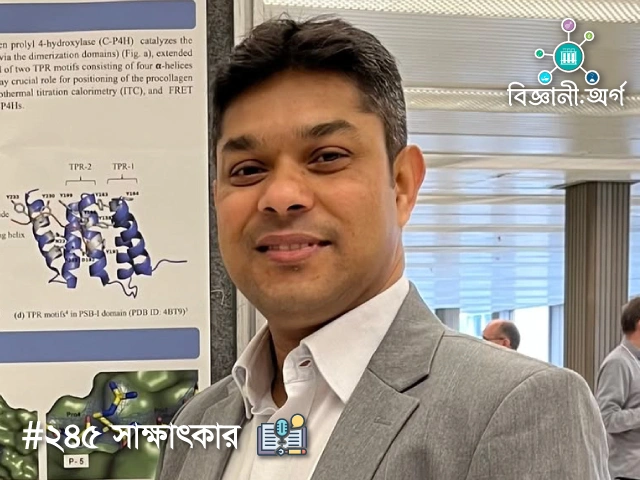
The unraveling of a protein’s three-dimensional structure could become a weapon in the fight against cancer — Dr. Mohammad Mubinur Rahman is conducting tireless research at the University of Oulu, Finland.
For nearly six months of the year, everything in Oulu, Finland remains covered in ice. Yet, in a university laboratory of this cold country, a Bangladeshi scientist is investigating the molecular structure of a protein molecule trapped within crystals — a structure that may one day open new doors in cancer treatment.
Dr. Mohammad Mubinur Rahman. He completed his PhD in Enzyme Structure and Function from the University of Eastern Finland. Afterwards, he did his first postdoc at Aalto University, his second postdoc at the University of Southern Denmark, and currently works as a postdoctoral researcher at the University of Oulu. His research area — structure-based drug discovery, meaning discovering new drugs through the analysis of protein 3D structures. In an online session of Biggani.org, he openly shared the stories of his research, life’s challenges, and guidance for young researchers from Bangladesh.
Collagen, Cancer, and the Story of an Enzyme
Collagen is a very familiar protein in the human body. Its role is essential in skin firmness, bone strength, and blood vessel structure — collagen is involved in nearly everything. But when this beneficial protein becomes excessive, it turns dangerous.
Dr. Mubinur’s research primarily centers around a special enzyme called collagen prolyl 4-hydroxylase (Prolyl 4-hydroxylase). This enzyme performs a critical chemical modification during collagen production: it adds a hydroxyl group to proline, an amino acid in collagen. Only after this chemical transformation can collagen assume its functional, fibrous (fibrillar) structure and remain stable in the body. If the enzyme doesn’t work, collagen falls apart.
The problem begins when this enzyme becomes far more active than usual in cancer cells. In cancer cells, the gene for this enzyme is excessively activated (in genomics, this is called “up-regulated”), leading to the production of much more enzyme than normal. The excessive enzyme in turn produces excessive collagen. And it’s this excess collagen that makes cancer even more serious.
“When too much collagen accumulates, it forms a hard shell around the tumour,” explains Dr. Mubinur. This thick layer of collagen helps cancer cells to proliferate rapidly, turns the tumour solid and consolidated, and facilitates metastasis — that is, spread of cancer to other organs. Most worryingly, this dense collagen barrier blocks chemotherapy drugs from reaching the cancer cells, reducing treatment effectiveness.
What’s the solution, then? The group Dr. Mubinur works with aims to normalize collagen levels by regulating the activity of the prolyl 4-hydroxylase enzyme. For this, an inhibitor is needed — a compound or molecule that can bind to the enzyme and stop or slow its function. Essentially, the main goal of this research is to halt the enzyme’s action and break the chain of cancer progression.
This enzyme has three different forms, or isoforms. All three do the same thing — they convert the amino acid proline to hydroxyproline — but exactly where, when, and how each functions is still not fully clear. Research has shown that the primary substrate of the first two isoforms is collagen, but the substrate for the third isoform remains to be discovered.
Three-Dimensional Protein Structure — Why is it So Important?
To understand how a protein functions, its structure must be known. At the molecular level, knowing precisely where and how each amino acid is arranged comes from the 3D structure of the protein. Without this knowledge, it’s nearly impossible to design effective drugs.
Dr. Mubinur gives a compelling example to explain this concept. “We have five fingers on our hand. To grip something tightly, all five play a role. Missing one reduces strength.” Similarly, in an enzyme’s active site — where the chemical reaction happens — each amino acid has a specific role. Some form hydrogen bonds, some participate in ionic interactions, some maintain a hydrophobic environment. Knowing the 3D structure reveals each amino acid’s role, the nature of the active site, and the chemical features an inhibitor should have to work there.
Without understanding the structure, it’s impossible to refine a drug molecule. Dr. Mubinur’s lab has found an inhibitor that works at the micromolar level so far. But this isn’t enough for therapeutic use — nanomolar potency is needed, which is more than a thousand times stronger. Achieving this requires knowing the three-dimensional structure of the protein-ligand complex — where to add a negative charge, where to place a methyl group, where a positive charge is needed — the answers come only from the 3D structure.
Crystallography: The Timeless Tool of Science
Scientists use three main methods to determine a protein’s three-dimensional structure: X-ray crystallography, NMR spectroscopy, and cryo-electron microscopy. Dr. Mubinur specializes in X-ray crystallography, and is also learning the cryo-EM technique.
The history of crystallography is a remarkable chapter in science. The key evidence for the double-helical structure of DNA — one of biology’s most revolutionary discoveries — came through this technique. Rosalind Franklin was the scientist who first used X-ray crystallography to capture DNA’s diffraction pattern. Watson and Crick modeled DNA based on this data. Unfortunately, due to an early death from ovarian cancer, Rosalind did not receive the Nobel Prize, though she is now widely recognized as the true contributor behind this breakthrough discovery.
In X-ray crystallography, a protein is first purified and crystallized. X-rays are then shone at the crystal, scattering the light in different directions to form a diffraction pattern. This pattern, after several steps, is used to deduce the protein’s three-dimensional structure. For large or membrane-bound proteins, cryo-EM is more suitable — but the equipment is extremely expensive and not readily available everywhere.
Dr. Mubinur’s target enzyme is about 256 kilodaltons in size — a relatively large molecular weight. The team is now trying to resolve its 3D structure using cryo-EM.
Substrate Binding Domain — Where the Key Lies Hidden
The simplest way to block any enzyme is to insert an inhibitor into its active site — where the chemical reaction takes place. But this case is complicated. The human body has other enzymes whose active sites are structurally similar to that of prolyl 4-hydroxylase. Blocking those with an inhibitor would disrupt their functions too, leading to side effects.
The solution lies in a unique part of prolyl 4-hydroxylase — the substrate binding domain or peptide substrate binding domain. Scientists believe collagen first attaches in this region, and only afterwards does the specific amino acid get modified at the active site. Studies have shown that altering this substrate binding domain significantly reduces the enzyme’s activity. This means it could be the ideal drug target — and since other enzymes lack this exact substrate binding domain, the risk of off-target side effects is far less.
The research team has already designed several synthetic ligands that mimic the substrate — called substrate fragments. By co-crystallizing with these ligands, the binding mode has been identified. Screening chemical libraries has yielded some promising compounds, which are now being analyzed via molecular docking — using computer simulations to see if these molecules fit properly into the protein’s active site.
Molecular Docking — Virtual Drug Testing Inside a Computer
Molecular docking is a computational method where a protein and a potential drug molecule are digitally aligned. The computer predicts how the molecule enters the protein’s active site, how tightly it binds, and what interactions occur with which amino acids.
In Dr. Mubinur’s research, docking has shown that the promising inhibitor found in the lab features two aromatic rings, while the protein’s active site contains two hydrophobic pockets — a highly significant match. Docking confirms that the team is on the right track.
But docking results alone are not enough — they must be validated by wet-lab experiments. In Bangladesh, many researchers publish papers based solely on docking, but Dr. Mubinur’s own experience shows that compounds with great docking results sometimes simply won’t dissolve in lab solutions. Eight compounds were sent, he tried to dissolve them, incubated at 37 degrees, but they just settled to the bottom. You can’t test such compounds in cells. So publishing based only on docking is ultimately meaningless. Computational results must be cross-checked with biochemical experiments to be meaningful.
The Long Path of Drug Discovery — A Step-by-Step Journey
Dr. Mubinur clearly states that they are still at the very beginning of drug discovery — but every step is vitally important.
The current stage of research is determining the target protein’s 3D structure and identifying potential inhibitors. Once the structure and effective inhibitors are found, the next phase will move the work to collaborative researchers who will test it in cell culture and animal models (mouse models). There, it will be observed whether the enzyme is truly inhibited in target cancer cells and whether this affects collagen synthesis.
A key challenge is that this enzyme works in the cell’s endoplasmic reticulum— a specific internal compartment. The drug molecule must first cross the outer cell membrane, then reach the ER — each layer is a hurdle. Cell permeability (i.e., whether the compound can enter the cell) is a crucial criterion. If it passes this test, it moves to mouse or animal models. Success there leads toward clinical trials.
“When I was a PhD student in 2012,” recalls Dr. Mubinur, “a computer-aided drug design professor told us that it can take 15–20 years for a drug to reach the market successfully. That made me sad — I thought I’d never see results before retirement.” However, in this age of artificial intelligence (AI), that reality is rapidly changing.
Artificial Intelligence — Accelerating Research
AI is condensing the long journey of drug discovery. Dr. Mubinur welcomes this change.
Previously, a medicinal chemist might design a handful of molecules in a day. Now, with AI tools, it is possible to generate hundreds of thousands of derivatives (analogs) from one template in the same time. With AI tools like V-Tox or DeepCAM, it’s possible to virtually test a compound’s toxicity. Virtual platforms can also analyze a drug’s path through the body, including where it will degrade — degradation path analysis.
The most revolutionary change in structural biology has come through AlphaFold. This AI tool from DeepMind can predict a protein’s 3D structure just from its amino acid sequence, and with up to 98–99% accuracy. Previously, these results took months of gruelling lab work.
Dr. Mubinur uses this tool for protein research. “Many proteins don’t dissolve easily,” he says. “With AlphaFold models, you can see ahead of time which loops or regions may cause problems. Cutting those parts out makes the protein stable. This saves months of lab effort.” AI will advance even further, and its biggest impact will be in drug discovery.
Yet, the need for crystallography isn’t over. While AlphaFold can predict structure, the actual 3D structure of protein-ligand complexes can only be determined in the lab.
Career Paths in the Expansive World of Biotechnology — Which Direction to Take?
Biotechnology is a vast field. Agriculture, medicine, pharmaceuticals, industry — it penetrates every sector. Young students are often confused: which path should they pursue?
Dr. Mubinur’s advice is simple but profound: “Don’t choose a field because it’s popular — choose where you can excel.”
He explains that opportunities differ by time and place. In Nordic countries, agricultural biotechnology has little value — half the year is frozen, fields are scarce. There is far more investment in medical and pharmaceutical biotechnology. In agricultural countries like Bangladesh, agricultural biotechnology is highly relevant. In the US, Canada, or Australia, it’s comparatively easier to build a career in any field than in Europe. So don’t just consider the subject — also factor in which country has more opportunities in which area.
Another crucial question: academic career or industry career? Working in industry requires high-throughput screening, robotics-based methods, and specific technical skills. At university, one may test a thousand compounds per plate — companies do the same for millions, with robots. Therefore, along with theoretical knowledge, practical training and understanding industry needs is essential.
Another key tip from Dr. Mubinur: take practical courses in techniques like LC-MS, mass spectrometry, ITC (isothermal titration calorimetry). Taking the course won’t make you an expert — but seeing how the equipment works makes later troubleshooting and data analysis much easier. These instruments are used in companies, so this familiarity is directly valuable for your career.
GMO and Science Against Misinformation
In Bangladesh, many misconceptions and fears swirl around genetically modified organisms (GMOs). On social media, one often sees posts claiming “GMOs cause cancer”, “They contain heavy metals”, “They destroy our reproductive ability”. Dr. Mubinur is quite clear on this issue.
“Those who say GMOs mean bacteria are being injected just don’t understand what it really is. Germs mean virus, bacteria, fungi — a cellular entity. Genetic engineering is something completely different.”
Genetic engineering means transferring a gene from one source to a plant or animal. A gene responsible for enhanced yield, disease resistance, or a particular trait is identified and inserted into the target plant. There’s no heavy metal, no germs here.
However, it’s true that in some cases, GMOs may cause allergenic reactions, as new proteins are produced, and some people may be sensitive to them. This is why all countries have strict regulatory guidelines for approving GMOs. Companies that develop GM products must clear these safety tests before bringing them to market.
The real problem arises when products approved in another country are imported without proper local testing. That’s the responsibility of authorities. But spreading the idea that GMOs are inherently poisonous without evidence is anti-science.
Dr. Mubinur gives an interesting example — the detergents we use for laundry contain protease and lipase enzymes that remove stains. These enzymes are produced from thermophilic bacteria — microbes that survive in hot springs at 160 degrees Celsius. The gene from those bacteria is used to produce heat-resistant enzymes through recombinant technology — a kind of genetic engineering we use daily without realizing it.
The Research Landscape in Bangladesh — A Frustrating Picture, and a Call to Possibility
What Dr. Mubinur repeatedly faces when attending international conferences abroad is disheartening. Many researchers come from India, some from Pakistan — but almost none from Bangladesh.
The Protein Data Bank (PDB) — where scientists globally deposit their solved protein structures — holds none from Bangladesh. India has many. So does Pakistan. This isn’t just a statistic — it’s a reflection of a country’s research capability.
“Bangladesh doesn’t even have a single diagnostic kit made in-house and marketed,” says Dr. Mubinur. “That’s extremely unfortunate. Microbial infections kill children and the elderly — from diarrhea to sepsis — yet we can’t even make a basic diagnostic kit.” He raises questions about the cancer research institute: Is it only supposed to provide chemotherapy? There must be basic research into cancer, and screening for therapeutics from natural compounds — attention is needed there.
Still, he is not without hope. Taking the example of manufacturing biomaterials from spider silk protein, he points out how injectable gel for joint repair can be made using this protein. Such ideas have even been patented recently in Hong Kong. Biological tape for wound closure can also use this. These are not prohibitively expensive studies; with willpower and institutional support, similar research could be done in Bangladesh.
“Our universities should take initiatives for participating in international conferences and building networks. It’s not enough to just sign ‘collaboration’ agreements with foreign universities — the real work is bringing local researchers onto the global stage.”
From Khulna to Oulu — A Tale of Struggle
Dr. Mubinur’s journey was not smooth. He studied at Khulna University — where there were few modern research facilities at that time. After spending a year and a half working in sales and marketing in Bangladesh, he went to Sweden for his master’s; everything felt new. Faced with advanced topics like bioinformatics and structural biology, he was initially overwhelmed.
At that critical moment, he found support from some South Indian classmates — open-minded and helpful. They showed him there was nothing to fear — read the protocols, work slowly. During a structural analysis training, he struggled to spot differences between two protein structures. A classmate pointed out — this loop shifted, that part changed confirmation. Recognizing these made the fear go away.
He then enrolled in a special course called ‘Research Training in Biology’. Two months of rigorous practical training — from cloning to protein purification, everything. He learned the reasoning behind each step — why use this buffer, why this temperature — everything on his own. He studied tirelessly for those two months.
The result? After two months, he landed a one-month research assistantship, then completed his entire thesis as a paid research assistant. And one Indian friend — whom Dr. Mubinur thought knew much more than him — one day admitted he himself was intimidated by Dr. Mubinur, because his protein experience was greater.
The lesson is simple: make timely investments in yourself, face your fears, and never fall into inferiority by comparing with others.
Study Gaps — Are They Really an Obstacle?
Many Bangladeshi students worry — I have a gap in my studies, will I ever get the chance for higher education abroad? Dr. Mubinur says that while study gaps are an issue, they are not everything.
For master’s admission, a study gap is not a major problem if you spent that time doing relevant work — experience in a pharmaceutical company or lab can offset the gap. The real hurdle comes when seeking a PhD position.
If you don’t secure a PhD position within a year to a year and a half after completing your master’s, your supervisor’s memory fades. Every year brings new batches and new high-performing students. So start reaching out for PhD positions as soon as you’re halfway through your master’s thesis — apply with an appearance certificate as a smart strategy.
The Dream of a Scientist
At the end of the session, what Dr. Mubinur said is not just a scientist’s dream — it’s the wish of a patriot.
“I want to be able to go to an international conference and say — that research is from such-and-such university in Bangladesh. I haven’t had that chance yet. But it should happen.”
There are many talented researchers in Bangladesh — at home and abroad. What’s needed: institutional support, opportunities to participate internationally, and investment in fundamental research. Scientific progress isn’t just about IT parks or garments — it’s about building people who seek the causes of disease, invent drugs, and improve the quality of life.
In his laboratory at the University of Oulu, Dr. Mohammad Mubinur Rahman is doing just that — striving to unravel a protein’s three-dimensional structure and crafting a new weapon against cancer. His journey is not just a scientific quest — it’s a message for every young Bangladeshi researcher: even with limited resources, you cannot stop; you must overcome your fears and push forward, and one day, Bangladesh’s name will shine brightly on the map of global science.
Watch the interview with Dr. Mohammad Mubinur Rahman on YouTube at the link below: 👇👇👇







This comment has been sanitized for the English site.