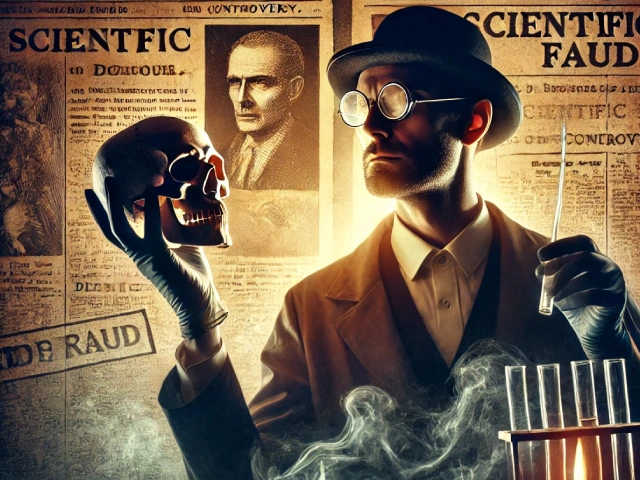
On a summer evening in 1912, everyone was watching in astonishment at a renowned archaeological meeting in London. Scientist Charles Dawson announced that he had made a remarkable discovery—a part of a human skull that was the perfect missing link in human evolution! The members of the assembly were stunned, as this was the “Piltdown Man”—hailed as a groundbreaking discovery in the scientific community.
But decades later, in 1953, modern radiocarbon dating tests revealed that this so-called “primitive human” was actually an elaborate hoax. The skull was from a medieval human, while the jawbone belonged to an orangutan!
A Question: Is Science Always on the Path of Truth?
The main responsibility of a scientist is to seek the truth. But sometimes, due to personal fame, rivalry, or economic advantage, some scientists resort to dishonesty.
Take the example of renowned American physicist Robert Millikan. In the 1910s, he measured the electron’s charge through the oil drop experiment. Although his research laid the foundation of modern physics, it was later discovered that he had omitted some “inconvenient” results from his data to make his conclusion seem consistent. On this, scientist Richard Feynman remarked,
“If you are not honest with yourself, then you are not doing science, you are just fooling yourself.”
Some More Shocking Cases of Scientific Fraud
Hwang Woo-suk’s Stem Cell Fraud (2004)
South Korean scientist Hwang Woo-suk was once regarded as a global leader in stem cell research. He claimed to have achieved human cloning and created artificial stem cells. But in 2006, an investigation revealed that most of his research data was false. He had committed data fabrication, which caused a huge uproar in the scientific community.
John Darsee and His Deceit (1980s)
Medical researcher John Darsee seemed to promise new possibilities in heart disease treatment. But it was later found that most of his research results were fabricated and based on assumptions. Because of his deception, many patients received improper treatments.
Jonathan Piller and Biomedical Fraud (2010)
British researcher Jonathan Piller claimed to have made a groundbreaking discovery in cancer research. But within a few years, it was revealed that a large portion of his research was fabricated. As a result, several of his published papers were retracted, delivering a major blow to the world of science.
Examples of Fraud in the Context of Bangladesh
There are also examples of scientific fraud in Bangladesh. Some researchers have translated foreign research papers and published them under their own names. In 2018, after a group of researchers from Dhaka University published an article in an international scientific journal, allegations arose that it was a direct copy from another research paper. Subsequent investigations confirmed the allegations, leading to the retraction of the publication (Source: The Daily Star, 2018, “Plagiarism scandal at DU: Research paper retracted”).
Global Reactions and Readers’ Comments
Scientist and philosopher Carl Sagan once said,
“Extraordinary claims require extraordinary evidence.”
This remains one of the greatest truths in the world of science.
After learning about the history of scientific scandals, a student from Dhaka, Rafi Islam, said,
“I used to think scientists were always truthful. But by reading this article, I realized that even scientific discoveries need to be scrutinized.”
On the other hand, Professor Dr. Martin Hanson of Columbia University said,
“Science is inherently self-correcting. Over time, mistakes are exposed, and that is what makes science improve.”
Conclusion: Does This Make Science Questionable?
Science is never completely flawless, but its strength lies in its ability to admit mistakes and correct itself. The famous scientist Richard Feynman said,
“Science is a search for truth; it is never complete, but always progressing.”
No matter how many cases of fraud and deception emerge, the light of truth will eventually shine through. Because ultimately, science is a pursuit of truth.
References
- The Daily Star, 2018, “Plagiarism scandal at DU: Research paper retracted”
- Broad, William J. “Betrayers of the Truth: Fraud and Deceit in the Halls of Science.” Simon & Schuster, 1982.
- Nature, 2006, “Stem-cell fraud investigation: How Hwang Woo-suk fooled the world”
- The Guardian, 2010, “Fake cancer research scandal: Jonathan Piller’s case exposed”