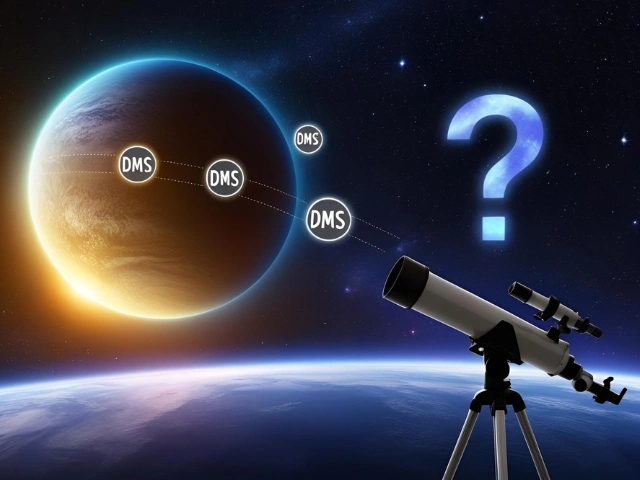
One summer evening, the eyes of the whole astronomy-loving world were on Cambridge University, UK, as Dr. Nikku Madhusudhan announced a groundbreaking revelation: “For the first time in human history, we have detected possible signs of life on a habitable planet.” The news immediately sparked a global sensation—but just how reliable is this information?
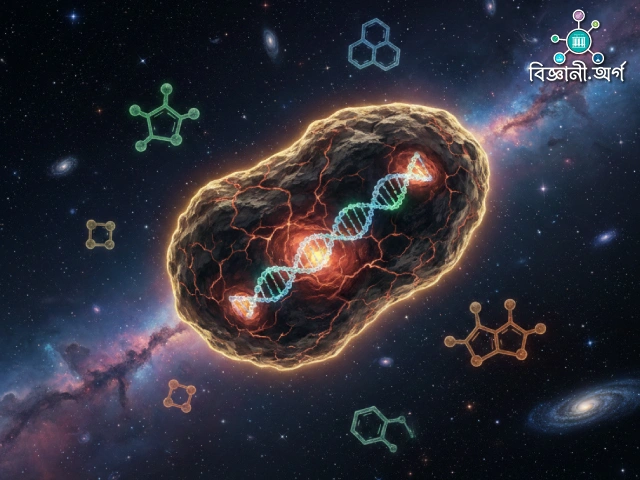
Dr. Madhusudhan and his research team claim that on K2-12b, a planet 124 light years away, previously considered an ocean-rich world, they have detected a biological molecule called Dimethyl Sulfide. On Earth, this molecule is mainly produced by the decay of marine algae and other microorganisms, serving as a strong indicator of life’s presence.
But the question remains—is this really definitive evidence of life?
Dimethyl Sulfide: A Sure Sign of Life or a Cosmic Deception?
While dimethyl sulfide on Earth is a compound released by living organisms, scientists caution that it can also be created through non-biological processes. For example:
- A 2024 study found this molecule in the interstellar medium (the clouds of gas and dust between stars).
- In 2023, a dimethyl sulfide–like molecule was synthesized in the lab using ultraviolet (UV) light.
- This molecule has even been detected in lifeless comets.
These findings make it clear that simply detecting this molecule could be risky to present as evidence of life.
Planet K2-12b: A Possible New Earth?
K2-12b is about five times as massive as Earth and smaller than Neptune. It lies in its star’s “Goldilocks zone”—an area where liquid water could exist. According to Dr. Madhusudhan’s research, the amount of dimethyl sulfide in K2-12b’s atmosphere is a thousand times higher than on Earth. But scientists still consider this a tentative discovery.
Experts’ Opinions: Revolutionary, But Caution Needed
- Astrobiologist Edward Schwieterman from the University of California says, “It’s an exciting possibility, but we still don’t have enough evidence.”
- Researcher Laura Kreidberg from the Max Planck Institute adds, “Extraordinary claims require extraordinary evidence. Until then, we can’t be sure that we’ve truly found life.”
Even NASA has not commented on this research, although previously they issued detailed statements about the presence of methane and carbon on K2-12b.
Statistics and Context
- Currently, over 5,500 exoplanets have been discovered. Only a few among them are considered potentially habitable.
- The James Webb Space Telescope (JWST), launched in 2021, has enabled the analysis of the atmospheres of more than 50 exoplanets so far. K2-12b is considered one of the most promising candidates among them.
Final Words: Proceeding with Caution on the Path of Science
Science progresses through discovery, doubt, and evidence. The possibility of finding life is certainly revolutionary, but reaching a definitive conclusion will require further verification and intensive research.
So the question remains—are we truly no longer alone, or is our telescope just sending us a false signal?