Introduction
Have you ever stood on the rooftop or in an open field late at night, gazing up at the sky? The world around you silent, countless stars glittering above your head, as if thousands of eyes are quietly watching you. In that moment, a peculiar question might arise: have these stars always been right here? Tomorrow, a thousand years from now, or even ten million years later—will they remain in exactly the same place? We usually think of the sky as something constant. Just as mountains stand still, rivers flow, the stars in the sky too seem eternal. But modern science tells us this idea is wrong. The sky is, in fact, a moving story.
A vast, silent realm, yet full of strange realities. And the most astonishing chapter in this cosmic tale is: the universe is expanding. But the question doesn’t end there. Why is it expanding? What—or who—is pushing it? And why is this force so famously called “dark energy”?
What does expansion mean?
First, we need to break a common misconception. When we hear “the universe is expanding,” many people think,
“So, does that mean the Earth is getting bigger?”
No. Not at all. Let’s use a simple example to understand this. Imagine you have a rubber balloon. You use a pen to make several small dots on its surface. Now, slowly start inflating the balloon.
What do you notice?
The dots themselves are not growing in size, but the distance between the dots is increasing—they are moving farther apart from one another. The universe is expanding in just this way. Galaxies, stars, planets—they all remain more or less the same. But the empty spaces between them—that is, space itself—is what’s getting bigger. This expansion isn’t happening from any center. There is no “middle point.” Wherever you stand and look, you’ll see everything moving away from you.
A Bit of History
This discovery didn’t happen overnight. It’s the result of human curiosity, patience, and many sleepless nights spent watching the sky. In the 1920s, an American astronomer named Edwin Hubble was observing distant galaxies. He noticed something strange: almost all their light appeared a bit redder. This phenomenon is called “Redshift.” For example, when an ambulance approaches you, its siren sounds sharp. But as it moves away, the sound becomes lower. The same happens with light—if a star or galaxy is moving away from us, its light shifts toward the red. Hubble saw that almost all galaxies are moving away from us, and the farther a galaxy is, the faster it’s receding. This discovery proved that the universe isn’t static—it is continuously expanding. Hubble’s discovery later became the main foundation for the Big Bang theory. Because if everything is moving apart now, then in the past, everything must have been together at a single point.
The Big Bang
If the universe is expanding today, what happens if we reverse time? Just as a balloon gets smaller as air is let out, if we run time backwards, the universe would become denser and smaller. This idea gave birth to what we call “The Big Bang Theory.” The Big Bang doesn’t refer to a gigantic explosion. It didn’t take place in any specific location. Rather, all of space and time began to expand together.
In the beginning, the universe was extremely hot, dense, and filled with energy. Then, particles formed. Atoms were created. Stars were born. Galaxies took shape. And in a small corner of it all, on a tiny blue planet, a remarkable species called humans came into existence.
How much is the universe expanding?
Logic would suggest that after the Big Bang, the universe started expanding at a tremendous speed. Over time, that expansion should gradually slow down. After all, there is gravity in the universe. Stars, galaxies, everything is pulling on one another. You’d expect that pull to eventually slow down—and maybe even halt—the expansion. But science says something entirely different!
Let’s take a familiar example from daily life. Suppose you throw a ball straight up. At first, it quickly rises. But gradually, its speed decreases—because Earth’s gravity is pulling it downward. Eventually, the ball stops, and then falls back down. For a long time, scientists imagined the universe in exactly this way.
They thought that the Big Bang was like throwing that ball—an initial burst of energy causing expansion, then a gradual slowing down. Maybe one day the expansion would stop completely. Some even believed that, eventually, the universe would start contracting again.
This idea seemed so logical that, for most of the twentieth century, scientists took it as truth and based their research on it. But in the 1990s, an unexpected discovery changed everything.
At that time, scientists were observing certain stellar explosions in distant galaxies, called “Type Ia Supernovae.” In astronomy, these supernovae are very important because their brightness is almost always the same. This lets scientists measure distances and the rate of the universe’s expansion.
Scientists expected that these observations would confirm that the universe’s expansion was slowing down. But the results astonished them. The measurements said that the expansion wasn’t slowing down; instead, it was speeding up over time. Imagine you throw a ball up, and instead of slowing down and stopping, it keeps accelerating upwards by itself—that’s what was happening!
The results were so shocking that many refused to believe them at first. The calculations were checked and rechecked, the instruments tested, and separate teams conducted their own observations—as well as crosschecks. But in the end, the conclusion was clear: the universe isn’t just expanding, it’s expanding at an accelerating rate. There had to be some unknown force behind this strange acceleration. This idea gave birth to a new, mysterious concept called “dark energy.”
Dark Energy: The Unseen Driving Force
The force driving this unexpected acceleration was named “dark energy” by scientists. It’s called “dark” because:
- It does not absorb light
- It does not emit light
- It cannot be directly detected
But its effect is profoundly real.
According to today’s measurements:
| Component | Ordinary Matter | Dark Matter | Dark Energy |
| Percentage | ~5% | ~27% | ~68% |
This means that everything we see, touch, and sense makes up only a tiny part of the universe.
What exactly is dark energy?
The best honest answer is—we don’t know for sure. There are some possibilities, for example:
- Energy of empty space:
Quantum physics suggests that even completely empty space is not truly empty. There might be energy present there. Perhaps this energy is what’s pushing the universe from within.
- Einstein’s Cosmological Constant:
At one point, Einstein added a constant to his equations, but later dismissed it as a “mistake.” Now, it seems that this could be the mathematical form of dark energy.
- Misunderstanding gravity:
Some scientists suggest that perhaps our entire understanding of gravity is incomplete.
Is dark energy dangerous?
The question may sound odd, but it is valid. If this energy grows stronger in the future, what will happen?
- Big Freeze
This is the most probable outcome. Galaxies will drift farther apart, the birth of new stars will cease, and the universe will grow cold and dark.
- Big Rip
An even scarier possibility. The expansion will become so rapid that galaxies, stars, planets—everything—will be torn apart. Someday even atoms themselves will cease to exist.
Final thoughts: Where do we stand?
Today, humanity stands at a point in time when we’ve begun to realize that the universe is not static, but a dynamic, expanding reality. What we see is just a very small part of it. The vast remainder is invisible and mysterious.
Edwin Hubble showed us the universe is expanding. Even Albert Einstein’s old ideas are now taking on new meaning. Yet the truth is, we are still uncertain about dark energy. We know it exists, because we see its effects. But what it really is remains unknown.
Perhaps, in the future, a new discovery will unveil this mystery. Maybe one of us will say, “I know why the universe is expanding this way.”
No matter how vast the universe is, the human drive to question is even greater. And it’s those very questions that will keep leading us into the unknown.
Tahsinur Raiyan,
Ninth Grade Student,
Special Interest in Science and Mathematics.
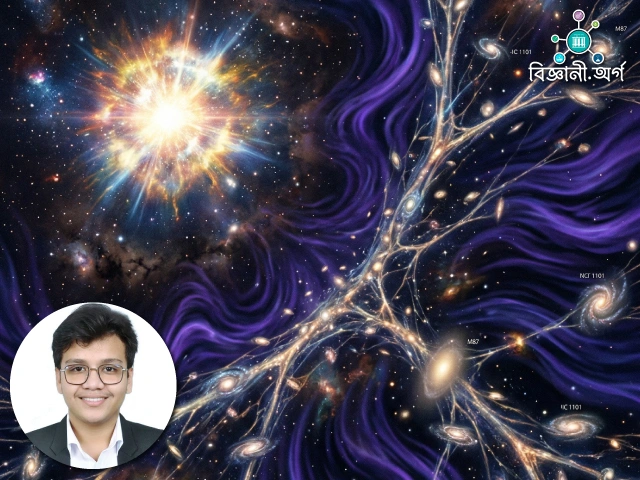
Founder and Director, Raiyan’s Readers’ Corner.