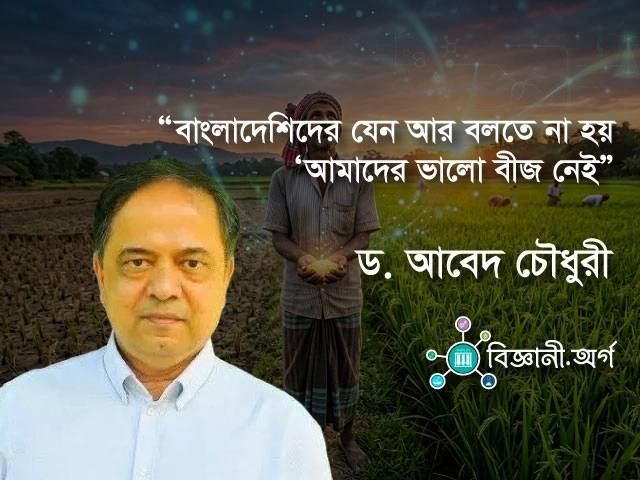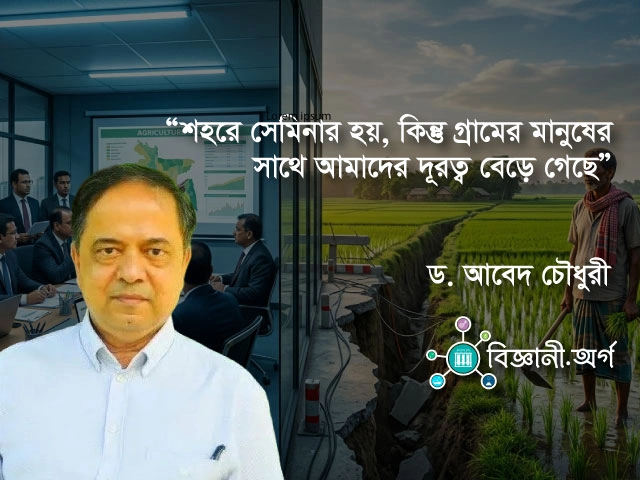
There is no shortage of discussions about agriculture in Bangladesh. Seminars are held in the capital, conferences take place, and policy papers are published. Yet, rapid and visible changes rarely reach the lives of farmers in the fields. Pointing to this reality, plant scientist Dr. Abed Chowdhury says, “There are seminars in the city, but our distance from rural people has increased.” His comment reflects a profound crisis at the heart of national agricultural policy and development practices.
Field Voices Are Absent in Policymaking
According to Dr. Abed Chowdhury, agricultural policymaking often takes place in city conference rooms where the real experiences of rural farmers are not directly reflected. As a result, while the decisions may look impressive on paper, they don’t align with reality when implemented in the field. For example, he notes that although there are policies for distributing seeds, fertilizer, or technology, many farmers do not actually benefit from them in practice.
The problem here is not only administrative; it is also a result of a psychological distance. Urban policymakers often see the village as a “target for development,” but not as a “collaborative partner.” Unless this perspective changes, it will not be possible to implement policy effectively.
Investment Gaps and Lack of Long-Term Planning
Investment in agricultural development is often discussed, but Dr. Abed Chowdhury raises the question of how much of that investment actually goes towards research and innovation. In his view, without sufficient funding for long-term research—such as seed development, increasing crop disease resistance, or adapting to climate change—agriculture cannot progress sustainably.
Too often, development projects are focused on achieving short-term results. This brings superficial changes without solving the fundamental problems, and after a few years, things return to the way they were. In a sector like agriculture, where results take time, real progress is not possible without patience and long-term planning.
It’s Essential to See Farmers as Partners
According to Dr. Abed Chowdhury, farmers should not be viewed merely as beneficiaries—they must be seen as partners in development. Farmers’ experiences and local knowledge can often provide valuable input for policymaking. For example, which varieties of rice grow best in a particular area, or which diseases are most common—farmers are the ones with the most practical knowledge. If this expertise is not incorporated into policy, decisions often become disconnected from the realities on the ground.
Bridging Science and Policy
Dr. Abed Chowdhury believes it is crucial to create an effective connection between scientists and policymakers. If technologies developed in the laboratory cannot reach the field through appropriate policies, the social impact of that research remains limited. Likewise, if policymakers are not updated with scientific information and research findings, their decisions may be ill-prepared to face future challenges.
A Final Word
“There are seminars in the city, but our distance from rural people has increased”—this single sentence clearly highlights the weaknesses in our approach to agricultural development. For agriculture to advance, it is necessary to understand on-the-ground realities alongside paper policies. Unless a bridge is built between the rural and urban, the fundamental crises in agriculture will remain unresolved for years to come.
Read the full interview with Dr. Abed Chowdhury: