The twinkling stars in the night sky are not just elements of beauty—they are also the source of our very existence. But how are stars formed, where do they come from, and how do they end?
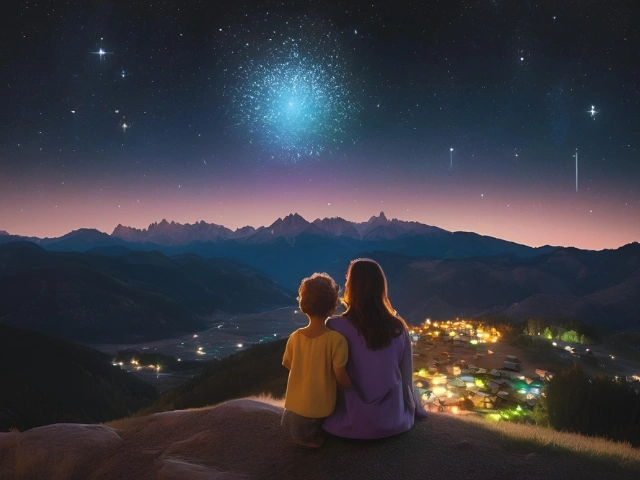
A cold night. After leaving the noise of the city behind, Neela’s family visits a distant mountain village. A small cottage surrounded by greenery, with an open field next to it. After dinner, little Tamim took Neela by the hand and pulled her outside. He said, “Mom, look at the sky—so many stars! Are all of these suns?”
Neela paused for a moment and then replied, “Yes, in a way. But not all of them are suns, some are fake suns…”
It’s not just Tamim—many adults also mistakenly think stars are simply ‘points of light’ or ‘small suns’. But the true nature of stars is far more complex, something scientists have come to understand through centuries of research.
The History of Defining a Star
Ancient civilizations used to foretell the future by observing the stars in the sky. But modern science says that a star is a type of celestial object that generates its own light—through a physical process called nuclear fusion.
American astronomer Dr. Phil Plait writes, “A star is a hot, burning ball of plasma formed by its own gravitational force, within which immense energy is generated by nuclear fusion at the core.”
In this fusion process, hydrogen atoms constantly combine to form helium, releasing heat and light in the process. For example, our Sun burns 620 million tons of hydrogen every second!
“The Sun is continuously emitting energy that lights and warms the entire solar system.” — NASA Solar Dynamics Observatory
Where Do Stars Begin, and Where Do They End?
But are all bright objects stars? Astronomers say no. An object is considered a star only if it undergoes the fusion of single protons of hydrogen within itself. Objects slightly larger than Jupiter which do not meet this threshold are called brown dwarfs—which are capable of limited, short-lived, and incomplete fusion.
NASA scientist Lisa Bentley explains, “A brown dwarf is a kind of ‘failed star’. There is some fusion happening inside, but not as sustained as a true star.”
And what about large stars? They don’t exist forever, either. Some stars end their lives in universe-shaking supernova explosions, resulting in the formation of neutron stars or black holes. Smaller stars like our Sun gradually lose their outer layers and become white dwarfs.
Debates and Realities Among Scientists
The debate over the definition of a star is not yet settled. Just as the International Astronomical Union (IAU) faces controversy over the definition of planets, the question “Why isn’t a brown dwarf considered a star?” keeps arising in the case of stars too.
Yet science teaches us that knowledge is never final—definitions also change with data and research.
Dr. Abdul Mukit, Professor of Physics at the University of Dhaka, says, “Students often ask about the difference between a star and a planet. I tell them, the beauty of science is here—it lets you ask questions, and the answers can change over time.”
Our Sun Among the Stars
In the end, our Sun is also an ordinary star. Its age is about 4.6 billion years, and it is believed that it will shine for another 5 billion years.
But among countless stars, it is a medium-sized one that has given us life and light. So, the stars in the sky are not just mysteries—they are the guardians of our existence.
“A star is not just about light, a star is about life. We are alive here because one star is burning just right.” — Mother Neela
Next time you look up at a star in the sky, remember that its light may have started its journey thousands of years ago—just to tell you that you are a part of a wondrous universe.
Sources:
- Phil Plait, Scientific American
- NASA Solar Dynamics Observatory
- Dr. Lisa Bentley, California Institute of Technology
- Dr. Abdul Mukit, University of Dhaka
Read more:
- The Stories of Neutron Stars and Black Holes
- Planet vs Star: The Boundaries of Definition
- Memorable Supernova Explosions: Cataclysms of the Universe