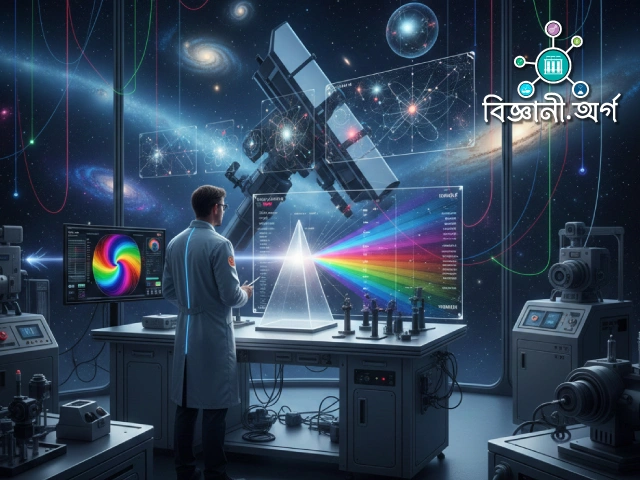
In the history of science, there are certain instruments that are not merely technologies—they are gateways expanding the boundaries of human knowledge. Spectroscopy, known in Bengali as barnalibikshan (spectroscopy in Bengali), is such a tool. At first glance, the name may suggest a device that only has to do with colors or simply works with light. But its real power runs much deeper—it unveils the intricate relationship between light and matter, allowing us to discern what elements are present in an object or gas, how molecules or atoms are structured, and even how far away or how hot they are.
Scientists often describe it as a device for reading the fingerprints of matter. Just as every person’s fingerprint is unique, each element or compound absorbs or emits light in a pattern unique to itself—a specific spectral pattern. Analyzing these patterns is the core task of spectroscopy.
Innovation and History
The journey of spectroscopy began in the early nineteenth century, when scientists split sunlight with a glass prism and saw seven colors, like a rainbow. In 1802, British scientist William Hyde Wollaston noticed some dark lines in the spectrum of sunlight. But in 1814, German scientist Joseph von Fraunhofer took this research further and precisely marked the positions of hundreds of dark lines. These lines are still known today as Fraunhofer lines.
Later, in 1859, Gustav Kirchhoff and Robert Bunsen together showed that these lines actually originate from the elements present in the Sun’s atmosphere. Thus, modern spectroscopy was born—a revolution not only in physics but in chemistry, astronomy, and biology as well.
Scientific Principle: How Spectroscopy Works
The basic principle of spectroscopy is simple, but its implications are profound. When light passes through a substance or is emitted from a heated object, it splits into different wavelengths (or colors). The electrons of different elements and molecules occupy specific energy levels, absorbing or emitting precise amounts of energy.
This energy matches a specific wavelength of light. So, if light is split with a prism or diffraction grating, one will see that some particular wavelengths are missing (absorption spectrum), or some are especially bright (emission spectrum). By analyzing the type and position of these, scientists can determine the chemical composition, temperature, pressure, and even motion of matter.
Applications: Types of Experiments
Today, spectroscopy is used in almost every field of science.
In physics—by analyzing the spectrum of gases, one can determine their structure and temperature. For example, the electronic configuration of hydrogen is determined by analyzing the Balmer series.
In chemistry—by analyzing the spectra of different elements, the chemical composition of unknown substances can be discovered. For instance, in forensic tests, one can detect the presence of toxic metals like lead or arsenic in a sample.
In astronomy—by analyzing the light from distant stars and galaxies, we can learn what elements are present, how fast they are moving, and even determine the rate of expansion of the universe (Hubble’s law). One of the main research methods of the famous Hubble Telescope is spectroscopy.
In biology—the absorption spectra of different biomolecules are analyzed to determine the concentration, structure, or changes in proteins and DNA.
In the semiconductor industry—photoluminescence spectroscopy is widely used to determine the purity and structure of materials.
Ease of Use and Importance
Early spectroscopic instruments were large, complex, and expensive. But with today’s technological advances, compact and affordable devices have been developed which can even be connected to a laptop or smartphone.
Many open-source or low-cost DIY (Do-It-Yourself) spectrometers are available for students to perform basic experiments. For example, a simple spectrometer can be built with a CD disk, some cardboard, and a webcam—sufficient for learning spectral analysis at the school level.
In terms of significance, spectroscopy is a kind of universal language—by using it, scientists can translate the fundamental relationship between matter and light. It opens paths to new discoveries in research and is used in various fields from quality control in industries to environmental monitoring.
Famous Discoveries
Spectroscopy has enabled many groundbreaking discoveries. For instance, in 1868, by analyzing the spectrum of the sun, astronomers Pierre Janssen and Norman Lockyer discovered a new element named helium—which had never before been found on Earth.
Additionally, Edwin Hubble measured the redshift in the spectra of distant galaxies and proved that the universe is expanding. This discovery forms the foundation of modern cosmology.
Relevance for Bangladeshi Researchers
Even though Bangladesh lacks large-scale astrophysics or particle physics labs, spectroscopy instruments—especially UV-Vis, IR, and Raman spectroscopy—are used in many chemistry, biology, and physics labs in universities and research institutes.
Even if access to instruments is limited, there are numerous simulators and virtual labs online where students can practice experiments. For example, PhET Interactive Simulations (University of Colorado) offers interactive spectroscopy simulations for free.
Moreover, by collaborating with international laboratories, Bangladeshi researchers can analyze data obtained from spectroscopy—not only the instruments but data processing skills are equally important.
Conclusion: A Call to Young Researchers
Spectroscopy is not just an instrument—it is a new way of seeing, making the invisible world visible to us. From the most distant stars in the sky to the tiniest molecules in the lab—everything is within its reach. If young scientists in Bangladesh can master this technology, they can not only enhance the quality of their own research but also establish a stronger presence in the global scientific community.
So, check today—does your university or lab have a spectrometer? If not, start exploring simulators online. The key to unlocking the doors of knowledge is in your hands—it’s time to open the door.