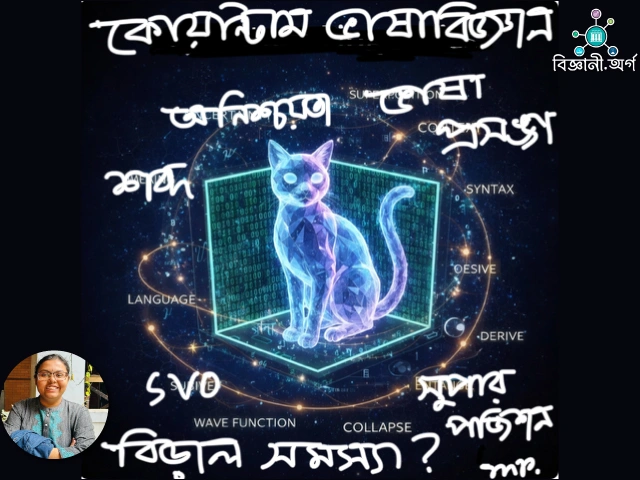
Language is not always simple and straightforward. Just as we don’t always say what we mean in a single phrase, language is filled with layers of possible meanings. Think about it: when you say, “I’m fine,” does that phrase only carry its literal meaning? Not at all; it can convey a host of different emotions—reassurance, pain, sarcasm, or even avoidance. Everything depends on who is listening, the context in which it’s said, and the tone. Think of it this way: just as in quantum physics, you can’t determine the state of a particle until you measure it, in language, meaning, too, exists in a state of “superposition.”
My journey into linguistics didn’t begin with machines, models, or computation. These thoughts started with Mrs. Nayra Khan (Associate Professor, University of Dhaka) in the Department of Linguistics at Dhaka University. Her lectures and writings first introduced me to Natural Language Processing (NLP), not just as a technical field, but as a perspective for thinking about language differently. Language isn’t just something to be analyzed on paper—it can be modeled, tested, and observed. I did small-scale experiments, made mistakes, learned, and tried again. Traditional grammar taught me about structure, structural linguistics revealed the complexity of relationships, and generative grammar hinted at the abstract and perfect structures beneath language. But there were gaps: Chomsky primarily worked in syntax, yet relatively less in phonetics, semantics, or pragmatics. Quantum linguistics fills these gaps; through science, mathematics, and computation, it explains how words carry multiple meanings and how meaning emerges from context.
Remember Schrödinger’s cat? In quantum linguistics, words and sentences are much like that cat. Perhaps the most mysterious animal in science is Schrödinger’s cat. In 1935, Austrian physicist Erwin Schrödinger described a thought experiment where a cat inside a sealed box could be both ‘alive’ and ‘dead’ at the same time. Until you open the box, the cat exists in a mix of both states, or in ‘superposition.’ While this sounds like a fairytale, in the world of subatomic particles—or quantum reality—it’s the ultimate truth. What’s interesting, though, is this complex scientific puzzle isn’t limited to the lab or just equations of physics. The answer is no. As you read these words, the meanings in your mind behave just like Schrödinger’s cat. Thus a new science is born: quantum linguistics.
Is Language a Quantum System?
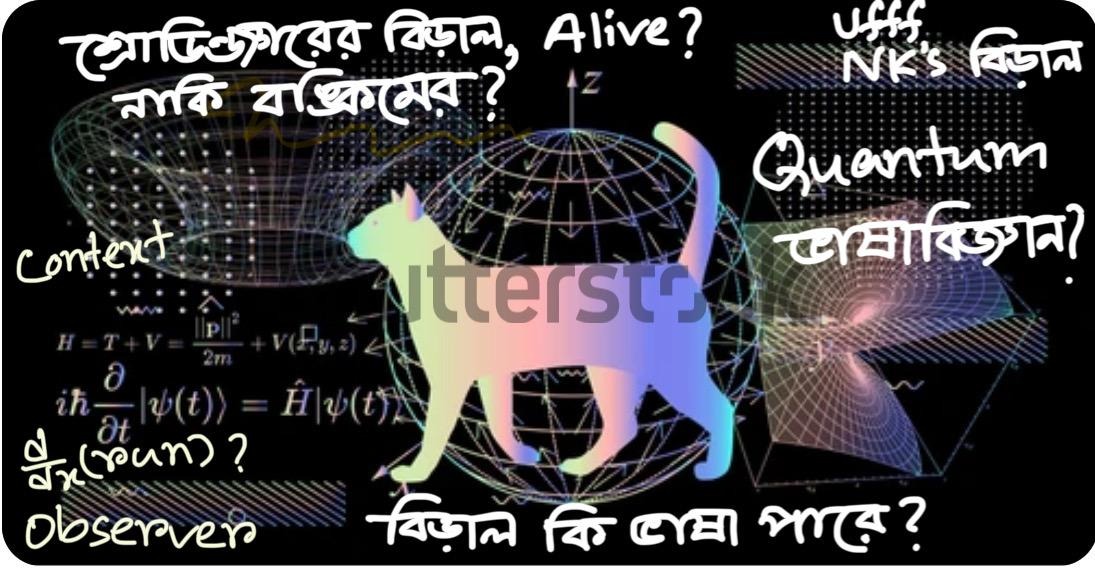
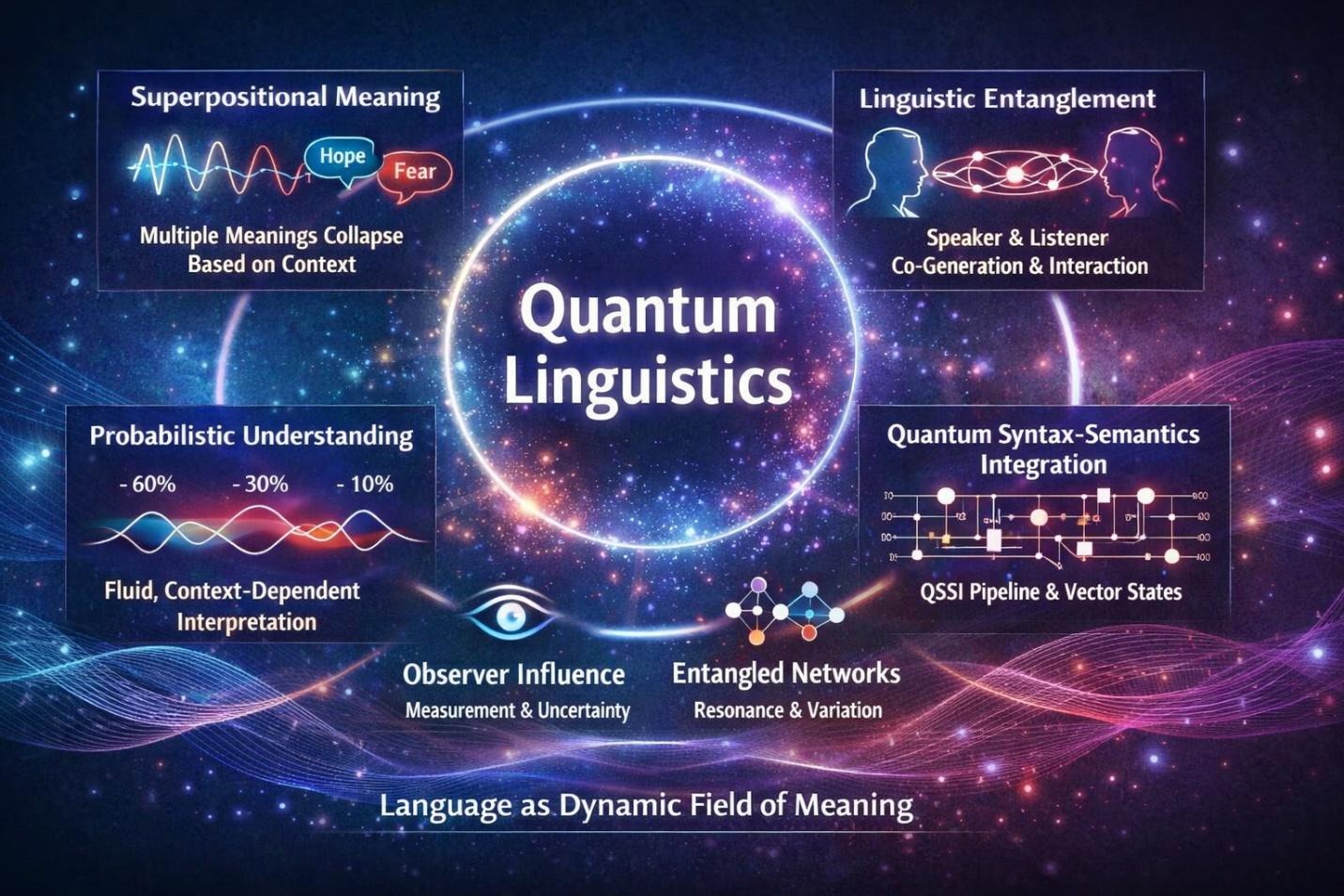
In quantum linguistics, words and sentences behave like quantum particles: they exist in multiple possible states until a conscious observer “measures” them. Take Schrödinger’s cat: alive and dead at the same time, until seen inside the box. In the same way, the meanings of words exist in a web of possibilities. For example, the word run can mean physical movement or managing a company. Both meanings coexist as possibilities, but context causes the meaning to collapse to a single, definite sense.
Sentence structure is not fixed, either. For instance, in Bangla, a sentence can be SVO (“Ami bhat khai” – I eat rice) or OSV (“Bhat ami khai” – Rice, I eat); both exist as potential states, and context determines which form collapses into use. Syntax is intricately linked: a change in the meaning of one word can affect another, just as entangled quantum particles influence each other.
One day I wondered, is language confined only within rules and structures? I think not. Take the example of a black hole—you know, a black hole doesn’t “pull” light in, but it bends space-time around itself so much that light follows the curved paths and can’t escape. Likewise, language and meaning don’t follow a fixed route. When a sentence is spoken, its meaning “collapses” with the context and the listener’s mental state.
The Superposition of Language
Imagine a word like “BAT.” It can mean a mammal or sports equipment at the same time. The word carries multiple meanings with different probabilities. When a listener hears the sentence, their mind collapses one of those possible meanings based on the context. For example, “I’m going to play with the bat”—here, it’s clear bat refers to sporting equipment. But if you say, “A tiger’s bat is running on the street,” the meaning changes.
This idea demonstrates that language depends on the observer. Meaning depends on who is listening and the context in which it’s said. The same sentence can carry different meanings in different contexts.
Syntactic and Semantic Entanglement
Another strange feature of the quantum world is ‘entanglement’ or quantum addiction. If two particles are entangled, changing one immediately alters the other, no matter how far apart they are. Einstein called this ‘spooky action at a distance.’
Does something similar happen in linguistic grammar or syntax? Absolutely. Let’s take an example from Bangla. “She boi porche” (He/She is reading a book) and “Ami boi porchhi” (I am reading a book). As soon as ‘she’ changes to ‘I’, the verb ending ‘porche’ also instantly changes. Here, the subject and verb seem to be invisibly tied together or entangled. A change in one inevitably transforms the other.
In quantum language, words and phrases are entangled with each other. For example, “Nayra hurt herself.” Here, the words Nayra and herself are linked. The positioning and interpretation of one is directly related to the other. This entanglement implies that parts of language are never independent of each other—they are interconnected, and a shift in one part can affect the meaning of another.
This is not limited to syntax; it applies to semantics as well. For instance, the phrase “I’m fine”—its meaning shifts depending on tone, context, and word choice.
The Uncertainty Principle of Language
According to Heisenberg’s Uncertainty Principle, a particle’s position and momentum can never both be precisely known at the same time. Does a similar barrier exist in linguistics? Researchers say yes. There is a kind of uncertainty principle when it comes to word meaning, too. The more precisely you try to define a word’s literal meaning, the more its emotional depth or metaphorical nuance fades away.
Poets, when they write poetry, use this flexibility or uncertainty of meaning. The meaning of a satirical or ironic statement can’t be pinned down exactly using a dictionary, because meaning and emotion interweave and create an uncertainty cloud with each other.
Just as physics has the uncertainty principle, language’s determination of concrete meaning also decreases possibilities and flexibility. If we try to pin down the meaning of a word completely, we lose its subtlety in emotion or context. But if we keep its flexibility, the meaning remains a bit indeterminate.
Think again about black holes. A black hole doesn’t directly pull light in; rather, it bends the surrounding space-time so that light can no longer escape. It’s the same with language. When a word is spoken, its potential meanings move along the contextual curvature. Some understand, some do not, but the waves of possibility remain. Just as once inside a black hole’s event horizon there’s no way for light to escape, in language, possibilities are determined by context. That’s why we don’t just analyze language—we observe it, understand it, and through it, unlock new horizons of possibility.
Just as a black hole teaches us that gravity not only pulls but warps paths, quantum linguistics teaches us that language not only conveys meaning, but shapes it through context, observer perspective, and possibility. Our sentences, words, and meanings are fields of possibility where observation and circumstance bring about new meanings at different times. In this way, we cross the threshold into the new world of language—quantum linguistics. Language is not just a chain of words, but a dynamic universe of possibilities where meaning is born from the collision of context, silence, intention, and interpretation. Traditional linguistics often treats language within fixed structures and defined meanings, but in actual language use, a sentence can carry many meanings at once, with its meaning determined at the moment of the listener’s interpretation. This is where Quantum Linguistics is born and becomes necessary. Quantum linguistics exists to interpret the uncertain, multi-layered, observer-dependent nature of language. For language is not always bound by rules; its true nature is hidden within possibility itself.
Author,
Manisha Rani Biswas
Department of Linguistics, University of Dhaka.
Research Coordinator, Dhaka University Research Parliament.
Email: [email protected]