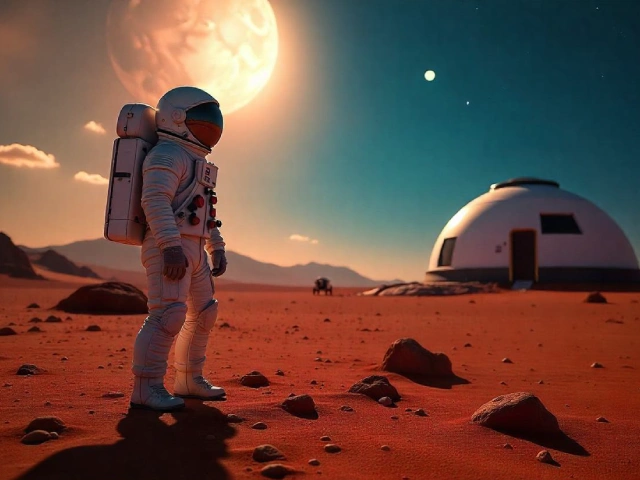
The dream of setting foot on Mars is not new. In the history of space exploration, it has long been considered a symbolic goal. Establishing a settlement on Mars means humanity’s first interplanetary presence—an immense step toward the next phase of our civilization. However, scientists have now issued a new word of caution regarding this dream.
According to new research by a team of international scientists, including those from UCLA and MIT in the United States, humans would be able to stay on Mars safely for a maximum of four years. Staying any longer could result in deadly exposure to cosmic rays.
Unlike Earth, Mars does not have a magnetosphere to protect it from solar and deep space radiation. As a result, long-term stays on Mars could expose human bodies to dangerous levels of radiation.
This research was published in the journal Space Weather, which specifically highlights the critical importance of choosing the right time for a Mars mission. According to the researchers, planning missions during the solar cycle’s maximum phase (solar maximum) is safest. At this time, increased solar particle activity helps shield Mars from galactic cosmic rays.
With current technology, a round trip from Earth to Mars could take less than two years. That’s why scientists believe a successful mission is possible within the four-year safety window. However, this requires developing advanced radiation shields and launching missions at the optimal time.
This research not only offers guidance for space agencies but also conveys an important message for private organizations like SpaceX. Long-term projects such as NASA’s Artemis program or SpaceX’s Mars colonization plans will have to reconsider their strategies in light of these findings. Future missions may need to use artificial magnetospheres, underground bases, or water-based materials for radiation protection.
This research once again proves that, in Mars missions, ensuring a safe environment for the human body will be the biggest challenge—alongside advances in technology and time management. Yet, through these efforts, humanity may one day be able to establish a long-term settlement on Mars.
Learn more:
UCLA Research on Mars Radiation Risk
Do you think we’ll one day be able to build a permanent colony on Mars? Share your thoughts in the comment box below.