News Desk, Biggani Org | [email protected]
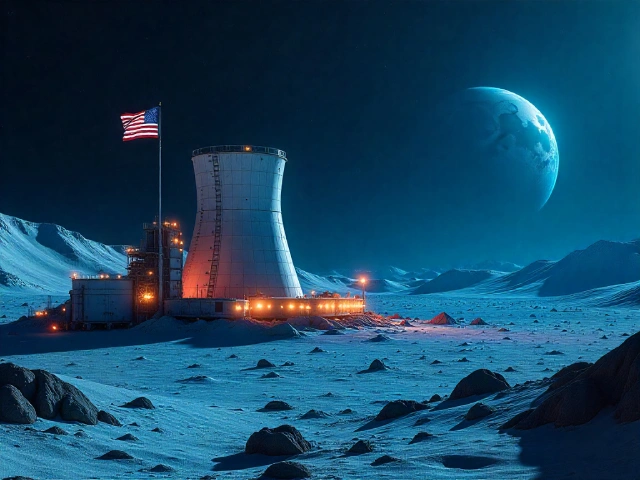
A nuclear power plant on the surface of the Moon—it might sound like something straight out of science fiction, or perhaps a daring prediction of the future. But no, this is no longer confined to the realm of imagination. In July 2025, US space agency NASA has issued a new directive, stating that the project to build a nuclear reactor on the Moon must be prioritized, and preparations should be made to send it there by 2029.
Behind this decision lies as much scientific necessity as there is geopolitical rivalry. Reports suggest that China and Russia are planning a joint project to set up a nuclear-powered base near the Moon’s south pole. This region receives very little sunlight, resulting in permanent shadows—and deep within those shadows lies a precious deposit of water ice. This ice could serve as a source of water and oxygen for future space missions, and even be used to produce rocket fuel. That’s why there’s now a kind of “lunar race”—a silent but intense competition over this region.
NASA’s acting administrator Sean Duffy—formerly a Fox News host and now head of the US Department of Transportation—is leading this project. According to his directive, a nuclear reactor capable of producing at least 100 kilowatts of electricity will be sent to the Moon. By comparison, in 2022, NASA awarded three companies contracts worth $5 million, but their proposed reactors were only capable of 40 kilowatts.
A lunar night lasts almost two weeks, and during that time temperatures drop far below freezing. Relying solely on solar power makes survival during this period extremely difficult. This is why nuclear energy systems have become so important. But the question remains: who will benefit from this reactor? The future of NASA’s Artemis project is still uncertain. Although Artemis III plans to land humans on the Moon in 2027, the SpaceX Starship-based lander continues to face many challenges. Should launches get delayed, the entire project is at risk.
However, it’s not just technology or weather—there are legal challenges to this initiative. According to the 1967 UN Outer Space Treaty, no country or individual can claim ownership of any part of outer space. Yet, the treaty states that anyone who establishes a settlement there first must be shown “due regard” by others. By leveraging this clause, some argue that by installing a nuclear reactor, the United States is essentially trying to create a ‘keep-out zone’—an area that could be off-limits to others.
To many, NASA’s nuclear initiative seems like killing two birds with one stone—on one hand, generating electricity, and on the other, strategic occupation. What’s concerning, however, is that this ambitious plan conflicts with the White House’s anti-science stance. For instance, the proposed 2026 budget includes significant cuts to NASA’s science research activities. There’s even a proposal to completely halt funding for joint NASA and Department of Defense research into nuclear rocket technology.
In addition, there are moves to stop the use of radioisotope power systems in robotic missions where large reactors aren’t necessary—such as for small spacecraft sent to distant planets of the solar system. Yet these are the very technologies that, for many years, have provided the world with invaluable information about new planets and moons.
In this context, NASA’s new nuclear initiative appears to be a kind of political statement. On one side, it’s a response to the China-Russia rivalry, and on the other, a sort of “fait accompli” for future administrations—as if to say, “We’ve already started, now there’s no going back.”
But the scientists themselves are conflicted. What will such a massive reactor actually power? If Artemis III gets postponed, if humans don’t reach the lunar surface, then where will all this electricity go? Or is the real purpose simply a symbolic display of power?
The answers to these questions remain unknown. But one thing is clear—space is no longer just a place for exploration and discovery. It is becoming a new battleground for geopolitical rivalry, where the struggle for power is shrouded in technology. This clash of science and politics makes us wonder: are we truly going into space to learn, or to establish dominance?
A nuclear reactor in the solitude of the Moon will carry not just energy, but also a reflection of human ambition, competition, and displays of power. Whether this move marks a victory of science or the dawn of a new age of geopolitics—only time will tell. But even now, we must carefully consider how we will use science for the welfare of humanity, and where we might end up making it a tool of politics.