Current State of Biodiversity:
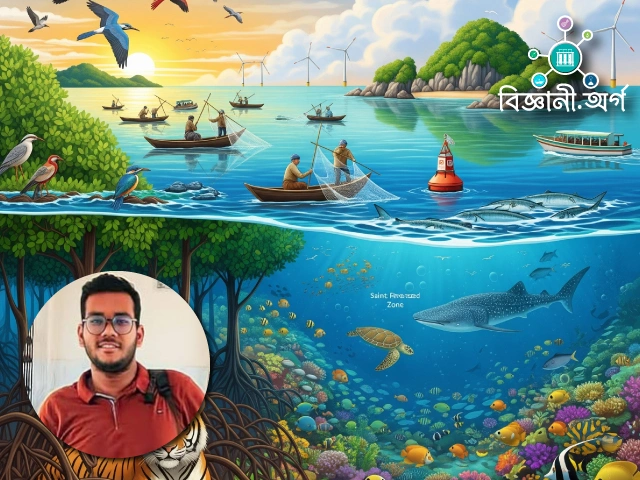
Bangladesh is a country rich in environmental diversity. It comprises five main ecosystems – coastal and marine, freshwater, terrestrial forest, hilly, and agriculture-based (homestead) ecosystems. These ecosystems are home to a vast variety of plant and animal life. For example, within just 147,570 sq km, Bangladesh boasts an estimated 34 species of amphibians, 109 reptiles, 301 resident birds, 176 migratory birds, 120 land mammals, and 3 marine mammal species. The country’s total forest cover has alarmingly decreased and now constitutes only about seven and a half to eight percent of its area. Looking at the marine environment, Bangladesh’s 710 km coastline and 118,813 sq km economic zone harbor nearly 740 marine species. The Sundarbans is the world’s largest mangrove forest, serving as a sanctuary for the Royal Bengal Tiger and many other endangered species. In contrast, Saint Martin’s Island, being the only coral island, has its coral forests under national (and recently marine protected) conservation. Additionally, wetlands such as Hakaluki and Tanguar Haor are preserved as national wetlands, providing habitat for numerous migratory and local birds and fish.
Initiatives for Biodiversity Conservation:
The government has taken diverse initiatives to conserve endangered ecosystems. According to the Forest Policy 1994, a target was set to protect 10% of forests by 2015. The enactment of the Biodiversity Act in 2000 provided a legal framework for biodiversity conservation. Alongside the declaration of national parks and sanctuaries in haor, hilly, and coastal areas, Tanguar Haor has been designated as a Ramsar site, and hunting without permits has been banned in important wetlands like Hakaluki, Hail, and Setapahar. The Department of Environment has already declared 9 areas as Ecologically Critical Areas (ECA), aiding ecosystem protection. Additionally, five Hilsa sanctuaries have been established and, to conserve juvenile Hilsa (jatka), an eight-month ban on their capture per year and a 22-day ban on catching gravid Hilsa has been imposed. The Forest Department is running native tree plantation programs for the conservation of endangered plants. NGOs and international organizations are also playing crucial roles. For example, UNDP has initiated the ‘National Blue Economy Action Plan’ and national dialogues on ‘Blue Bonds’ to empower coastal communities and assist in policymaking. Recently, IUCN Bangladesh published the first national Red List of plants, revealing that seven plant species have become extinct over the past century and five more are critically endangered.
Climate Change and Challenges:
Climate change is severely impacting Bangladesh’s ecosystems. Especially, coastal forests are shrinking due to sea level rise and cyclones; research indicates that since 1964, about 210 sq km of Sundarbans land has eroded into the sea. In 2020, Cyclone Amphan caused more than $14 billion in damages. The Sundarbans’ mangroves, acting as natural disaster barriers, have been weakened by pollution and unscientific cutting due to inadequate funding and manpower. Abnormally warm sea water is causing significant damage to coral species; for instance, between 2018 and 2021, coral bleaching on Saint Martin’s Island reduced coral cover from 1.32 sq km to 0.39 sq km. Rising water temperatures are also affecting marine fish habitats and their reproduction. Climate change and human-induced biodiversity loss due to deforestation and other causes are matters of serious concern for experts.
The Blue Economy: Concept and Relevance-
The blue economy refers to sustainable economic growth, increased employment, and ecosystem conservation through the use of marine and coastal resources. As Bangladesh is located along the Bay of Bengal coast, there is unique potential for implementing this concept. The blue economy concept has been highlighted in the 7th Five Year Plan as a new horizon for the economic development of coastal-rich countries. Increased investments have been proposed in sectors relating to the blue economy in Bangladesh, such as fisheries, marine tourism, renewable energy, and shipbuilding. According to a UNDP report, Bangladesh is pursuing innovative marine crop production, coastal clean-up initiatives, and policy development for blue economic growth.
Marine Resources and Sustainable Development:
Marine resources play a significant role in Bangladesh’s economy. About 15% of the country’s total fish production comes from the sea. In the 2021-22 fiscal year, a total of 4.8 million tons of fish were caught, including 0.7 million tons of marine fish. However, excessive economic harvesting has reduced marine species diversity (in 1971 there were 475 marine fish species, which has now dropped to 394). To prevent further depletion, since 2015, the government has not issued new fishing vessel licenses for industrial fleets and has banned destructive nets like set-bag nets and push nets. In 2000, a 698 sq km marine reserve was declared in the Bay of Bengal, followed by the declaration of a 1,738 sq km MPA in the Swatch of No Ground area in 2014. In 2019, about 3,188 sq km of sea area near Nijhum Dwip and Hatiya was made an MPA. In 2024, 1,743 sq km of waters surrounding Saint Martin’s Island were declared a Marine Protected Area. As part of marine policy, the government (in 2014 and 2016) introduced an eight-month Hilsa fishing ban for gravid Hilsa and a 22-day total Hilsa fishing ban. Renewable energy sources such as wind and nuclear are also gaining importance; for example, in 2023, a 500-megawatt offshore wind project was approved, and a target has been set to produce 5 gigawatts of power from both sea and land wind by 2030.
Policies and Future Directions:
The government is moving forward with strategic policies for blue economy and ecosystem conservation. The national plan now recognizes the blue economy as a source of growth. For example, the 7th Five Year Plan lists 12 initiatives including investment in marine-resource-based industries, renewable energy, research and development, and education. Research suggests that Bangladesh needs to adopt “multidimensional national policies, a national marine strategy, and marine spatial planning” to advance the blue economy. Policy-level actions include recent conservation declarations for marine areas such as Saint Martin’s Island by the Ministry of Environment, and initiatives like Bangladesh Forest Transparency. Internationally, Bangladesh is preparing to take a leadership role at the 2025 UN Ocean Conference, where sustainable ocean-based development will be prioritized.
Conclusion:
Conservation of Bangladesh’s diverse ecosystems and the sustainable use of marine resources require not only a single strategy, but coordinated efforts and long-term planning. To tackle climate change and other challenges, integrated action among all stakeholders—governmental and non-governmental—is essential. If synergy between blue economy initiatives and ecosystem conservation is established, Bangladesh’s ecological and economic goals will be strongly achieved.
Md. Fahad Husain
Student, Department of Zoology
Shaheed Bulbul Government College, Pabna (Affiliated with National University, Bangladesh.)