


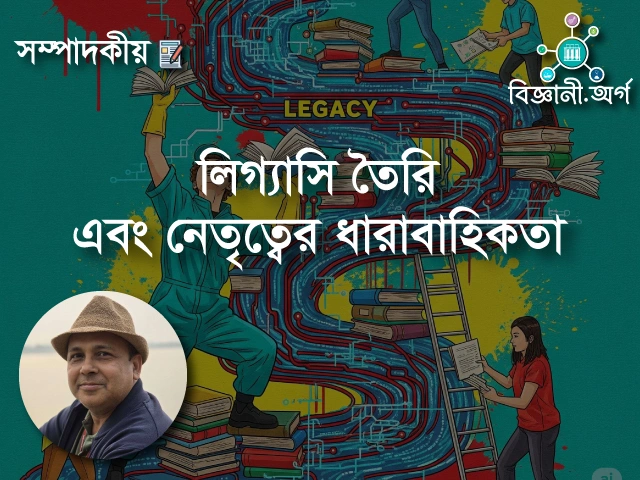
Dr. Mashiur Rahman
In several of my personal projects, I have taken the lead myself, but I haven’t been able to bring in anyone new to continue the leadership. Why this failure? Reflecting on that question led me to write this piece, as a kind of self-examination.
Since the dawn of human civilization, people can generally be divided into two groups. One group was socially connected; they didn’t do things alone, but instead hunted large prey together. Anthropologists have named them Neanderthals (Homo neanderthalensis), considered by many to be our ancestors. On the other hand, there was another group who lived in solitude, physically strong and industrious, hunting alone and planning only for their personal survival. Leadership scholars have referred to them as Homo erectus or Australopithecus. (As a side note, as simply as I’ve put it, there are disagreements among leadership scholars on this classification, which I acknowledge here.)
Anthropologists have observed that, over time, it is only those who were socially connected—essentially the Neanderthals—who managed to survive. If we look at humanity’s history, it became clear that the greater our social connection, the more assured our progress would be.
Why Isn’t There Continuity?
Entrepreneurs or leaders often have to establish their initial concepts alone in the beginning. However, the problem is that these legends become so deeply focused on creating something new that many neglect to prepare the next generation of leaders, resulting in failure to ensure a continuation of what they’ve started. Focusing solely on founding something alone makes it difficult to keep the initiative flowing sustainably.
We have natural limitations, as we cannot live forever. So, to continue the legacy, we must pay attention to how our acquired knowledge and skills can be passed on to the next generation.
In the context of Bangladesh, a survey in 2018 showed that 72% of the youth are interested in undertaking new initiatives and leadership, but only 28% receive effective leadership training. Therefore, ensuring a continuity of leadership is essential, so that there is no future gap in creativity or leadership.
Examples of Leadership:
If we look at history, Socrates fostered a tradition among his students that spread across the globe after his death. Great thinkers such as Plato, Xenophon, Antisthenes, and Aristippus were students of Socrates. In the modern era, this process has become even easier, but it still requires strategy and forward-thinking leadership.
How Can Legends Ensure Continuity?
1. Documentation: It is crucial to write down and publish your own experiences and philosophies. This may involve extensive writing, publishing books, or creating digital content to share with everyone.
2. Build a Community: To spread your ideas, create a community or a group of followers who can distribute your concepts across different segments of society.
3. Leadership Development: Identify one or more suitable individuals to become future leaders, and give them the independence and space to lead, so that they can carry forward the legacy in their own way.
4. Provide Mentorship: An important aspect of creating a legacy is mentorship. Leaders should not focus solely on their own achievements but play an active role in grooming the next generation. Mentorship is critical for ensuring continuity.
5. The Importance of Values and Vision: Legacy is not only about achievements; forming a vision and upholding values for the future is essential. Leaders should clearly communicate their values and future plans so that their followers can proceed in the same direction in the leader’s absence. Leaders should move beyond their personal egos and focus on broad, long-term impact.
6. Leverage Digital Technology: In the modern era, digital platforms are crucial for preserving legacy. Leaders can store their thoughts, plans, and work digitally so the next generation can access and benefit from them.
Personal Experience of Building a Legacy
When I was pursuing my PhD in Japan, I noticed that laboratories were often focused on creating new areas of research. The head researcher or professor would collaborate with junior faculty and students to make new discoveries and contribute to knowledge creation. In the process, they would train new researchers, passing on their skills and methodologies. Even after their death, the junior researchers would continue those projects. As a result, year after year, the same lab would keep working in that particular field, and the research would become ever more refined. The death of a scientist did not stop knowledge acquisition; instead, it continued to flow, establishing the researcher’s legacy.
With this idea in mind, when I began teaching at North South University, I tried to set up a lab next to my office. The goal was to generate new knowledge with students in the field of technology. But I admit that I failed to maintain that continuity. Later, however, I started working on the scientist.org platform and have been trying to establish that ideal virtually. The advantage of virtual work is that I can spread my ideas and concepts much more easily.
I am writing this article not just for readers, but also for myself. The scientist.org platform is not just for me—I must focus on making it long-lasting and capable of being carried forward by generation after generation, and I am working towards that goal. I am now working to build a community and to develop brand ambassadors and new leaders for the platform. If you are interested in working with us, I invite you to contact me. Together, we can go much further.
Finally, my advice to community leaders is: Create opportunities for the next generation to lead in order to sustain your concepts and leadership long-term. To maintain the continuity of the values you have established, don’t confine your skills and experiences to yourself. Instead, create leaders and communities capable of carrying your ideals and initiatives forward to everyone.









This comment has been sanitized for the English site.