Medicine is a discipline where matters of life and death are intertwined. A doctor often must make decisions in a matter of moments—sometimes in less than a second. In this reality, it is impossible to ignore the importance of rote memorization. If a patient’s breathing suddenly ceases, and in that moment the doctor needs to know the oxygen flow rate, the precise dosage of a drug, or which ventilator setting to choose—if the doctor has to look for these details in a book, the patient’s life will be at risk. Therefore, memorized knowledge is the doctor’s instant weapon, without which clinical work is almost impossible.
But here lies the issue: if medical science relies solely on rote learning, its progress will stagnate. The history of medical education shows that every major discovery has come from the courage to question established knowledge. Alexander Fleming would never have brought antibiotics to the world if he had not looked at the mold growing in a petri dish and asked, “Why did these bacteria die?” Ignaz Semmelweis sparked the ideas of germ theory and handwashing by questioning the high maternal mortality rate in Vienna’s hospitals, wondering, “Why do fewer mothers die when midwives deliver babies, but more die when doctors do?” In other words, it’s not only memorization; new ways of thinking have transformed medicine.
Dr. Ronald Harden, a pioneer in medical education and long-time editor of the journal Medical Teacher, said—
“Core knowledge must be instantly available in the doctor’s mind, otherwise patient safety is at risk.”
That is, if a doctor does not retain fundamental knowledge by heart, safe patient care is not possible.
The reason for this is clear. Every day, countless patients arrive, requiring rapid diagnosis and decision-making. At such moments, a doctor does not have time to consult books or the internet. An emergency physician may recite drug dosages for a dozen patients daily—this would not be possible without memorized knowledge present in his or her mind.
However, Harden also warns—
“If education remains stuck in rote recall, innovation dies.”
In other words, memorization is necessary, but if it becomes the sole goal of education, then innovation, research, and discovery will all come to a halt.
An editorial in the British Medical Journal (BMJ) stated—
“The 21st century doctor must be more a problem-solver than a walking encyclopedia.”
The significance of this statement is profound. Having a reservoir of facts is important, but the doctor’s real role is to solve problems.
Professor Richard Schwartzstein from Harvard Medical School said in his lecture—
“Students should not just know what to think, but how to think.”
That is, students should not merely memorize answers, but rather learn to think through problems deeply.
Indian medical educator Dr. Suhas Prabhu (Journal of Postgraduate Medicine, 2019) has shown that South Asian students are often so immersed in memorization that they become confused when handling real patients. Even if they can recite thousands of facts on an exam, many feel lost when a patient presents symptoms in an unusual way.
In the medical colleges of Bangladesh, India, Pakistan, or Nepal, rote memorization remains a dominant factor. From the very start of entrance exams, students dive into a marathon of memorization. Even just a few years ago, a survey at Dhaka Medical College revealed that most students depended on rote learning and lagged in clinical problem-solving skills.
The result of this memorization-centric approach is that, although students do well in exams, they often feel helpless when confronted with atypical symptoms or complex cases. Yet, the true essence of being a doctor lies in handling new or challenging situations—something only possible through free thinking.
In contrast, the medical education systems in America, Europe, and Australia have gradually shifted from rote learning to problem-solving and research-based thinking. In methods such as Problem-Based Learning (PBL), students are given real patient cases, which require not rote memorization, but analysis, discussion, and logical reasoning. This approach better prepares them for the future. The hopeful news is that Bangladesh’s MBBS curriculum has already begun emphasizing Problem-Based Learning (PBL). This change is paving the way to go beyond the limits of rote learning, building students’ analytical and problem-solving abilities.
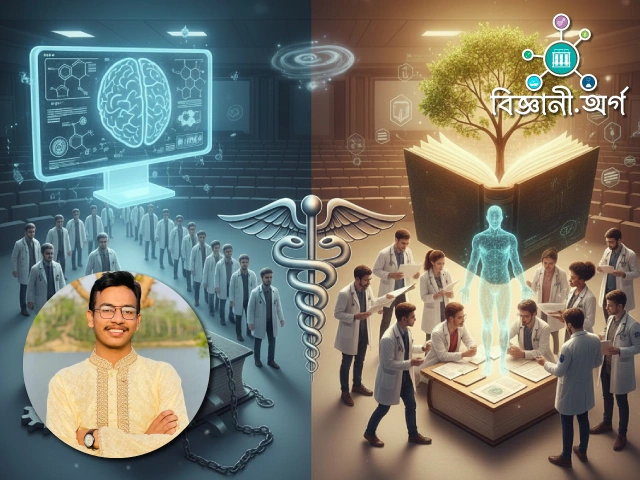
It is impossible to learn medicine without memorization. But that is only the foundation. No matter how strong the foundation is, if walls and a roof are not built upon it, it will never become livable. Those walls and roof are built with free thinking, the courage to question, and a spirit of research.
Therefore, we should not make rote memorization the sole aim in education, but rather use it as a tool for free thinking. Memorization is necessary for exams, but questioning is equally necessary for the progress of medicine.
The core strength of medicine stands on two legs—one is memorized knowledge, the other is intellectual freedom. It is impossible to stand if either leg is weak. Therefore, our education system must be designed so that students not only know what to study, but also learn how to think.
Doctors should not become people who merely memorize drug names, but true problem-solvers, researchers, and servants of humanity. And medical science will move forward only along that path—where the boundaries of memorization exist, but the sky of thought remains open.
Md. Iftekhar Hossain
MBBS 1st Year, Cox’s Bazar Medical College, Bangladesh |
Areas of interest: behavioral science, neuroscience, and habit science.