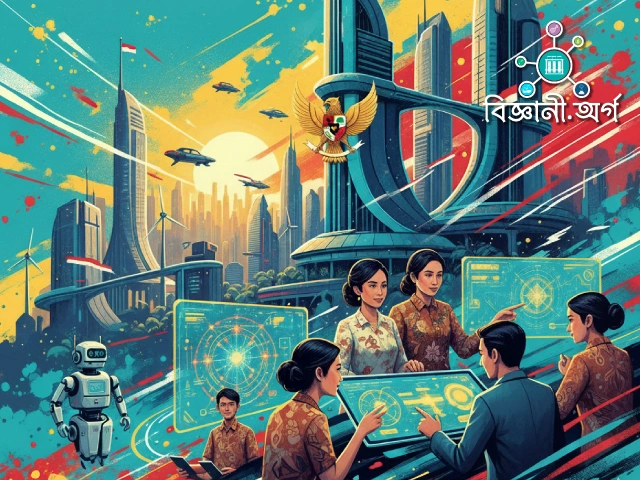
How is the future of a country shaped—by natural resources or by the right strategies and technology? Indonesia believes the answer lies more with technology. The largest country in Southeast Asia has recently unveiled its national artificial intelligence (AI) roadmap, aiming to guide the country towards the so-called “Golden Indonesia” by 2045. Minister of Communication and Digital Affairs, Meutia Hafid, stated clearly that AI is not just technology, but a strategic tool that can change the trajectory of national development, provided there is a proper governance framework and effective planning.
This roadmap is essentially a white paper—outlining policy guidelines, development priorities, and funding structures. The government calls it the foundation of an “inclusive and ethical AI policy.” A 443-member task force was assembled for its creation, involving government officials, researchers, industry representatives, civil society, and even the media. As a result, the document is not limited to technologists; it reflects the perspectives of various segments of society. The white paper has now been released for public consultation, inviting further feedback to ensure that policy reflects reality as closely as possible.
However, Indonesia’s journey with AI didn’t begin today. As early as 2020, the country formulated its first artificial intelligence strategy. But since the end of 2022, the rapid rise of generative AI has left previous plans somewhat outdated. Hence, this new roadmap is considered an updated strategy designed to keep pace with global technological advancement. At its core are three major pillars: developing skilled human resources, fostering research and industrial innovation, and strengthening infrastructure and data.
Looking at human resources, Indonesia aims to produce 100,000 AI-trained personnel each year. Around 30 percent of these will be developers, with 30 percent of them as specialists and 70 percent as practical implementers. The remaining 70 percent will be general users who can apply AI in their own work. Additionally, the government wants at least 20 million people to have basic AI knowledge by 2029. Such an ambitious plan might sound unrealistic to some, but for a populous country like Indonesia, with the right education policy, it’s not impossible.
It’s not just about skills—there’s major emphasis on research and industry as well. The government says research must be advanced, relevant, and beneficial to society. Therefore, universities, research institutions, and industries will be encouraged to collaborate. There will be an “open sandbox” platform, allowing new innovations to be tested in a free environment. This means AI solutions will not only exist on paper, but can be seen in action in sectors like agriculture, healthcare, and transportation.
Infrastructure forms the third pillar of the roadmap. To harness AI, high-capacity computing, GPU/TPU, and reliable data centers are essential. Indonesia plans to build a national cloud infrastructure, including a sovereign data center to securely store data within the country. Alongside this is a green data center initiative, where public-private partnerships will utilize energy-efficient and environmentally friendly technology. The document also emphasizes that technological advancement cannot be sustainable if it comes at the expense of the environment.
The roadmap is also notable for how it sets strategic priorities—agriculture, healthcare, education, economy, administrative reforms, energy, and the environment are all included. Over the next three years, from 2025 to 2027, special focus will be on public services. In healthcare, AI will be used for disease detection, remote patient monitoring, and accurate distribution of medicines and vaccines. Education will feature adaptive learning platforms, with customized content for each student—even exam papers can be graded automatically. Public service will include chatbots and data analysis-based policy support. In transportation, there will be smart traffic systems and improved public transit management.
Of course, the biggest question in implementing all these plans is funding. For this, Indonesia’s government has arranged a phased financing structure, involving government budgets, private sector participation, and international partnerships. The newly established sovereign wealth fund “Danantara” will play a crucial role in this process. It will set up a “Sovereign AI Fund” and create innovative financial instruments. In the initial phase, funding will go towards research, pilot projects, and infrastructure development; later, it will expand to industry, universities, and startups.
This AI roadmap for Indonesia is not merely a technological document, but a guide for future generations. A nation that once broke free from colonial chains now aims to establish its leadership in the digital world. But the question remains—how effective will such a plan be in practice? Will there be enough investment, skills, and political will to reach the targets? Only time will tell.
But one thing is clear—Indonesia has realized that in the 21st century, artificial intelligence is not just about technology; it’s at the heart of economics, society, and national thinking. If the roadmap can be successfully implemented, not only will the dream of “Golden Indonesia 2045” be realized, but Indonesia may also emerge on the world stage as a new technological power in Southeast Asia. Other developing countries, including Bangladesh, can also learn important lessons from this experience—on how to combine planning, policy, and technology to pave the way for the future.