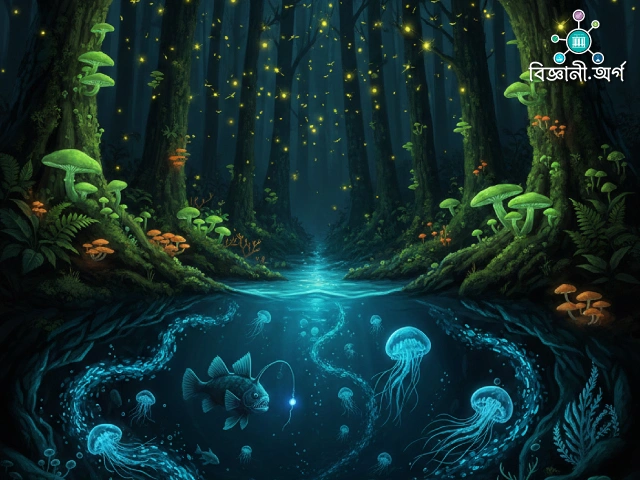
Everything—life, nature, science—continues an endless quest for light. But light doesn’t always mean the sun, lamps, or flames. In the vast darkness of our planet, there are many living beings whose bodies emit their own light. This light isn’t warm like a torch, nor distant like starlight, but it is the silent wonder of living chemistry. This light is called bioluminescence.
In the shadowy depths of the ocean, beneath the forest canopy, or even inside tiny cells beyond our sight, special bioluminescent organisms display this remarkable feature.
Bioluminescence is a type of special chemical reaction that takes place inside living organisms, producing light without generating heat. That’s why it’s called cold light. In nature, we witness countless glowing phenomena, but the soft glow of fireflies, the mesmerizing blue of deep-sea fish, and the wave-like flashes of dinoflagellates are truly wondrous and beautiful.
Usually, two main components work in this light-producing reaction—
1. Luciferin — a type of light-emitting molecule
2. Luciferase — an enzyme that triggers the oxidation of luciferin
When luciferin is oxidized using the energy from ATP (Adenosine Triphosphate), photons are released. This is what we perceive as light.
In bioluminescence, about 90–100% of the energy is transformed into light. That means there’s so little heat produced, this light doesn’t burn or raise temperature.
Luciferin–Luciferase Reaction
There are three main steps in this reaction—
1. Luciferin first binds with luciferase
2. Then oxygen is added, forming an excited-state compound
3. When this molecule returns to the ground state, the visible light we see is produced
Different organisms use different types of luciferin, such as: firefly luciferin, bacterial luciferin, marine luciferin, etc. This diversity in nature greatly enhances the beauty of bioluminescence.
Many organisms possess special light-producing cells called photocytes.
Here, the bond between luciferin and luciferase gives birth to light.
Bioluminescence is not just a chemical reaction—it is also a genetic process.
Some bacteria contain a gene cluster called lux operon, which prepares the luciferase proteins and all the necessary components for light production.
Bioluminescence in Nature
The world’s deep seas are vast, lightless darkness. The highest number of bioluminescent organisms live there. The Anglerfish hunts using a lure in front of its head. The soft body of a jellyfish emits blue light that gives the entire environment a heavenly glow. The light of dinoflagellates ignites nighttime ocean waves like blue fire.
The soft, rhythmic light pulses of the firefly are not just for beauty—they also function as a mating signal.
The bioluminescent glow of mushrooms (known as foxfire) creates a stunning sight in the darkness of the forest.
Several bacteria and single-celled organisms produce light for their own benefit. Marine bacteria Vibrio fischeri is a classic example. Sometimes it illuminates the body of a squid, and sometimes forms a symbiotic relationship to help with navigation.
Many deep-sea creatures use counter-illumination. They emit light from the underside of their bodies that mimics the faint glow from above, making it nearly impossible for predators to spot them.
The light on the anglerfish’s head acts as a bait to attract prey. Jellyfish create dazzling flashes of light to lure small animals. The light of the firefly is a type of code—each species has its own rhythm. Some bacteria use quorum sensing, using their glow as a message. Meanwhile, some animals suddenly emit intense bursts of light to confuse predators and escape.
Bioluminescence in Science
Green Fluorescent Protein (GFP) and luciferase are used as biological markers.
Tracking where genes are active or how cells are changing—these are now vital parts of modern research.
With luciferase-based assays, viruses, bacteria, tumor cells, or metabolic disorders can be detected. This technology is highly popular because of its quick results and high sensitivity.
Bacteria engineered to detect pollution have been developed—if heavy metals, toxins, or contamination is present, they light up.
It’s like an SOS signal for the environment. Bioluminescent biosensors are now used everywhere from space research to hospital labs.
Fluorescence is the ability to absorb external light and re-emit it in a different color.
On the other hand, bioluminescence is the result of chemical reactions inside cells—no external light is needed here.
By inserting bioluminescent genes into plants, it is possible to create light-emitting plants, which in the future could serve as alternatives to street light poles.
In marine research and underwater robotics, bioluminescent signals are used to improve navigation systems. In the future, glow-based real-time monitoring could be used for cancer tracking, drug delivery, and even gene therapy.
Final Thoughts
Bioluminescence is not just light—it is the combined language of life, chemistry, evolution, and the aesthetics of nature. The sight of light sparking in the earth’s deepest darkness—a view we may never see with our own eyes—is brought before our understanding by science.
This light is not fire, yet it gives warmth. It keeps our curiosity alive. It brings the silent wonders of nature before us.
Tahsinur Rayyan,
Eighth grade student,
With a special interest in science and mathematics.
Founder and Director, Rayyan’s Readers Corner.