


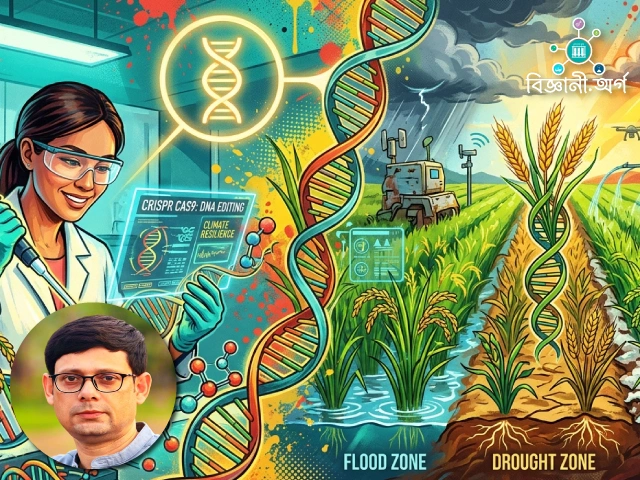
A pressing question stands before global agriculture today—
Will we be able to ensure food security in the future?
As the population continues to grow, climate change is constantly posing new challenges to agriculture—drought, salinity, floods, tidal surges, new diseases, and pests are making food production increasingly uncertain. At this crossroads, science has introduced a groundbreaking technology—CRISPR-Cas9, known as the “molecular scissors,” because it can enter the blueprint of life, DNA, and make precise changes at targeted spots.
This technology can introduce specific changes inside genes to create crops that can survive in adverse conditions. That’s why the question is now so important—Can CRISPR-Cas9 change the future of our food security?
1. What is CRISPR-Cas9?
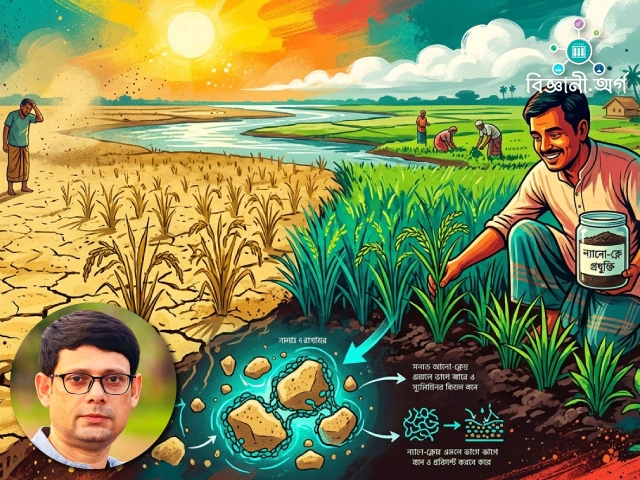
Simply put, CRISPR-Cas9 is a gene-editing technology that allows targeted modifications to specific segments of an organism’s DNA (Figure-1). Think of it much like correcting a mistake in a document on your computer.
Imagine there’s a mistake in a large piece of writing. First, you find the error, then you erase it, and if needed, you replace it with the correct part. CRISPR-Cas9 does nearly the same with DNA. If there’s something in a plant’s genetic instructions that makes it vulnerable to drought, salinity, or disease, scientists can attempt to make targeted changes at that specific location.
2. How does it work?
This technology has two main components.
- The first is guide RNA (gRNA). This works much like a GPS, pinpointing the exact location in the vast expanse of DNA that needs to be altered.
- The second is the Cas9 enzyme. It goes to the targeted site and precisely cuts the DNA. The cell then uses its natural repair process to join the ends back together. It is during this repair that the desired genetic change can be introduced.
Although it may sound complex, the core idea is simple: target a specific area, cut it, and alter the genetic outcome.
3. Why is this important for food security?
Food security is not just about filling stomachs; it involves the availability of sufficient, safe, nutritious, and affordable food. CRISPR-Cas9 can play a role in all four dimensions.
- Firstly, it can help increase nutritional value. Research is ongoing worldwide to enhance the levels of vitamins, minerals, or antioxidants in crops. In the future, rice, wheat, and vegetables could be developed that offer not only higher yields but also improved nutrition.
- Secondly, it can help reduce post-harvest losses. It’s possible to develop fruits or vegetables that do not spoil quickly, do not turn brown easily, or can be stored for longer. In Bangladesh, where a large portion of produce is wasted after harvest, this is a significant advantage.
- Thirdly, CRISPR can help develop disease-resistant crops. By strengthening the natural defense systems of plants, reliance on chemical pesticides can be reduced.
4. The potential in climate-resilient agriculture
Bangladesh is one of the countries most affected by climate change. Salinity is increasing in coastal regions, droughts strike the north, and flash floods frequently disrupt farming in the haor wetlands. In this reality, crops that can withstand adverse environments are essential.
This is where CRISPR-Cas9 holds huge potential. Researchers are working to identify genes that control traits like salt tolerance, drought resistance, disease resistance, or the ability to maintain yield under both biotic and abiotic stress. By targeted edits to these genes, it may be possible to develop new desirable traits much faster.
Traditional breeding methods typically take a long time (around 10–12 years) to develop a new variety. Gene-editing technologies can shorten this timeline (to 2–3 years) and make research more targeted. Even though the journey from research to field deployment is not yet easy, the potential is undoubted.
5. Is this GMO (Genetically Modified Food)?
This is where most confusion among the public arises. Many think CRISPR automatically means GMO. But it’s not that straightforward.
Traditional GMOs often involve inserting genes from another organism into a crop. In contrast, many applications of CRISPR involve making small, targeted edits to a plant’s own genes without introducing foreign DNA. That is why many scientists believe that some forms of CRISPR-based edits shouldn’t be considered equivalent to traditional GMOs.
However, it’s also important to remember that evaluation must depend on the technology’s nature, its intended use, and the regulatory framework. Science offers possibilities, but sound policies and risk assessment are just as crucial.
6. Why is this important for Bangladesh?
Rice in Bangladesh is not just a crop—it is the backbone of food security. Alongside it are wheat, maize, lentils, oilseeds, vegetables, and cash crops. To sustain agriculture amid climate change, we need not just higher production but stable production.
In this context, CRISPR-Cas9 may play several major roles in the future:
- Developing salt-tolerant rice varieties for saline regions,
- Creating drought-tolerant varieties for drought-prone areas,
- Development of disease-resistant crops,
- Developing nutrient-rich varieties,
- Ensuring more sustainable production by reducing the use of agricultural inputs.
If research infrastructure, skilled personnel, policy transparency, and public awareness advance together in Bangladesh, this technology could open up new horizons for innovation in agriculture.
7. What are the challenges?
The greater the potential, the more tangible the challenges.
- The first challenge is research capacity. Gene-editing requires advanced laboratories, precise testing, biosafety protocols, and long-term investments in research.
- The second challenge is policy framework. Clear guidelines are needed on how to evaluate crops, test for safety, and approve for field release.
- Thirdly, there’s societal acceptance. Words like gene, biotechnology, and GMO often evoke fear among the public. That’s why clear, accessible science communication is essential.
- Fourth, there are issues of equity and fairness. Benefits of the technology should not be confined to large companies or a limited group, but must also reach smallholder and marginal farmers.
8. What should Bangladesh do?
To harness the potential of technologies like CRISPR-Cas9 in Bangladesh, several aspects require special attention:
- First, clear and science-based regulations on plant gene editing are needed.
- Second, collaboration among national research institutes, universities, and international partners should be strengthened.
- Third, public awareness and science-based communication must be strengthened so that people receive information-based understanding instead of confusion.
- Fourth, smallholder farmers’ interests should be central in the application of the technology.
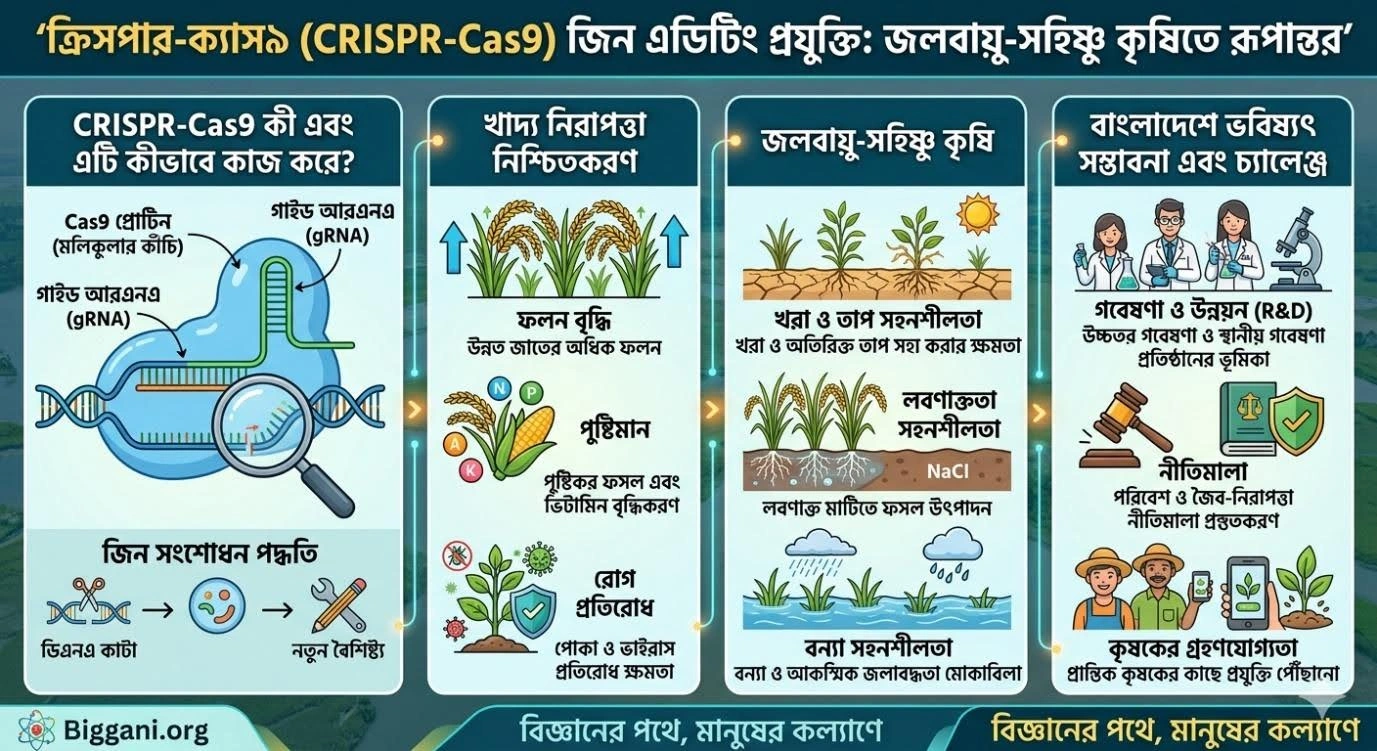
Figure-1: CRISPR-Cas9—A conceptual illustration of climate-resilient agriculture and food security through gene editing
9. Conclusion
The question at the outset—Will we be able to ensure food security in the future?—still does not have a definitive answer, but CRISPR-Cas9 has opened the door to possibilities.
This is no magic wand, but it is a technology that can advance agriculture more quickly, precisely, and purposefully. For countries like Bangladesh, where climate change, nutritional deficiency, and food production are deeply intertwined, this could be a powerful scientific tool.
Still, the future doesn’t depend on technology alone.
Visionary policy, strong research infrastructure, and most crucially—public trust are needed.
If these three pillars can be built together, perhaps very soon we ourselves will write the answer to that question—
The future of food security is being built not just in imagination, but in reality.
Author:
Dr. Ripon Sikder,
Deputy Program Director (Seeds), Partner Project, BADC, Dhaka






Impressive! though I’d appreciate a brief clarification on how precise, targeted modifications are made within a plant’s own genome without introducing external genes.
Thank you very much for your opinion.