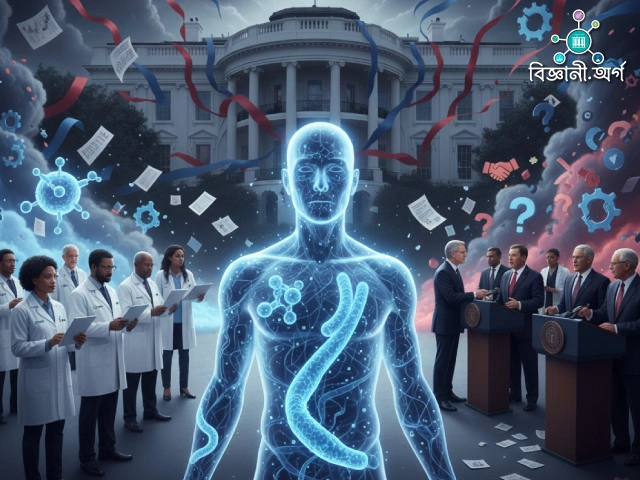
Even now, I get chills remembering five years ago. In August 2020, the COVID-19 pandemic had brought the entire world to a standstill. Schools closed, national lockdowns, fear everywhere—and in that single year alone, according to the World Health Organization, nearly 3 million people died. In the midst of this paralysis, the vaccine arrived. The first mRNA vaccine, approved for emergency use in December 2020, was quickly administered to millions. By the end of January, over 100 million doses had already been given in the United States alone. Billions worldwide have received the vaccine. Scientists say that as a result, hundreds of thousands of lives have been saved.
The United States government played a major role in this success. Under the “Operation Warp Speed” initiative, $18 billion was spent to rapidly develop this technology. Yet today, that very same government is gradually turning away from mRNA vaccines. Funding is being reduced, research collaborations are being cut, and even top officials at health agencies are expressing doubts about the vaccine’s effectiveness. The current Director of the National Institutes of Health has even hinted that public distrust is a key reason behind this decision.
So what is really happening? What does the science say?
mRNA is a type of molecule that helps cells make proteins from DNA. Vaccines use this same process—except here, genetic instructions are given specifically to produce certain proteins from a virus. The presence of these proteins prepares our immune system to fight the real virus. Research on mRNA-based vaccines had been going on for years, but the pandemic accelerated its implementation tremendously. After the virus’s genetic code was published in January 2020, a vaccine reached the public in just one year—whereas it usually takes about ten years for a drug to reach the market.
Early trials showed that the Pfizer-BioNTech vaccine was about 95% effective in providing protection. While no vaccine is 100% effective, in a deadly pandemic this level of success was groundbreaking. However, objections to the technology arose from the very beginning. The well-known American anti-vaccine activist, Robert F. Kennedy Jr., repeatedly raised questions about the vaccine’s safety and efficacy. He is now the head of the U.S. Department of Health. Under his leadership, nearly $500 million in mRNA research funding has recently been canceled. Kennedy argues: “The data shows these vaccines are not effective at preventing respiratory infections like COVID or flu.”
But the evidence suggests otherwise. During the COVID pandemic, these vaccines saved millions of lives. Scientists are trying to develop mRNA-based vaccines for many other diseases, including the flu. Conventional flu vaccines are made by cultivating viruses in chicken eggs, a time-consuming and prediction-dependent process—which doesn’t always guarantee effectiveness. In contrast, mRNA vaccines can be produced quickly and adapted rapidly to target specific viral variants. Research is even underway to create a universal flu vaccine.
There is of course debate over safety. Many people experienced short-term fever, fatigue, or flu-like symptoms after vaccination. In rare cases, neurological or cardiac complications have been observed. Analysis shows that the risk of myocarditis increases somewhat in young men after vaccination. But it’s important to note—this risk is even higher if someone gets COVID. So, although there are risks, they are limited and negligible compared to the benefits of vaccination.
Still, it is surprising that the U.S. government is turning away from this technology entirely. Policymakers claim that lack of public trust is the main reason for this decision. Ironically, some of those now expressing these concerns were once vocal critics of mandatory COVID policies and vaccine requirements. On the one hand, public trust has waned; on the other, political influence seems to be outweighing scientific evidence in policy making.
Curiously, the U.S. government is not shutting down all vaccine research, only scaling back mRNA-based programs. A significant portion of funding is being redirected toward older technologies—those that use inactivated viruses. Many researchers have labeled this decision as “disappointing” and “harmful for the future.” At the same time, there is still support for new mRNA-based therapies in cancer treatment, though these are now being referred to by names other than “vaccine.”
Through all of this, the question remains—is this a political diversion from scientific progress? It is not easy to suddenly declare a technology that saved millions of lives ineffective or unsafe. Instead, rebuilding public trust, disseminating accurate information, and investing in long-term research should be the main priorities. Science teaches us that no new technology is ever perfect—but innovation is the key to progress.
We must not forget: it was the mRNA vaccine that proved how rapid scientific innovation can protect humanity in a global health crisis. If research stops now for political reasons, in the future we may have fewer effective tools to combat even more severe pandemics. If we allow fear or distrust to halt scientific progress, all of humanity will pay the price. So today’s question is—Is America really retreating from the path of science, or is it falling into a trap of political complexity that the whole world may one day have to pay for?