Guest Writer:
Professor Dr. Moha: Yamin Hossain
University of Rajshahi
The development of a country does not rely solely on natural resources, grand infrastructures, or economic statistics. The true strength of a nation lies in its people. If the people are educated, skilled, creative, and ethical, that nation will progress rapidly. But a nation that neglects education and does not prioritize human resource development finds its future gradually becoming uncertain. Both history and reality confirm this truth.
The Importance of Education and Human Resource Development:
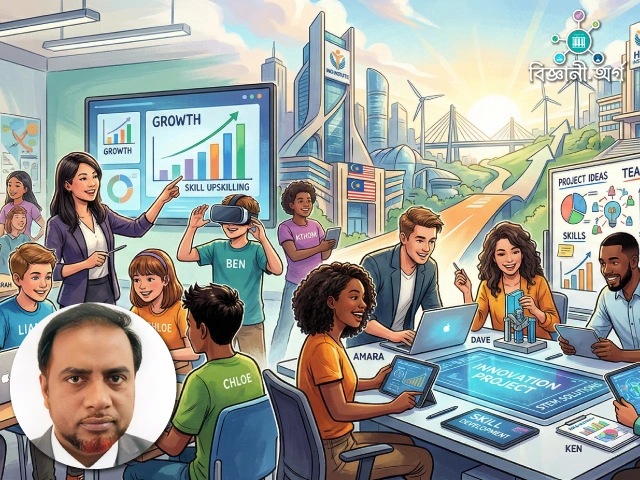
Education is the main driving force behind a nation’s development. Education not only imparts knowledge but also fosters critical thinking, problem-solving abilities, and creativity. An educated population has the capacity to innovate new technologies, establish industries, and guide society along the path of advancement.
Human resource development refers to enhancing people’s skills, knowledge, health, morality, and productivity. If a state invests in the education, training, and skill development of its people, those individuals strengthen the nation’s economy, industry, science, and administration.
The Consequences of Neglecting Education:
In societies where education is not valued, ignorance, poverty, and social inequality increase. Lack of education narrows people’s thinking and leads to the proliferation of superstition and crime in society.
Moreover, without education, a country’s workforce cannot become skilled. As a result, that country falls behind in international competition. Progress in industry, technology, and research also becomes slow.
Examples from Developed Countries:
Many developed nations have made education and human resource development the foundation of their progress. For example, Japan rose from the ashes of World War II and, through investment in education and technology, became one of the world’s leading economies.
Similarly, South Korea transformed itself in just a few decades from a poor country to a developed industrial nation by emphasizing education, technology, and the creation of a skilled workforce.
These countries realized that intelligence and skills of people are far greater assets than natural resources.
The Context of Bangladesh:
Bangladesh is a country full of potential. It has a vast young population, which could become a major strength for the country if properly utilized. However, if the education system remains limited to merely producing degrees and does not focus on skill development, this potential cannot be fully harnessed.
There is a need to place greater emphasis on research, technical education, vocational training, and skill development in Bangladesh. Education must be made practical so that students are prepared not just to pass exams, but to solve real-life problems.
What Needs to Be Done:
Several crucial steps must be taken to secure the future of a nation—
1. Increasing adequate investment in education.
2. Emphasizing technical and skill-based education.
3. Creating an environment for research and innovation.
4. Integrating education with ethics and human values.
5. Creating opportunities for youth employment and entrepreneurship.
Conclusion:
A nation’s future depends on how much it values its people. No country can sustain long-term progress if it neglects education and human resource development. Therefore, to build a prosperous and stable future, education and human resource development must be given the highest priority.
After all, the greatest asset of a country is not its minerals, rivers, or structures—the greatest asset is its educated, skilled, and honest people.
Note: Sourced from Facebook: https://www.facebook.com/share/p/18NX8vKDN5/