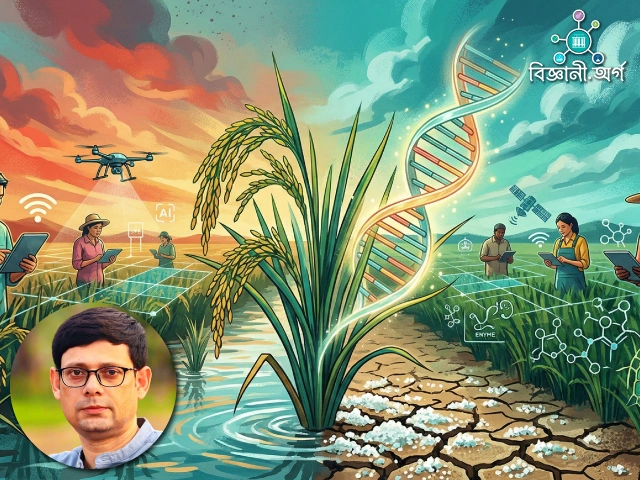
1. Introduction: Why is Immediate Caution Necessary?
Food security and climate change—these two crises are now stark global realities. According to the World Food Organization (2022), the global population may reach nearly 9 billion by 2050, and food demand could rise by up to 85%. At the same time, increases in global average temperatures could significantly reduce the production of major crops like rice, wheat, maize, and soybeans.
Bangladesh, known as a low-lying delta, is among the most vulnerable countries to climate change. Coastal salinity, sudden floods, droughts, cyclones, and irregular rainfall all make agricultural production systems increasingly uncertain.
Therefore, food security is no longer just about production—it is a question of stability and adaptation.
2. Food Security: An Integrated Scientific Framework
Food security goes beyond just food production. It stands on four pillars, namely—
- Availability—Adequate food production
- Access—Affordability and market access
- Utilization—Nutritional value and health
- Stability—Long-term consistency
Climate change is affecting all four pillars: crop yields decrease, food prices rise, diversity of nutritious foods declines, and production becomes uncertain. Thus, the crisis is multifaceted.
3. Biological and Physical Impacts of Climate Change: What Happens Inside Crops?
Although the sources of temperature increase, drought, and salinity are different, inside the plant, they ultimately cause similar types of biochemical and physiological instabilities. Rising temperatures first impact the stability of proteins and membranes; the activity of Rubisco and other enzymes decreases, the integrity of thylakoid membranes is disrupted, and pollen viability drops during reproduction. This leads to reduced carbon fixation and impaired energy production. In drought, the crisis begins with lack of water—stomata close, reducing CO₂ intake, creating imbalances in the photosynthetic electron transport chain, and increasing ROS (Reactive Oxygen Species) production, which damages lipids, proteins, and DNA. In salinity stress, ionic toxicity and osmotic pressure occur first; disruption of Na⁺/K⁺ balance impairs enzyme functioning, reduces water uptake by cells, and damages chloroplast pigments. In all three cases, a common pattern emerges: reduced carbon metabolism, energy crises, increased oxidative stress, and ultimately reproductive failure and yield loss. In other words, although environmental stresses differ, the crisis core within the plant lies in the collapse of metabolic balance and energy instability; hence, integrated adaptation strategies are necessary.
4. Climate-Resilient Agriculture: Modern Scientific Solutions
4.1 Genomic Breeding and Climate-Resilient Varieties
Genomic breeding is an advanced method where comprehensive genome-level marker analysis, DNA sequencing, bioinformatics, and statistical predictive models are used for rapid selection of desired traits.
While conventional breeding may take 8-12 years, genomic methods can significantly shorten this timeline.
Modern agricultural science now employs—
- QTL mapping
- Marker-assisted selection—identifying specific genes or Quantitative Trait Loci
- Genomic selection—effective for complex traits like yield, drought tolerance, and heat tolerance
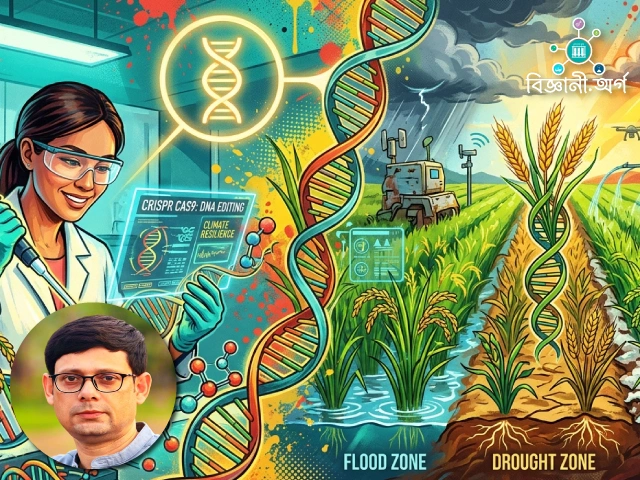
- CRISPR gene editing—precision editing of specific genes
As examples: The Sub1 gene → submergence-tolerant rice; Saltol QTL → salinity tolerance; DREB gene → enhances drought tolerance.
Real-world success: The development of Sub1-containing rice varieties in flood-prone regions of Bangladesh is a notable achievement. These are not just crops; they represent the genetic security of food. In addition, there are—
Multi-Omics Integration Methods
Multi-omics integration now combines the following approaches—
- Genomics
- Transcriptomics
- Proteomics
- Metabolomics
- Phenomics
This integrated analysis helps understand the complete network of stress responses.
Phenomics and High-Throughput Screening
Using drones, sensors, and advanced imaging technologies, it’s now possible to quickly and accurately measure canopy temperature, NDVI indices, chlorophyll content, and even root architecture. This field data enables real-time assessment of a crop’s physiological status. As a result, by integrating genomic data with field assessments, it’s easier to develop targeted, effective varieties and select stress-tolerant crops.
4.2 Physiological Adaptation: Stress Biology
The first line of defense against heat, drought, and salinity stresses related to climate change is the plant’s physiological and biochemical adaptation ability.
Under stress, plants do not remain passive; rather, multiple integrated stress responses are activated from the cellular to the whole-plant level. Through these responses, crops strive to survive.
This is how crops endure—
- Osmolyte accumulation: Proline and Glycine Betaine work as osmoprotectants.
- SOD, CAT, and APX enzymes are activated, increasing a plant’s stress tolerance.
- Heat shock proteins (e.g., HSP70, HSP90, etc.) play key roles in stress signaling.
- Altering root depth and architecture
To further strengthen physiological adaptation, several modern techniques are being researched, such as—
- Nano-fertilizers—zinc, silica, and iron nanoparticles are showing positive results in stress tolerance
- Silicon application—strengthens cell walls, reduces transpiration, lowers ROS damage, and controls Na⁺ uptake
- Microbiome-based stress tolerance—Plant Growth Promoting Rhizobacteria such as Bacillus and Pseudomonas enhance crop resilience under stress
4.3 Digital and Precision Agriculture
Because of climate change, weather unpredictability has become agriculture’s greatest risk. When, how much, and how intense rainfall will be, or what temperatures will rise to—these predictions are more uncertain than ever.
Maintaining agriculture in this era of uncertainty requires data-driven decision making. This is where digital and precision agriculture become crucial.
Precision agriculture is a scientific approach in which—
The right amount + at the right time + in the right place of water, fertilizer, and management are applied.
In this age of weather uncertainty—
- Satellite-based crop monitoring—NDVI (Normalized Difference Vegetation Index), canopy temperature, chlorophyll indices, biomass estimation, etc., can be measured.
- Soil moisture sensors—act as precise monitors, enhancing water use efficiency and avoiding both over- and under-watering
- AI-based yield forecasting—by integrating weather data, soil quality, historic yield, and satellite imagery, yield predictions become possible
- Real-time agricultural advice—delivered directly to farmers via digital platforms and mobile apps, including weather alerts, pest/disease warnings, fertilizer recommendations, optimal sowing time, etc.
4.4 Crop Diversification and System Resilience
In the era of climate change, the biggest risk is uncertainty. The unpredictability of drought, flood, or increased salinity makes monoculture-based farming systems highly fragile. In contrast, system resilience refers to how quickly an agricultural system can recover from loss and return to production.
Diversified farming increases system resilience as follows—
- Enhancing soil biodiversity—maintains soil bio-functionality. For example, legumes fix nitrogen, laying the foundation for the nutrition of subsequent crops.
- Stabilizing nutrient cycles—while nutrients like nitrogen, phosphorus, and potassium deplete unilaterally in single-crop systems, diversified systems restore this balance.
- Risk buffering mechanism—if one crop is lost to climate impacts, another may survive. This reduces financial risks and assures food security, known as the ecological insurance effect.
Some examples in Bangladesh—
- Rice-pulse crop rotation—restores soil nitrogen, increases soil organic matter, reduces production costs, and improves drought tolerance
- Integrated rice-shrimp farming—an effective model for salinity-tolerant agriculture, enabling income diversification and climate adaptation
- Alternative crops in saline areas—sunflower, barley, quinoa, and salt-tolerant vegetables
4.5 Soil Carbon and Ecosystem Restoration
In the context of climate change, agriculture both contributes to global warming via greenhouse gas emissions and, when managed correctly, plays a key role in climate mitigation by conserving carbon.
According to scientist Hudson, on average, increasing soil organic matter by 1% enables the soil to retain an additional 20,000–25,000 gallons (≈ 75,000–95,000 liters) of water per acre. This capacity can vary with soil type (sand vs. clay).
Increasing soil organic carbon—
- Enhances water retention—creates macropores and micropores by improving soil porosity, increasing water-holding capacity
- Improves soil structure—aids root growth and facilitates nutrient uptake
- Boosts drought tolerance—high SOC retains soil moisture longer, moderates temperature fluctuations, and stabilizes microbial activity
4.6 Carbon-Based Sustainable Agricultural Practices
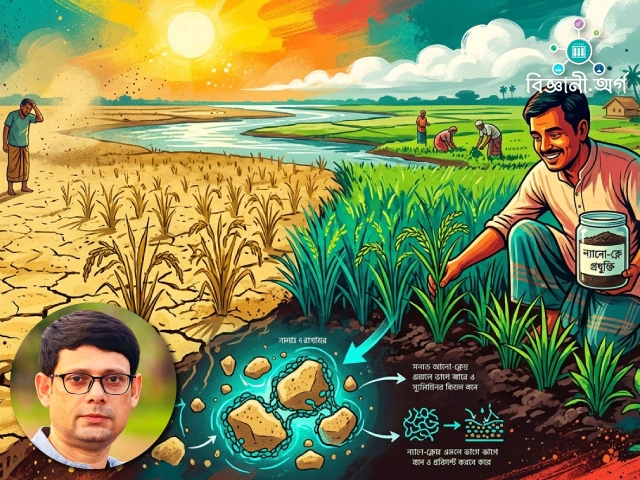
- Biochar application—long-term carbon sequestration, improves soil pH, increases cation exchange capacity (CEC), reduces Na⁺ absorption (beneficial for salinity), and enhances microbial activity
- Conservation agriculture—increases soil organic carbon, reduces erosion, improves water retention, and lessens carbon emission
- Agroforestry—increases carbon storage, provides shade to lower temperatures, enhances soil organic matter, and improves biodiversity
5. Social and Policy Adaptation
The battle against climate change involves more than just lab or field technologies. It also depends on social organization, policy support, market structures, and institutional capacity. If scientific innovations can’t reach farmers, or if market and policy frameworks don’t support them, adaptation cannot be effective. For vulnerable nations like Bangladesh, successful adaptation depends on the integration of knowledge generation, technology transfer, market linkages, and policy support.
5.1 The Necessity of Region-Based Agricultural Planning
Region-based agricultural planning is a vital policy tool. Not all regions have the same climate or soil conditions. For example—salinity prevails in coastal areas, floods in the haor wetlands, and drought in the north. Due to these differing realities, a single national strategy does not work. Thus, region-specific crop calendars, suitable variety selection, and seasonal risk analyses are needed. This reduces production risks and ensures efficient use of resources.
5.2 Local Seed Banks: A Ring of Genetic Security
- Local seed banks are an important pillar of social adaptation. Seeds are now not just agricultural inputs—they are strategic assets.
- Community seed banks preserve native resilient varieties, enabling quick recovery after disasters.
- This reduces farmers’ dependence on external sources and preserves local diversity.
5.3 Stability of the Supply Chain
Modernizing food storage and cold chain infrastructure keeps the supply chain stable. Often, food crises become acute not just from shortages of production but from supply disruptions. For this reason, region-based warehousing, cold chains, and rapid transportation are essential to ensure food availability and stability. This also reduces market volatility.
5.4 Early Warning and Risk Management
Early warning systems make adaptation effective. Through digital technologies, advance information about cyclones, droughts, floods, and pests becomes available. Based on this information, farmers can adjust sowing times or secure early harvests, reducing potential losses.
5.5 Farmer Capacity and Knowledge-Based Agriculture
- Farmer training and capacity building are foundational for adaptation. Technology only becomes effective when users understand it.
- Increasing farmer expertise in climate-smart agriculture, soil health, and water management boosts resilience.
- When a knowledge-based farming community is established, adaptation strategies become more sustainable.
5.6 Food Security: An Integrated Framework
Food security is a multidimensional equation. It is built upon biological, economic, and policy pillars. Without balance among these three, a sustainable food system cannot be established.
6. Future Challenges for Bangladesh
In Bangladesh’s reality, climate adaptation strategies must necessarily vary by region. In coastally saline zones, genetically salt-tolerant varieties and integrated rice-shrimp models may prove effective; in the drought-prone north, varieties with deep root systems, water-efficient irrigation (such as AWD), and soil carbon-enhancing management are more relevant; in the haor wetlands, short-duration submergence-tolerant varieties and robust early warning systems are vital. However, the reality is that an integrated national adaptation framework that combines genomic advancements, digital agriculture information systems, climate-smart technologies, and social-policy supports has yet to be fully established in the country. Thus, a gap remains in transferring technology from research to the field. In this context, climate change mitigation will require coordinated, evidence-based action among research institutes, seed producers, agricultural extension services, and policy makers. Through integrated planning, technology transfer, and policy support, Bangladesh can progress toward a stable and climate-resilient agricultural system.
Conclusion
To cope with the effects of climate change, it is not enough for agriculture to rely on a single solution. Only an integrated approach—encompassing genetic improvement, physiological resilience, digital information systems, crop diversification, soil carbon conservation, and policy harmonization—can ensure sustainable food security.
In the context of Bangladesh, climate-resilient agriculture means not just higher yields, but building stable, adaptive, and environmentally sound agricultural systems.
Author:
Dr. Ripon Sikder, Deputy Program Director (Seeds), Partner Project, BADC, Dhaka
Email: [email protected]