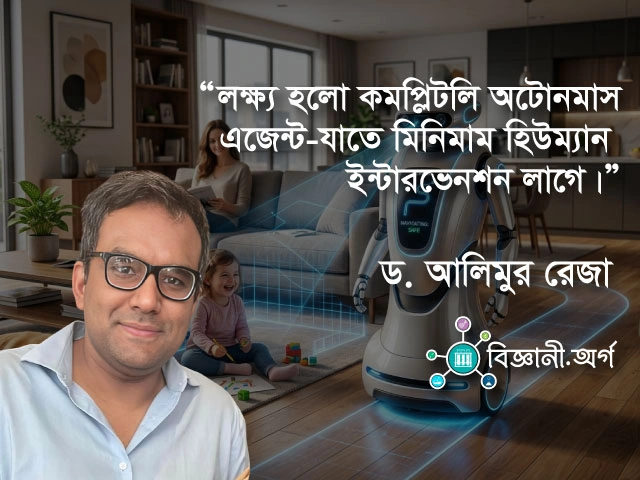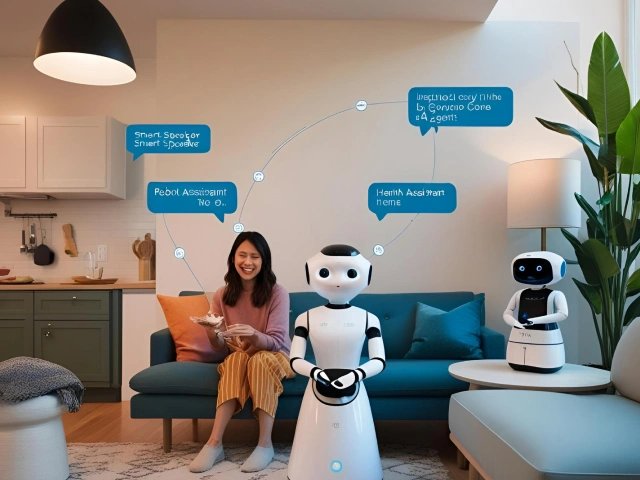
A few years from now. Sayantan returns home from work one evening, exhausted. As soon as he enters the door, he says, “I feel like having something light today.” Instantly, the smart speaker in the corner understands and connects with his personal health app. The app replies, “Your blood sugar is a bit high today, so soup and vegetables would be good.” Immediately, the kitchen robot cook receives this information and starts preparing the meal—without any human intervention.
This scenario may not be reality today, but it’s a very likely possibility in the near future. Because machines are learning to communicate with each other. And at the center of this revolutionary change is Google’s new agentic protocol: Agent2Agent (A2A).
What is Agent2Agent (A2A)?
Google recently unveiled their new agentic communication protocol, Agent2Agent or A2A. Its main goal is to enable different AI agents to converse meaningfully with each other, just as humans do.
Google Cloud Vice President Rao Surapaneni says,
“Each agent has distinct skills—some interpret data, some make decisions, others understand user habits. But if a user uses multiple platforms, managing each one separately is exhausting. We want agents to converse with one another naturally.”
This idea birthed A2A—an open-source protocol already developed with the help of more than 50 organizations, including Salesforce, SAP, Atlassian, MongoDB, LangChain, and more.
How does this protocol work?
Agent2Agent primarily facilitates effective communication between two types of agents—client agents and remote agents.
- Capability Discovery: Agents declare their abilities in JSON format.
- Task Lifecycle Management: Manages a specific task from start to finish.
- Collaboration Messaging: Exchanges information, instructions, or results during a task.
- User Experience Negotiation: Decides in which format the information will be presented.
Rao explains,
“We’ve kept this completely open so the community can work on it. Just as HTTP or JSON became the foundation of our technology.”
Why is agent collaboration so important?
Today’s AI world is built from the blending of many companies and models. Some develop agents for managing email, while others create bots that understand calendars.
If these different agents can’t communicate, this incoherence could become a major obstacle in the future AI ecosystem.
Young software developer Tamanna Afroze says,
“There used to be wars over APIs, now it’s about the agents’ language. If Google’s A2A stands strong, it could mark the dawn of a new language in tech history.”
Who are the competing protocols?
Besides A2A, the market features—
- Anthropic’s Model Context Protocol (MCP)
- Cisco, LangChain, and LlamaIndex’s AGNTCY
- Microsoft’s AutoGen
Google wants there to be harmony among these. A2A is designed so it can operate alongside other protocols.
Rao says,
“MCP works with LLMs’ tools and data. A2A works at a higher level—where agents and applications understand each other.”
Indications for the future
A2A is still at an early stage. Though many major organizations are involved, it hasn’t yet become a standard.
However, experts say that if A2A is adopted, a single protocol could connect the entire agent world.
University student Rubaiyat Islam says,
“After reading about Agent2Agent, it feels like—AI won’t just be intelligent, it’ll be able to befriend one another. That’s what it really takes to be human.”
Conclusion
Just as TCP/IP once transformed the path of the internet, Agent2Agent may become the ‘language’ that brings groundbreaking change to the world of AI.
Soon, machines won’t just work—they will talk. And this is the dawn of a new era.
Share your opinions at biggani.org. Join this new chapter written in the language of machines as a reader yourself.