
Muhammad Redwan | Science and Technology Desk | 8 May 2025
The Great Adventure of Little “Theseus”
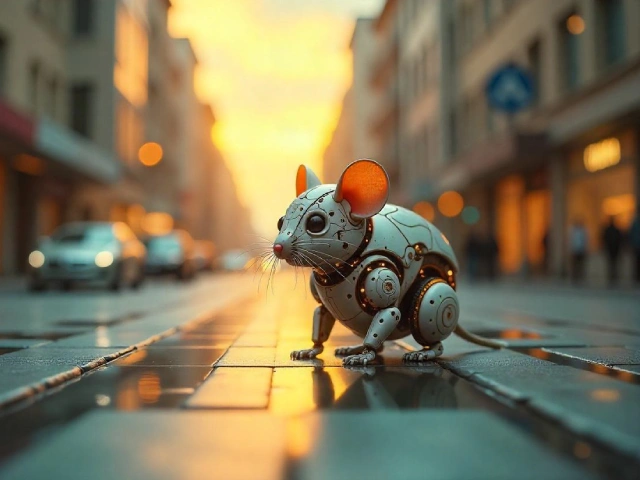
A tiny metallic mouse—named “Theseus.” Suddenly, it enters a maze. At first, it’s hesitant, but soon it starts finding its own way. It makes mistakes again and again. But with each error, it learns something new. Finally, it finds the correct path. The second time, there are no mistakes—it heads straight to the goal.
This fascinating story is from the 1950s. The small robot named “Theseus” was created by the renowned mathematician and father of modern information theory, Claude Shannon. No one imagined at the time that the revolution in modern artificial intelligence (AI) would begin with a metal mouse.
Micromouse: A New Chapter in Technology
In 1977, the United States hosted the first-ever unique competition called “Micromouse.” The challenge for engineers was to create a small robot that could navigate a maze on its own, without any outside help. Achieving this without a pre-made map, human assistance, or GPS was revolutionary at that time. The ability of those tiny robots to make autonomous decisions using sensors and algorithms amazed everyone.
Dr. Rasheda Tasnim, a veteran robotics researcher in Bangladesh, says,
“The roots of today’s major technological advancements actually come from these little robots. The micromouse of that era is the ancestor of today’s modern AI robots.”
Today’s AI: Controlling Not Just Mazes, But Entire Cities
The capabilities of that little robot were limited. But today, AI’s power has spread across the world. It’s not just about solving mazes—AI is now controlling cars, diagnosing diseases, and making vital decisions from city traffic management to running elections.
Dr. Abid Hasan, professor at the Department of Computer Science, University of Dhaka, says,
“Fifty or sixty years ago, no one thought that AI would penetrate our lives so deeply. Now it’s hard to imagine life without AI.”
Small Innovations, Big Potential
According to analysts, today’s leading technologies were once mere toys or experimental projects. Companies like Google, Apple, or Tesla have reached where they are today by starting from these small innovations.
Salman Jubayer, a student at East West University and a young developer, says,
“Many people in our country give up when working on small projects. But it’s these small ideas that one day lay the foundation for huge industries.”
World-famous scientist and AI researcher Demis Hassabis says,
“The history of technology proves that today’s small discoveries become tomorrow’s revolutionary changes. Claude Shannon’s Theseus reminds us that we should never underestimate small innovations.”
Where Will AI Go in the Next Decade?
Researchers around the world say that in the next ten years, AI will become our closest companion. From decision-making to new discoveries, AI will lend a helping hand.
Tech entrepreneur Elon Musk says,
“In the next ten years, AI won’t just be an assistant—it will become a companion, deeply integrated into every aspect of our lives.”
Readers’ Opinions
Dear reader, are you thinking of any small innovation that could bring about a big change? Let us know.
Send us your opinion: [email protected]