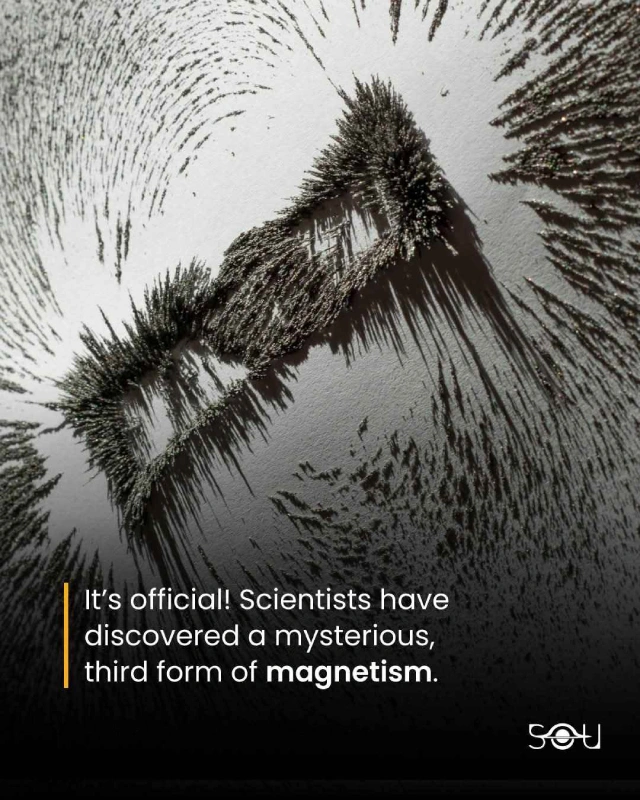
Magnetism is a mysterious and significant aspect of science. Every day, we encounter different types of magnets—from the magnets on refrigerator doors to the magnetic materials used in hard drive data storage. Until now, scientists have mainly classified magnetism into two categories: ferromagnetism and antiferromagnetism. However, researchers have recently confirmed the existence of a new type of magnetism, called altermagnetism. This new form of magnetism has been recognized as a groundbreaking discovery in the world of science.
What is Altermagnetism?
Altermagnetism is a type of magnetism considered to be a combination of ferromagnetism and antiferromagnetism. In ferromagnetic materials, the spins of electrons align in the same direction, creating a permanent magnetic field (such as iron magnets). On the other hand, in antiferromagnetic materials, electron spins are oriented oppositely, causing the magnetic fields to cancel each other out.
The uniqueness of altermagnetism lies in the arrangement of the energy bands of electrons: some parts display ferromagnetic properties, while others exhibit antiferromagnetic properties. As a result, the material may appear non-magnetic as a whole, but on a microscopic scale, it retains permanent magnetic characteristics.
Discovery and Research
Only a few years ago, scientists theoretically predicted the existence of altermagnetism. But in 2024, a team of researchers confirmed it experimentally.
Published Research:
J. Krempaský et al., “Altermagnetic lifting of Kramers spin degeneracy,” Nature (2024).
The researchers conducted X-ray analysis on a crystalline material called manganese telluride (MnTe) and observed a unique type of splitting in its electronic band structure. Through analysis of the data obtained from X-ray experiments, scientists confirmed that this material exhibits the properties of altermagnetism.
Potential Applications of Altermagnetism
The discovery of this new type of magnetism could revolutionize various fields of science, especially in spintronics.
1. Spintronics and Advanced Electronics
At present, electronic devices mainly operate based on the charge of electrons. However, spintronics is a technology that can store and process data using the spin of electrons. With altermagnetic materials, it may be possible to create more advanced and efficient spintronics devices that operate faster and consume less power than conventional electronics.
2. Advanced Memory and Storage Technology
The exceptional magnetic properties of altermagnetic materials can enhance the capabilities of memory devices. For example, magnetic materials are currently used in RAM and hard drives. The inclusion of altermagnetic materials could pave the way for even more durable and faster memory in the future.
3. Quantum Computing
Altermagnetism could be a promising field for quantum computing. Quantum computers process information using qubits, which depend on the spin of electrons. With altermagnetic materials, it may be possible to develop more stable and efficient qubits.
4. Advanced Magnetic Sensors and Measurement Technology
Scientists are considering creating new types of magnetic sensors utilizing altermagnetic materials, which can detect various magnetic fields with high sensitivity.
Future Prospects
Research on altermagnetism is still in its early stages. Nevertheless, due to its versatile applications and technological potential, it has become a topic of great interest among scientists and engineers. Researchers hope that in the coming years, further studies will lead to the development of advanced spintronic devices, smart memory, and next-generation computing technologies.
Conclusion
Altermagnetism marks a new chapter in science, changing conventional ideas about magnetism. The discovery of this new magnetic property, beyond ferromagnetism and antiferromagnetism, could transform future technologies. Especially in spintronics, quantum computing, and advanced data storage, it has the potential to spark a revolution.
If researchers can further harness the potential of altermagnetism, a new era in electronics and information technology may soon emerge.
What do you think—how could this new discovery impact the future of technology? Let us know your thoughts!