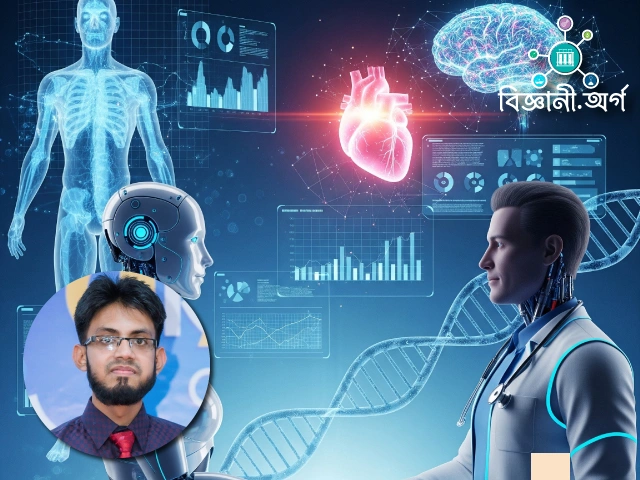
Zainul Abedin Sagar
MBBS 4th Year (Session: 2021-22)
Mymensingh Medical College, Mymensingh
Interested in exploring the potential of artificial intelligence in molecular oncology and healthcare
The Changing Face of Technology and the Dilemma of Human Thought
“Will medicine remain solely in human hands?” This question can be heard these days in doctors’ corridors, conferences, and even among the general public. Artificial Intelligence (AI) has already entered the realm of medical science. On one hand, doctors are concerned—will this technology take away their jobs? On the other, scientists claim that AI will make medicine more precise, faster, and cost-effective.
So the question arises—Is AI actually a rival to doctors, or an ally?
What is Artificial Intelligence and How Does It Work in Medicine?
Artificial Intelligence (AI) is a technology capable of thinking, learning, and making decisions like humans. In medicine, AI mainly works through medical data analysis, disease diagnosis, treatment planning, patient monitoring, and even surgical assistance.
One of AI’s core strengths is its “machine learning” capability—that is, it can learn from experience and make more accurate decisions in the future.
Noteworthy Examples of AI-Driven Medical Technologies Worldwide
IBM Watson for Oncology:
Based on machine learning and clinical research data, it suggests personalized treatment plans for cancer patients.
A study found that in 93% of cases, IBM Watson’s treatment recommendations matched those of experienced oncologists (JCO Clinical Cancer Informatics, 2019).
SkinVision (App):
Analyzes skin photos taken with a mobile camera to identify possible risks of skin cancer, including melanoma.
PathAI:
Primarily used for analyzing histopathology slides. AI can accurately detect malignancy—sometimes even more precisely than humans.
Google’s DeepMind – AlphaFold:
Has revolutionized medical research by predicting protein folding. According to a 2021 report in Nature, it achieved 90% accuracy.
Will AI Replace Doctors or Empower Them?
Many doctors are concerned—”If robots can see patients, why do you need us?”
In reality, the picture is entirely different.
👉 AI is a decision support system, not a decision-maker.
👉 It can analyze, but it cannot understand a patient’s expression, family background, or anxiety.
So, in terms of Clinical Judgment, Empathy, and Ethical Decision Making—AI can never be a substitute for doctors.
Medicine is never just about curing disease—it’s also about giving courage, hope, and love to people.
The Bangladesh Context: Windows of Opportunity and Real-World Barriers
AI has not been fully adopted in Bangladesh yet, but signs of change are slowly emerging.
A health-tech startup called Doctor Koi has launched an AI-based chatbot for analyzing symptoms.
Praava Health and CMED use software for digital medical records and for analyzing patient health reports.
Several initiatives focusing on diabetes and heart disease are using AI data analysis to assess risks.
But there are challenges:
1. There is no adequate data infrastructure.
2. Awareness and training in AI are lacking among doctors.
3. AI is still insufficient in rural healthcare.
If the government and private sector collaborate to provide training on AI tools, data protection, and policy-making—AI could help reduce health inequalities in our country.
Benefits and Limitations of AI in Medicine: A Comparative Overview
| Benefits | Limitations |
| Rapid disease diagnosis | Mistakes possible without sufficient data |
| Reduces costs | Lacks a human perspective |
| Can work 24/7 | Lack of ethical guidance |
| Helps provide healthcare to remote areas | Difficult to use without doctor training |
The Healthcare of Tomorrow: The Harmony of Human Heart and Machine Mind
Imagine this: You wake up in the morning and scan your face through an app. The app tells you—”You look tired under your eyes, you haven’t slept enough, your blood pressure might rise. Drink some water and get some rest.”
This is Preventive AI Healthcare—providing treatment even before disease sets in.
A study published in The Lancet Digital Health in 2024 stated,
“AI-driven predictive care could reduce preventable hospital admissions by 26%.”
So, the future of medicine will be—
“Human heart + Artificial mind” = Complete healthcare
Not Competition, but Collaboration is the Future
We are living in a sensitive era—where technology is reaching the very limits of human capacity. The advent of AI in medical science is opening new doors, but we must combine it with our humanity, empathy, and experience.
AI is not a substitute for the doctor—rather, it is an intelligent assistant, a rapid analyzer, a second opinion.
The role of AI in medical science is, “Doctor’s brain enhancer, not his replacement.”
It is through the combination of AI and doctors that tomorrow’s advanced healthcare will be built.
So, our mindset has to change. We need collaboration, not competition. Not fear—but learning and adaptation.
Because technology can never be the heart—and medicine without heart, is not medicine at all.
🔍 References:
Evaluation of Watson for Oncology, JCO Clinical Cancer Informatics, 2019
PathAI and Histopathology, American Journal of Surgical Pathology
SkinVision App Research, Journal of the European Academy of Dermatology and Venereology
AlphaFold and Protein Structure Prediction, Nature, 2021
Predictive AI in Healthcare, The Lancet Digital Health, 2024
AI in Clinical Decision Making, New England Journal of Medicine, 2016
Digital Health in Bangladesh, LightCastle Partners, 2023
CMED Health & Doctor Koi – Official websites