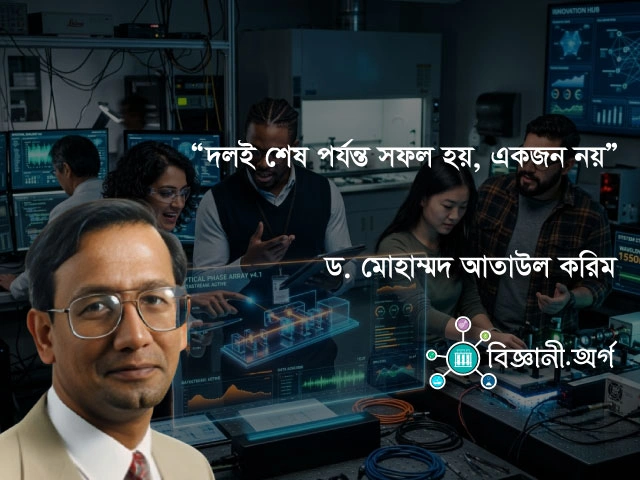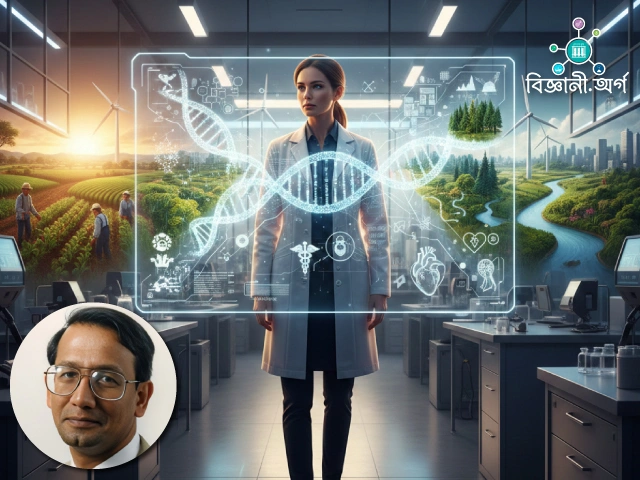
In the realm of science and technology, we often observe researchers deeply engrossed in solving specific problems with intense focus. Scientists may spend months fixing a minor error in an equation, deciphering a molecule’s structure, or troubleshooting an algorithm. Without such dedication, progress in research would be impossible. However, experienced scientists argue that if one’s perspective remains too narrow, the true impact of research can remain unfulfilled. Against this backdrop, Dr. Mohammad Ataul Karim’s important observation becomes particularly relevant—”A scientist must learn to see the big picture.”
By ‘the big picture,’ he refers to viewing research within its social, technological, and human context together. The job of a research project does not end with success inside the lab. Taking into account how the research will impact society, what problems it will help solve, and which new questions it will raise in the future—that is what seeing the big picture means. Take medical research as an example. If a new technology works well only in the lab but cannot be applied effectively in patient care, its value is greatly diminished. That’s why considering real-world applications from the very beginning of research is crucial.
Another aspect of seeing the big picture is interdisciplinary thinking. Modern research is rapidly moving beyond the bounds of single subjects. Today, artificial intelligence impacts fields such as medicine, agriculture, and environmental science. When the work of a computer scientist merges with a physician’s experience, new opportunities for innovation emerge. Understanding the importance of such collaboration is a vital part of seeing the big picture. According to Dr. Karim, scientists should look beyond their own specialized fields and seek connections with other disciplines.
This mindset is especially important for young scientists in Bangladesh. Too often, we consider exam results or the number of publications to be the sole measure of success. True success in research, however, is achieved when its impact becomes visible in society. If new technology improves farmers’ livelihoods or if environmental research leads to practical solutions for pollution reduction, then the research finds its full meaning. Therefore, it is essential to consider local realities and needs from the very start of the research planning process.
Seeing the big picture also means that a scientist must know how to work as part of a team. Solving big problems is often beyond the reach of a single individual. It requires bringing together people with diverse skills, learning from their experience, and moving forward collectively. In this process, a scientist may have to play the role of not only a researcher, but sometimes an organizer and sometimes a coordinator as well.
Ultimately, the statement “A scientist must learn to see the big picture” reminds us that science is not just a process of generating knowledge; it is a living endeavor tied to society. Only when science looks beyond the laboratory walls to address real social problems does it find its full strength and meaning.
Read Dr. Mohammad Ataul Karim’s full interview: