When a first-year psychology student sets foot on the campus of the University of Dhaka through its towering gates, her mind is filled only with excitement and dreams of a new life. But just two months later, she starts to sense a change in her own thoughts—shaped by her environment, the worldview of her friends, and the intellectual debates in her classes. Subjects she never cared about before now spark deep curiosity. Emotions that once ran high are replaced by detachment or intense observation. After countless late-night discussions with friends, she suddenly realizes that similar ways of thinking are gradually spreading among all of them—even though no one is teaching the others. Thoughts seem to drift through the air like a breeze, and brains simply absorb them.
In everyday language, we call this the “influence of environment,” but modern neuroscience explains it in greater depth as social brain wave synchronization or interpersonal neural synchrony.
The human brain is not an isolated island. Each of us is part of a signaling system, silently and continuously communicating with the brains of those around us. Just like a Wi-Fi connection, eye contact, the echo of words, or even silent presence, can trigger your brain’s neurons to synchronize with others.
Neuroscientific research has shown that when two or more people engage in an activity together—be it practicing music, having a discussion, or simply sitting together in silence—certain areas of their brains begin to synchronize. This is particularly evident in the prefrontal cortex, temporoparietal junction, and motor cortex. Through this, they form an invisible yet real “social harmony” that affects each other’s feelings and behavior.
This is the mysterious explanation for why you often notice that, over time, friends begin to adopt similar ways of speaking, joking, and even thinking. It’s not mere imitation; it’s neural entrainment, where your brain waves start to phase lock with others’ brain waves.
Now imagine, if you consistently spend time with people who are negative or depressed, whose brains are clouded with gloomy thoughts, you too will gradually be overshadowed by that gloom. Even though you haven’t consciously let anyone into your mind, they’ve entered simply through their brain waves.
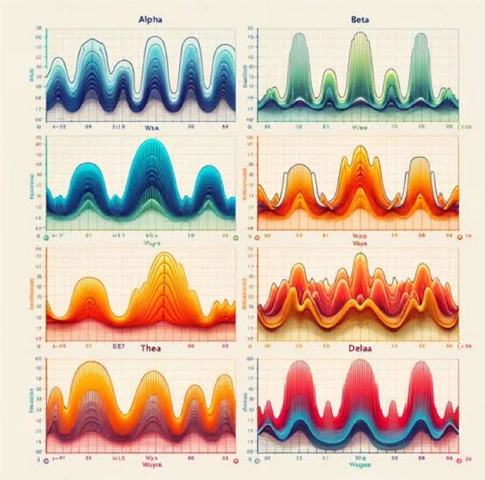
First, it’s important to clarify: your brain is constantly producing electrical impulses, what we call brain waves. These arise from massive coordinated activity among neurons. There are five types:
Delta, Theta, Alpha, Beta, Gamma, each reflecting a particular mental state.
But when you get very close to someone—physically or emotionally—something strange happens. Your brain starts to change its wave pattern and gradually aligns with the pattern of the other person. For example, if your Alpha waves were calm and their Beta waves were excited, your Alpha may diminish while your Beta increases, as if your brain is ‘phase locking’ to their rhythm.
This phenomenon is called neural synchrony.
For example:
Research has shown that when a teacher and a student discuss a subject with genuine interest, their prefrontal cortices and temporoparietal junctions experience a kind of neural union, and essentially “operate on the same frequency.” Similarly, when two friends engage in deep conversation or share a laughing moment, their EEG scans show the same kind of rhythm.
In a study at Germany’s Max Planck Institute, participating couples who listened to music together exhibited synchronized brain waves, especially during moments of joy and sorrow.
What’s even more astonishing: if two people simply hold eye contact—without speaking—their brain waves still begin to align to the same rhythm over time.
In other words, your brain is absorbing the feelings of those around you even before any words are spoken.
When does this echo happen most strongly?
When—
1. You are physically very close to someone
2. You share deep emotions (e.g., laughter, tears, excitement)
3. You are involved in a shared goal-oriented activity (e.g., group study, projects, pilgrimage)
4. Silence develops into a mutual understanding—where there are no words, but real connection
One mysterious phenomenon is that the brains of people who frequently spend time together can respond to each other’s brain waves even from afar. That means, if you’ve been friends with someone for a long time, some rhythms in your brain may have become so “mapped” to theirs that, even at a distance, your mood can mysteriously change in sync with theirs. Many people say, “I suddenly thought of him,” or “out of nowhere I felt down, and later learned he felt the same at that time”—this is not mere coincidence, it is a reality of social neuroscience.
In a small room at Dhaka University’s Arts Building, a student named Anik used to study. He was extremely curious and loved reflecting alone. His friend Sad was known as ‘the Reactor’—he reacted instantly to everything: loud laughs at stories, getting angry in a flash during arguments, always wanting to be in control.
Anik used to be very calm by nature. But after spending hour after hour telling stories with Sad every day, he noticed that he had, without realizing it, become very reactive himself. Even a slight comment from a teacher would make his heart pound, and he would jump in to answer questions in class—something he never used to do.
One night, sitting on the department’s rooftop, Anik suddenly said,
“You know, I’ve forgotten how to just be myself. Nowadays, seeing how reactive you are, I find myself doing the same.”
Sad was a bit surprised and replied,
“You didn’t used to be like this. Now I see even the smallest thing triggers a fire inside you!”
In reality, this ‘fire’ was the echo of brain waves.
Because they spent so much time together, Sad’s excited Beta Wave was gradually overpowering Anik’s Calm Alpha Wave. They had no idea their brains were programming each other.
Is this just a story? Not at all.
Neuroscience says that when you connect closely with someone, their mood, style of thinking, and even mental state gradually synchronize with your brain.
This is so profound that, in a 2017 joint study by MIT and Princeton, researchers found—
When two people spend time together, their brains’ Default Mode Networks (DMN) become synchronized—even if they are not speaking.
For example—
1. If one person is nervous, their close friend also starts to feel restless within minutes
2. If one is sad, and they spend time with a close one, the emotional shadow appears in both their Amygdala and Hippocampus
In other words, the brain waves of the people you’re with gradually redesign your own mind.
This can also be dangerous!
Imagine, if you spend your time with people who—
1. Always speak negatively,
2. Constantly express suspicion, fear, or sarcasm,
3. Focus only on sadness, helplessness, and giving up,
Then there’s nothing you can do.
Your brain will learn to think just like theirs.
Psychology calls this:
1. Emotional Contagion
2. Neural Entrainment
Your brain is no longer functioning independently.
It’s now copying someone else’s ‘mindset’.
So, what should you do?
Don’t let others influence you—be the influencer
There are very few people in the world who can change the entire environment simply by entering a room alone. Surely you know someone who makes a class go silent as soon as they enter, communicates their presence without a word, or whose very appearance makes you sit up straighter.
How do they do it?
They have simply learned to control the waves of their own brain.
And over time, have kept their thoughts, emotions, and focus in a clear, steady wave. When this state is achieved, their brain waves begin to synchronize those around them. At this point, you are no longer a victim; you become a ‘wave-setter’.
This is the secret of masterminds
A mastermind never tries to suddenly change the people around them. They know that the quiet rhythm of brain waves changes the world. They understand—
“Anyone who can fully control their own brain can cast a shadow on the minds of others.”
They prepare themselves so that—
1. Fear, doubt, or failure can’t enter their wave,
2. Their Calm Alpha Wave can override others’ Anxiety-driven Beta Waves,
3. The depth of their thoughts creates ripples—a silent influence.
This is leadership, this is intellectual control,
and this is the neuroscientific path to becoming a true mastermind.
So, now?
A direct question:
Are your brain waves still being influenced by someone else, or are you programming the brain waves around you?
The more often you ask yourself this question,
the more “master” you will become—
of yourself, of your own waves, and gradually…of your whole environment.
This is Not the End; It’s the Beginning!
Today, neuroscience is proving that
“You become just like the people you spend your time with—silently, without even realizing it.”
So now it’s time to decide: Will you be a ‘mind follower’ or a ‘mind architect’?
Md. Iftekhar Hossain
Medical student, Cox’s Bazar Medical College | Interested in neuroscience, habit formation, and behavioral change in the human brain.