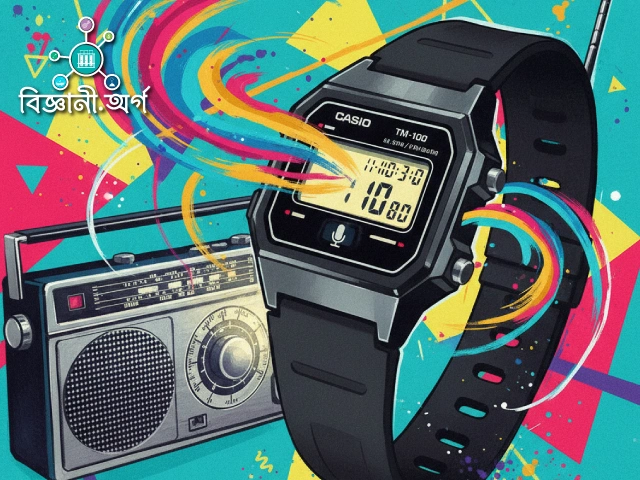
📻✋ Those days now seem beyond the imagination of the new generation. Once, the idea of broadcasting your own voice over radio using a device as small as a watch was unthinkable. Yet, Japanese technological audacity made that vision a reality.
The year was 1987. At that time, ordinary people didn’t have mobile phones, and the word “Internet” was virtually unknown. In such an era, the Japanese tech manufacturer Casio launched a revolutionary watch—the TM-100.
This watch didn’t just tell the time. Instead, it allowed you to broadcast your own voice to nearby FM radios. Walking down the street and want to say something to your friend next to you? No need for a mobile phone—you could transmit your voice directly to their radio with this watch!
🕰️ Technology Straight Out of Science Fiction
The Casio TM-100 was a “wireless voice transmitter watch”—in simple terms, a tiny radio broadcasting station that looked like a watch.
It included:
- An inbuilt microphone
- A hidden antenna
- And most impressively, it could transmit voice on frequencies from 76 to 90 megahertz.
Its range was about 100 meters, meaning your voice could easily reach someone inside a large field or building.
With this device, you could broadcast your voice to any nearby FM radio—as long as it was tuned to the correct frequency. In short, you could become a mini DJ, without any wires!
🇯🇵 Japan’s Innovative Spirit and the Bold Tech of the 80s
The TM-100 wasn’t just a product name; it became a symbol of an era when Japan was the epicenter of global technological innovation. Sony, Casio, Panasonic—all these companies were releasing one daring product after another.
This watch proved how Japanese engineers envisioned the future. They didn’t just think about current needs; rather, they imagined what people would eventually want.
Much of the “wearable communication” we see today in smartwatches and smartphones can be traced back to the initial concept brought to life in the TM-100.
📉 Why Did the TM-100 Fail?
Although the technology was remarkable, the TM-100 failed to make a splash in the market. Why?
- Cost: The watch was quite expensive for its time, making it unaffordable for most people.
- Regulations: In many countries, personal radio broadcasting was strictly regulated. As a result, it couldn’t be used everywhere.
- Practical Need: In reality, most ordinary people didn’t feel the need to speak on the radio using a watch.
So, while this innovative technology fascinated an entire generation, it failed commercially.
🧳 Its Place Today as a Nostalgic Treasure
Today, the TM-100 is no longer on the market. But to tech enthusiasts and lovers of 80s retro-futurism, it is an invaluable collector’s item.
On eBay and other collector sites, the price of this watch has skyrocketed. Many look at it and say, “This belongs in a movie!”
Now, as we live in the age of AI and smartwatches, the TM-100 has become a symbol of a brave new future—one that perhaps arrived a little too early.
📲 Has Today’s Tech Been Inspired by the TM-100?
The Casio TM-100 is no more, but its spirit lives on in many of today’s technologies:
- Voice command and voice calling in smartwatches
- Wireless transmission technologies
- FM radios and Bluetooth speakers
- The concept of communication via wearable devices
Today, we consider the voice-calling features of the Apple Watch or Samsung Galaxy Watch as exemplars of modern technology. But the seeds of this innovation were planted long ago—with the TM-100.
🔮 Lesson for the Future: Bold Innovation Doesn’t Always Succeed
The Casio TM-100 teaches us a vital lesson:
The most innovative products don’t always succeed in the market. But they show us the path to the future.
There are many such examples in the history of science and technology:
- Apple Newton: The first tablet computer
- Google Glass: Smart glasses
- Segway: Personal electric transportation
These products may not have become popular, but much future technology has been built on the ideas they introduced.
✍️ Final Thoughts: Never Stop Dreaming of the Future
The Casio TM-100 reminds us that technology isn’t just about meeting needs—it’s a bold attempt to turn human imagination into reality.
For today’s science students and tech lovers, this is a great inspiration—maybe no one understands your idea today, but one day that idea will become the foundation of the future.
So dream. Innovate. Maybe you too will one day create something that everyone laughs at in the beginning—but decades later, they’ll call it genius.
✒️ News Desk, Biggani.org
📧 [email protected]