The Night City, an Inevitable Guest
In the semi-dark of night, as soon as the light switch is flipped, a shadowy figure silently slips away through a crack in the wall. Looking closer out of curiosity—it’s a cockroach! While many of us dislike this creature, in reality, it is an incredible survivor. But what if these tiny beings could be controlled? What if we could direct their movements and activities?
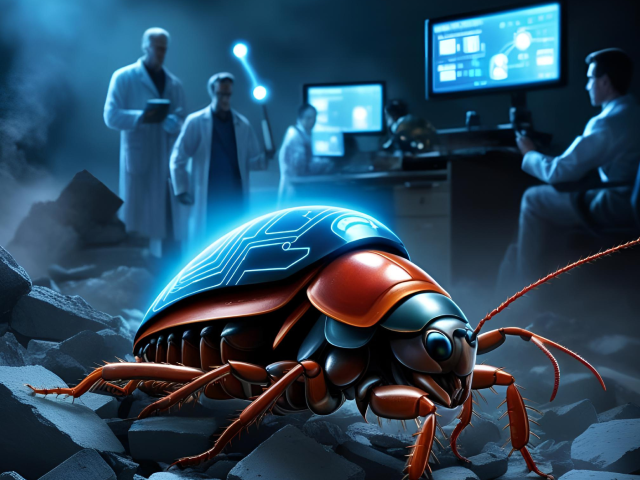
Thanks to scientific advancements, that is now possible! Researchers from Osaka University in Japan and Diponegoro University in Indonesia have turned cockroaches into cyborgs. By attaching special electronic devices, they are able to guide cockroaches to specific destinations. This technology could play a role in fields like disaster management and surveillance in the future.
The Merger of Science and Nature: How Does the Cyborg Cockroach Work?
The researchers tested on large cockroaches known as Madagascar hissing cockroach (Gromphadorhina portentosa). By attaching special electronic backpacks and sensors, they are able to control the movements of these cockroaches.
The lead researcher, Mochammad Ariyanto, a mechanical engineer at Diponegoro University, explains:
“There are various challenges in creating tiny robots. But we have looked for simple solutions—combining naturally adapted organisms with technology.”
The researchers have attached electrodes to the cockroaches’ antenna nerves, allowing their movements to be directed using electrical signals. As a result, cockroaches can be sent into narrow and dangerous places for research and exploration.
Through micro-electronics attached to the cockroach’s back, its movement can be directed. When a light electric signal is transmitted to the electrodes connected to the antenna nerves, the cockroach will move along a specific path.
Innovation vs. Ethics: Is This Technology Just Science or a Tool for Control?
This new technology holds great promise for use in disaster-stricken areas and rescue operations. These cyborg cockroaches could play a vital role in locating people trapped beneath earthquake rubble or searching in radio-active environments.
Keisuke Morishima, a researcher at Osaka University, says:
“The main challenges with robots are balance and autonomous movement. But our bio-hybrid technology can easily overcome those limitations.”
However, there are downsides to this technology as well. There are concerns about its misuse in surveillance, covert intelligence operations, or even military applications. Many have questioned—will this technology remain only in scientists’ hands or will it become a new weapon of control?
The U.S. military is already testing similar technology as an alternative to drones, which could be used for surveillance purposes.
Technology analyst Dr. Ahsanul Karim says:
“Every technology has two sides—one for development, the other for control. If this becomes a tool for surveillance, the privacy of ordinary people will be at risk.”
The Road Ahead: How Far Will Science Go?
This research has been published in the journal Soft Robotics. Scientists are still trying to control these cyborg cockroaches even more precisely. If successful, many other living beings may be controlled with such technology in the future.
If it is possible to control these small members of the animal kingdom in such ways, will similar technologies be applied to humans in the future? Does this signal a revolutionary change, or is it yet another example of human control? Science is moving forward, but so is our responsibility.
What do you think? Will this technological progress benefit humanity, or will it bring even greater danger?