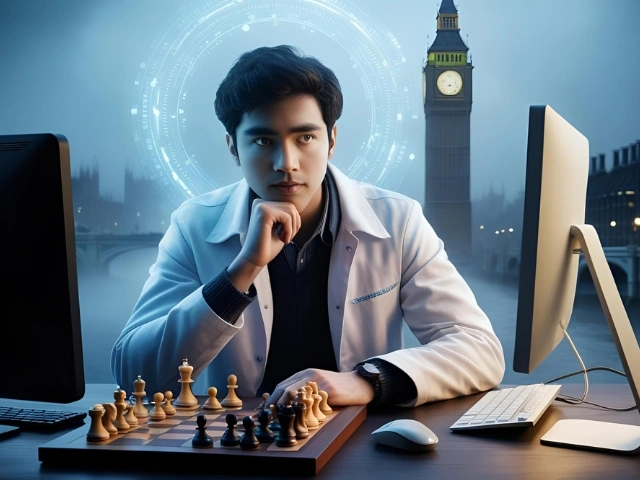
On a quiet morning in London, when a light mist lingers over the city, a teenage boy could be seen sitting at his desk in deep concentration. In front of him, a chessboard; beside him, a computer; and inside his mind, an invisible world—where thought and possibility have no boundaries. His name is Demis Hassabis. He is the protagonist of our story today. Although the name may sound unusual in Bengali, that is indeed his name.
Hassabis was gifted from a young age. At thirteen, he became a chess master. He was equally skilled in the world of computer programming. He kept himself busy by creating small games. One question always circled his mind—was it possible to build a machine that could think like the human brain?
Time moved on. After finishing his studies, he gradually turned towards game design, neuroscience, and artificial intelligence. A landmark moment changed the course of his life: AlphaGo.
The year was 2016. The eyes of the world were fixed on a strange match. The company organized a game of Go (known as “Yi Go” in Japan, “Weiqi” in China)—one of the world’s oldest board games. While the Bangladeshi game sixteen beads shares some similarities, Go is far more complex. On one side was Go legend Lee Sedol; on the other, AlphaGo—a system of artificial intelligence created by Hassabis.
Midway through the competition, AlphaGo made a move that had never been seen in the centuries-old history of the game. Everyone was stunned! Even Lee Sedol paused for a moment. The audience was silent. This was a move not made by a human, but by a machine. Demis Hassabis realized—this was not just a game. This was the dawn of a new era. In that match, the seasoned player was defeated by AlphaGo’s artificial intelligence.
AI is not only able to think like humans, but can even surpass human thought. And this realization took him towards an even greater dream—the path of saving human lives.
After AlphaGo’s historic success, Hassabis didn’t stand still. He understood that winning a game was not the ultimate achievement; the real victory would be if this technology could be used against humanity’s greatest enemy—disease. This vision gave birth to Hassabis’s company, Isomorphic Labs.
Leaving DeepMind, Hassabis now uses AI at this new venture to discover medicines. Especially for tough challenges like cancer and autoimmune diseases. His mission is now joined by pharmaceutical giants such as Eli Lilly and Novartis.
Their goal is singular: where it normally takes 10-15 years and billions of dollars to develop a new drug, using the power of AI, this process could be completed in a couple of years—or even less.
Recently, on 60 Minutes, Demis Hassabis made a bold declaration:
“I believe that within the next ten years, AI will be able to cure all major diseases.“
The host stared in amazement; the audience listened with bated breath. Hassabis calmly continued,
“In the future, when people talk about cancer or autoimmune diseases, they will no longer be things to fear. It will be just like how we now take antibiotics for fever or infections—a completely ordinary matter.“
This hope is built on the success of a remarkable tool they created themselves—AlphaFold. In just one year, AlphaFold accomplished what would have taken humans hundreds of years—mapping the structure of 200 million proteins. This achievement proves that Hassabis’s dream is not some outlandish fantasy.
In Demis Hassabis’s eyes, a vision of a new world emerges—a world where children no longer cry from cancer, the elderly no longer suffer from autoimmune diseases, and taking medicine becomes as simple as we now take cold remedies.
He knows the road won’t be easy. But the journey has begun. Through the shared dream of AI and humanity—a new human civilization is being born.