Power is not just a matter of politics or military strength—it shapes the economy, productivity, technology, and even the daily pace of people’s lives. And the foundation of this power is energy—in other words, fuel. Whoever controls electricity and energy is able not only to meet their own needs, but also to exert influence, make decisions, and steer the direction of development. Bangladesh is no exception to this reality.
Over the past decade, Bangladesh’s economy has advanced a great deal. The garments industry, agriculture, remittances, and more recently, information technology—all together have contributed to remarkable GDP growth. While there are several reasons behind this growth, I believe that at the core lies electricity. From a farmer’s irrigation pump to data centers in Dhaka, from the machines of small entrepreneurs to the running metro rail—everything relies on the supply and continuity of electricity. Yet, we rarely see much discussion about the future of this electricity system.
Although artificial intelligence (AI) technology is still in its early stages in Bangladesh, its potential is enormous. From government offices, healthcare, and education to law enforcement and business, the application of AI has begun. Startups, banks, and e-commerce companies are already using AI for customer service and data analysis. However, a fundamental requirement of this technology is electricity. As talks begin about AI-based data centers and machine learning models in Bangladesh, the question arises—how will we meet this massive demand for electricity?
Currently, a large portion of electricity production in Bangladesh still depends on fossil fuels. Electricity produced from coal, oil, and gas is harmful to the environment on one hand, and creates pressure on foreign currency reserves on the other. Every time oil prices rise, government subsidies increase and the budget balance is disrupted. Yet our future technological usage is becoming increasingly electricity-dependent. In this situation, if we do not decisively move towards clean energy, meeting the demand for electricity will become our greatest challenge.
With this reality in mind, we need to reflect on the direction we are heading. When power outages continue for days in various regions of the country, it’s not hard to imagine how, in the future, an expanding AI-dependent healthcare, education, or industrial sector could be disrupted by electricity shortages. Imagine—a hospital is using an AI-powered diagnostic device, but a sudden power cut halts its operation. Or a school, where students are learning through digital agents, but suddenly the network goes down because the backend data center has no power. These small scenarios will eventually form a bigger picture.
Bangladesh has indeed taken some steps towards clean energy production—the use of solar panels at the household level has increased, solar-powered isolation hospitals have been built, and a few hydropower projects are in operation. Yet, these are still extremely insufficient compared to the need. The government is relying on the import of LNG (liquefied natural gas) for electricity generation, but its future price is not stable. Additionally, dependence on rental power plants could have long-term negative consequences for the country’s economy. Just as a rise in oil prices pushes up the price of daily essentials for ordinary people, so too does the cost of electricity services get shifted onto their shoulders.
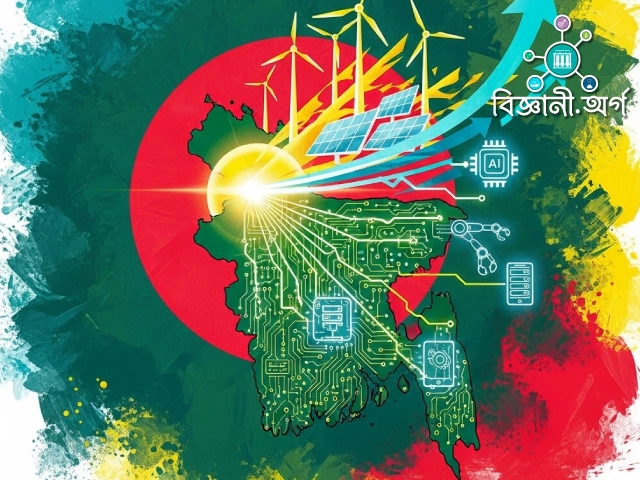
We now need an integrated energy policy—one that considers both fossil fuels and renewable energy. Not just solar or wind, but also nuclear power, hydropower, waste-to-energy production, and grid-based battery storage systems must be included. Educational institutions, research organizations, and technology companies in the country should come together to develop a realistic energy roadmap for the next 20 years. This will ensure that the expansion of AI technology and the country’s economic growth become complementary to each other.
No vision will survive without energy. No matter how grand a technological idea or knowledge may be, if there is no energy to implement it, it will remain only on paper. We must coordinate our AI plans with energy policy. Because in the coming days, electricity will be the driving force behind Bangladesh’s growth, and it is this electricity that will determine if we can progress on the path to digital development.
If a populous and promising country like Bangladesh adopts AI technology now and builds the necessary energy infrastructure for it, that could lay the foundation of our future economy. If we only react and do not plan ahead, we might face a reality where artificial intelligence exists, but there’s not enough electricity to power it. Then both technology and prosperity will exist only on posters—not in reality.