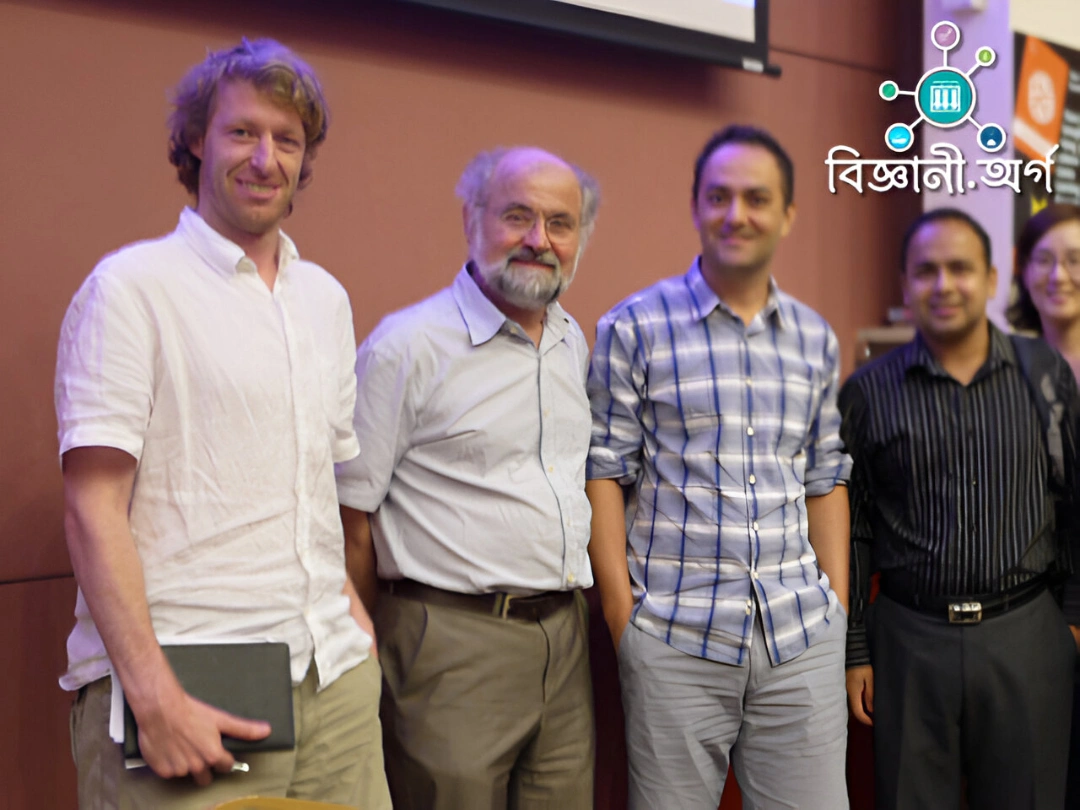
(Photo: The author with Professor Erwin Neher)
9 May 2012, Singapore
About a year later, around 2010, my professor once again invited me to resume research. He requested my help to complete some of the electronics work for the device. At his request, I took up the task again. Over the past ten years, a lot of progress had been made in his lab in Japan around this topic, but it still wasn’t possible to measure directly using circuits. After six months of work, I managed to give the electronics circuit a fairly complete shape. After nearly a year of work, I was finally able to receive signals using my own handmade circuit for the first time. We named this new technology Planar Patch Clamp. You can find a report related to this work here.
(Professor Erwin Neher invented the Patch Clamp device to uncover how cells communicate, an achievement that earned him the Nobel Prize. The author of this article has also conducted research on building this device. This article is written based on the author’s own experiences. )
It’s always quite difficult to get a taxi in Singapore in the evenings. The rush is heavier at this time as people return home from work. However, I had installed a taxi booking app on my phone a few days earlier. Thanks to that app, I was able to reserve a taxi very easily. All of us from our lab set off together in the taxi.
When we reached the Singapore Science Centre, evening was already approaching. Established in 1977, the Science Centre was designed mainly for teenagers—to help them understand different scientific concepts easily and to spark their interest in science. But today, we didn’t come to learn about science—we came to hear the words of Erwin Neher, a world-renowned scientist.
Erwin Neher and Bert Sakmann invented the Patch Clamp technology and won the Nobel Prize in 1991. At the time he received the Nobel Prize, I was studying at Rajshahi Cadet College, yet I had no idea that this technology would later become so closely intertwined with my own life. Before jumping into the main story, let me describe this technology in simpler terms.
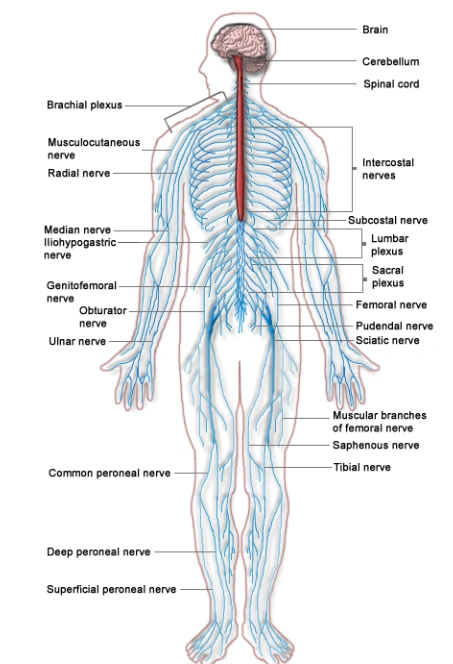
Image: Communication network of the human nervous system (Source: iahealth.net)
We know that the bodies of animals are made up of countless cells. These cells are always communicating with each other, and communication within the nervous system is particularly important. That’s because nerves transmit messages from different parts of the body to the brain, and then from the brain back out to various parts of the body. This is how we’re able to move our limbs. From perceiving light through our eyes to sending messages about injuries to the brain, these communication systems are crucial.
Human beings have long understood the existence of this communication. But due to a lack of technology, it was not possible to know the exact nature of this process, or how it really works. Neher and Sakmann invented a device to measure and understand this cellular communication, which became known as the Patch Clamp. Various types of ions play roles during this cell-to-cell communication, transporting tiny electric currents on the order of picoamperes. A single ampere equals 1,000,000,000,000 (twelve zeros) picoamperes. By measuring these minuscule electrical changes, the Patch Clamp can capture the communication between cells—it’s like measuring a flicker of light in a dark room.
Their invention was incredibly important, as it opened up a new horizon in front of humanity. After their discovery, scientists uncovered a remarkable network of communication among cells and learned how various proteins participate in these processes. Scientists call this type of communication the “ion channel,” since ions pass through different channels to convey messages from cell to cell.
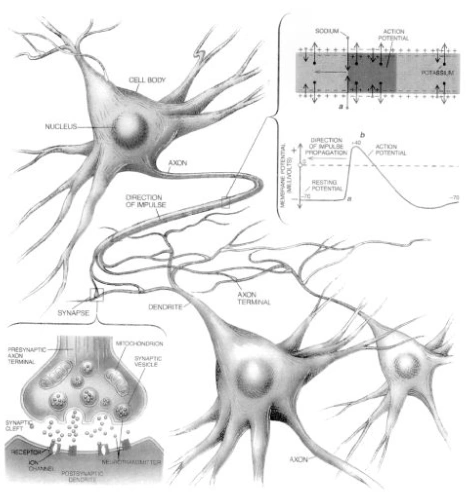
Image: Nervous system communication (Source: Fischbach, 1992, p. 52 )
Now, let’s return to my story. From childhood, I’ve always had an interest in building devices, and that interest eventually became the basis of my profession. While I was pursuing my master’s in Japan, I had the opportunity to build a Scanning Tunneling Microscope for observing matter at the atomic level. That experience deepened my enthusiasm for research even further.
Later, during my PhD, I became deeply interested in Neher’s Patch Clamp technology. This device allows researchers to study one single cell at a time—it’s not possible to quickly analyze many cells simultaneously. As a result, for drug research and other applications, it can be very time-consuming. I began to think that using nanotechnology, the Patch Clamp could be further improved to detect cellular signals more quickly and efficiently.
Around 2001, I submitted a research proposal to Professor Urisu in Japan, exploring the possibility of miniaturizing Neher’s invention using semiconductors. He immediately cautioned me that this would not be easy. Though driven by enthusiasm, I soon realized just how complex the workings of cells are, and how difficult it is to reliably collect signals from them. The biggest challenge was connecting man-made electronic circuits effectively with living cells.
Nevertheless, I was not discouraged, and continued my research. Finally, in 2004, I succeeded in recording neural signals using a semiconductor device. We published a research article on this achievement (link). We were the first successful research team in the world to accomplish this. This success formed the basis of my PhD. Later, I began new initiatives in information technology, first in the United States and then after returning to Bangladesh.
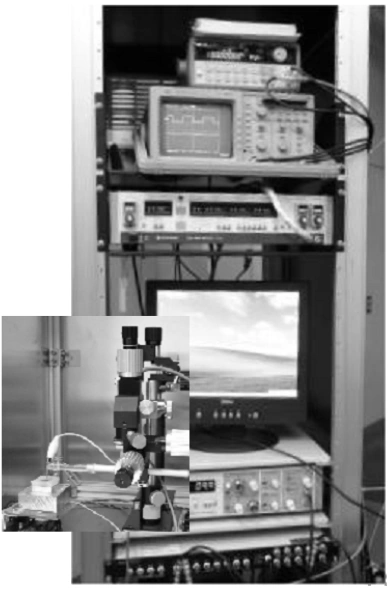
Device built by the author for measuring cell signals
(Collected from the 2005 PhD thesis)
Neher’s device directly patches a cell and receives signals from it. The whole process is very manual—you measure one cell at a time by hand. Studying the signals from multiple or even thousands of cells at once becomes very difficult. We tried to address this problem in our device. With the Planar Patch Clamp, by using semiconductor technology, it becomes possible to record signals from thousands—even millions—of cells simultaneously. Of course, we are not the only ones in the world building such devices; at the time, ten to twelve other research labs were working on similar instruments. In the near future, we will be able to investigate cellular signals even more easily.
Why this technology is important
Patch Clamp is not just another device; it’s a revolution in modern biology. By allowing direct measurement of the subtle electrical signals from cells, we’ve come to understand how cells communicate and what proteins and ion channels are involved in the process. This knowledge has revolutionized modern drug discovery methods.
Its contributions are especially invaluable in understanding and treating neurological disorders like Parkinson’s, Alzheimer’s, or Huntington’s disease. The main problem in these diseases is the disruption of neuronal communication. Patch Clamp technology allows us to pinpoint the exact process where this disruption occurs, which is the basis for developing new drugs and treatment strategies.
Not only that, but insights into ion channels have also opened new horizons for research into complex diseases like heart disease, diabetes, and cancer. The advanced, semiconductor-based version—the Planar Patch Clamp—enables simultaneous analysis of thousands of cells, greatly accelerating research. In the future, this could become a primary tool for personalized medicine and the development of the next generation of drugs.
Future Prospects
Technologies like the Patch Clamp are not limited to revealing the basic scientific mysteries of cells and neurons; they’re creating pathways to entirely new futures. Today, scientists are developing devices that can connect directly to the human brain. As a result, people who have lost their sight are now able to perceive light, shadow, or objects using visual prosthesis or artificial eye technology. Those who are paralyzed or have lost the ability to speak can now have their neural signals collected from the brain by special electrodes and translated into language by computers.
This kind of brain-computer interface technology is becoming a reality, ushering in a new revolution in medical science. Many researchers believe that in the future, not only will we restore lost sight or speech through this technology, but direct communication between human brains and machines will also become possible. Its origins are not from nowhere—the technology invented by Neher and Sakmann to understand the electrical signals of cells laid the groundwork for today’s remarkable journey.
Today, Neher recounted the story of his invention in his lecture. Interestingly, he began this work way back in 1969 during his PhD. It seemed as if he had dedicated his whole life to developing this technology. After his talk, I got the chance to speak with him. I told him about our work—he was delighted to hear it and encouraged me warmly. I then asked what he’s working on nowadays. He shared something interesting.
Not only is the communication system between cells and neurons remarkable, but it also changes over time. Sometimes these changes can be as brief as a second or as long as years. Such changes are part of a very natural process. He is now focused on researching why and how these changes in communication occur.
As we left the Science Centre after bidding him farewell, night had fallen. We left behind the moments spent with this world-renowned scientist. My own research journey has been shaped by the technology he invented. You are a pride of humanity, Professor Erwin Neher. Salute to you a hundred million times over.