


We often hear about fiber optics in newspapers and magazines. The most talked-about issue is the Bay of Bengal Optical Fiber Project, which will play a significant role in Bangladesh’s information technology sector in the near future. We are far behind in the field of information technology, but once we are connected to the world through this Bay of Bengal fiber optic network, we will have access to faster internet connections. But what exactly is optical fiber? What are its unique features that make it so widely discussed? Many mysteries about it remain unknown to many of us. First, I will discuss fiber optics, and then describe the current situation in Bangladesh.
Structure of Optical Fiber
Essentially, optical fiber refers to extremely fine strands of glass, similar in thickness to human hair, which can transmit light signals over long distances. Optical fiber is made from a very special type of glass fiber. The main component of ordinary glass is silicon dioxide. Due to the special arrangement of its molecules, light can travel through glass, which is why we can see things through it. However, because of the presence of unwanted substances in regular glass, light movement is hindered. This is why thicker glass tends to look opaque and often appears greenish. But optical fiber almost never contains such impurities, so light can travel through it over much longer distances. To illustrate the transparency of optical fiber, one could say if you stood on the surface of the sea made entirely of optical fiber, you would be able to see the seafloor.
Below is a diagram showing the simple structure of an optical fiber.
Optical fiber primarily consists of three parts:
Core: This is the main path for the light to travel through.
Cladding: The refractive index of glass in this layer is greater than that of the core.
Buffer Coating: This outer layer protects the fiber optic from friction.
Additionally, the optical fiber has a rubber jacket on the outside, which protects the optical fiber inside.
Types of Optical Fiber:
Optical fibers are divided into two types based on the size of their cores. Small core fibers are called single mode fibers, with a core diameter of 9 microns (1 mm = 1000 microns). Laser light is used to transmit signals through them, with wavelengths ranging from 1,300 to 1,550 nanometers.
Larger core optical fibers are known as multi-mode fibers. Their core diameter is larger than that of single mode fibers, at 62 microns. These use infrared light, with wavelengths from 850 to 1,300 nanometers. This infrared light is transmitted using Light Emitting Diodes (LED), which are generally cheaper than lasers. However, light waves from lasers are much more precise.
How does light travel inside optical fiber?
To understand this, we need to revisit some high school physics lessons. We learned that when we see fish in a river, they appear to be above their actual position. The reason we don’t see them at their actual location is because of refraction. When light enters one medium from another, its direction changes slightly—this is called refraction. If the second medium has a different density than the first, the refracted light will bend. How much it bends depends on the refractive indices of the two media and the angle at which the light enters the second medium.
The critical angle is a specific angle at which the light will begin to travel along the boundary instead of exiting—at this point, the angle of refraction is 90 degrees. However, if light enters at an angle greater than the critical angle, it reflects back entirely. This is called total internal reflection. Regular mirrors reflect about 90% to 95% of the light, but in an optical fiber, nearly 100% of the light is reflected. The refractive index of a typical optical fiber core is about 1.55, and for the cladding, about 1.45. Therefore, the critical angle for fiber optics is 69 degrees, so light entering at greater than 69 degrees will reflect at every point.
If this is hard to understand, just remember that as light passes through the core of optical fiber, it keeps reflecting internally like a mirror. In this way, the signal can travel a great distance inside the optical fiber, and that’s the secret of optical fiber. The cladding outside the core doesn’t allow any light to pass through. Therefore, the core is made of very pure fiber so that light can travel far. Nonetheless, some unwanted substances still mix with the fiber, so for very long optical fibers, optical regenerators are used in the transmission path.
Fiber Optic Relay System
The complete system that transmits and receives signals through optical fiber is called the fiber optic relay system. This system comprises the following components:
Transmitter: This converts any information into light signals and prepares them for transmission through the optical fiber. As mentioned earlier, laser and LED lights are used, typically with wavelengths of 850, 1300, or 1500 nanometers.
Optical Fiber: This is the main optical fiber through which the light travels.
Optical Regenerator: Used mainly in very long optical fibers to intensify the light waves. As previously mentioned, impurities in the core fiber can hinder the passage of light. When the length of the optical fiber exceeds about one kilometer, optical regenerators are required to amplify the light so it can travel farther. Essentially, this optical regenerator is a type of laser amplifier that strengthens the traveling laser light and allows it to travel much further. You may have heard about optical fiber under the sea, where such optical regenerators are needed.
Optical Receiver: This receives the light wave and converts the light signal back into a standard electrical signal. Usually made with photocells or photodiodes, which function as light sensors and convert the signal to electricity.
Advantages of Optical Fiber:
In practical communications, optical fiber has ushered in a new era. In many cases, optical fibers are replacing traditional communication systems. Previously, only large telecommunication companies used optical fiber, but now it’s increasingly being used in homes as well. For example, your home DVD player may have an optical fiber connection. The day is not far when every home will have an optical fiber plug. In the future, when people rent or buy a house, along with asking about gas and electricity connections, they’ll also want to know about optical fiber connectivity. While telephone and ISP systems have provided internet access so far, using optical fiber will give users access to faster internet. In Japan, new apartments and houses now come with built-in optical fiber.
Let’s look at the benefits of optical fiber:
1. Lower cost: Usually, optical fiber costs much less than conventional copper wires.
2. Thinner: Compared to copper wires, optical fiber is much thinner, allowing many fibers to be installed at once and transmit far more signals than copper wires.
3. Higher signal capacity: A copper wire can transmit only one signal at a time—when you’re on the phone, only you can talk through that phone line. But with optical fiber, many people can communicate simultaneously. Currently, standard optical fiber can transmit 10 gigabits per second, so the broadband internet we hear about in the future will use optical fiber.
4. Minimal signal loss: Signal loss is much lower in optical fiber compared to copper wire—almost none.
5. Light signals: Since optical fiber uses light waves, there is no possibility of crosstalk, so you get clear voice transmission on telephones. In conventional copper lines, the voice is often unclear.
6. Lower power: Sending signals over long distances with copper wire requires high voltages, but fiber optics require less power. With lasers, light waves can be sent farther at lower power.
7. Digital signal: Optical fiber works with digital signals, making it advantageous for computer networks and similar uses.
8. Fire-resistant: High voltage can sometimes cause copper wires to catch fire. Many fires, when analyzed, have been traced to overheated wires. With optical fiber, there’s no risk of overheating, so it’s much safer than copper.
9. Lightweight: Optical fiber is much lighter than copper wires because it’s made from fiber.
These numerous advantages are why optical fiber is becoming so popular. In our country’s telecommunications sector, fiber optics are also being used. For example, Bangladeshi mobile companies are using the railway’s optical fiber.
Bangladesh and Fiber Optic Cable
Bangladesh is mainly linked to the outside world through microwave satellite connections, which are extremely expensive. There are only two A-standard satellites in Bangladesh, located in Betbunia, Chattogram, and Mohakhali, Dhaka. Thirty kilometers from Dhaka in Talibabad there is a B-standard, and in Sylhet, a C-standard satellite station.
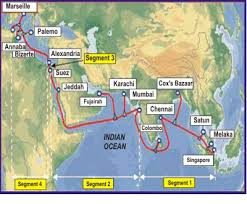
But all developed countries are connected to the world not only via satellites but also through fiber optic cables. The Americas, Europe, Australia, and other continents are linked by fiber optic cables running under the sea. Transmitting information through these channels is far cheaper per channel than through satellites. Fiber optics make fast communication possible. The first undersea cable, Trans-Atlantic (TAT-1), was laid in 1956 and was a regular telephone cable, but the first fiber optic submarine cable, TAT-8, was laid in 1983. This enabled 35,000 telephone connections across the Atlantic Ocean. Three submarine cables are being built under the Bay of Bengal—SMW2, SMW3, and FLAG. The most talked-about among them is SEA-ME-WE3 (South East Asia, Middle East, Western Europe). Discussions about SEA-ME-WE3 began in the 1990s. Unfortunately, Bangladesh did not participate in the SEA-ME-WE3 project. Despite considerable debate in newspapers and media, the then government did not take any initiative.
Since 1996, steps have been taken to connect major Bangladeshi cities via optical fiber cable networks. The first fiber optic connection was established between the telephone exchanges at Moghbazar and Gulshan in Dhaka. Currently, the inter-exchange connections in the cities have fiber optic connections. In 2001, STM-16 was established between Dhaka and Chattogram, and other regions have also been connected via fiber optic networks (see PDF file for details).
In the future, Bangladesh will join the global fiber optic network through the SEA-ME-WE-4 project. If that happens, Bangladesh will be able to connect to the world at about 10 gigabits per second. It will give Bangladesh free landing access to Singapore, Indonesia, Malaysia, India, Sri Lanka, Pakistan, United Arab Emirates, Saudi Arabia, Egypt, Italy, and France.
The first SEA-ME-WE-4 meeting of these 12 countries was held in Dubai on July 1–3, 2002. On September 4 in Jakarta, Bangladesh Telegraph and Telephone Board (BTTB) signed the SEA-ME-WE-4 Memorandum of Understanding (MoU). It is expected that the project will be completed in early 2005. Then we will no longer need to use the old VSAT system for internet access. People will experience the true meaning of broadband. SEA-ME-WE-4 will use Dense Wavelength Division Multiplexing (DWDM), making it possible to transmit 1.28 terabits per second. The tender process for this project has already begun.
Of course, it has not been easy for Bangladesh to reach this stage. Several foreign organizations applied various pressure tactics to connect Bangladesh to their own submarine cables. But by joining SEA-ME-WE-4, we will have access to fast connections at a much lower cost. In this regard, Bangladesh’s total cost will be 30 million dollars, and we will have to lay 1,240 km of fiber optic cable in the Bay of Bengal. Our dream of having a submarine cable is about to come true.









This comment has been sanitized for the English site.
This comment has been sanitized for the English site.
This comment has been sanitized for the English site.
This comment has been sanitized for the English site.
This comment has been sanitized for the English site.