


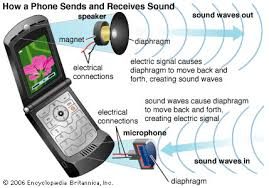
The electronic device that is undoubtedly impacting our daily lives the most today is the “mobile phone,” also known by some as the “cellular phone.” But how exactly does this phone work? How is it different from a regular telephone? Today, I will give you a general overview of how a mobile phone operates.
To begin with, a mobile phone is actually a “radio.” Initially, mobile phones functioned much like ordinary telephones, but nowadays, their uses have expanded greatly. Some of its uses are listed below—
1. Stores phone numbers and addresses
2. Maintains calendars and to-do lists
3. Sets appointments and alarms
4. Calculator
5. Email capabilities
6. Ability to view web pages
7. Simple games
8. Functions as a GPS, so you can also view your location on a map
9. Camera: Many mobile phones allow you to take pictures with a digital camera and send them to others via email.
Additionally, mobile phones with even more features are being released on the market.
Background: When exactly did the mobile phone begin? It’s difficult to pinpoint precisely. However, the two technologies that are considered its predecessors are the radio and the telephone. Their combination and modernization have created the present-day mobile phone. The telephone was invented by Graham Bell in 1876, and 18 years later, in 1894, Marconi invented the radio.
Before mobile phones, many people used radio phones in cars for mobile communication. But due to their large size, they were not portable by hand, and generally communicated through a central antenna over just 25 channels. This meant the transmission range of a radio phone had to be around 40 to 50 miles. And because there were so few channels, not many people could use them simultaneously. Now, let’s see how modern mobile phones work. Nowadays, a city or area is divided by the mobile company into many “cells.” Each cell typically covers about 10 square miles and is hexagonal in shape, with each having its own base station. In each cell, conversations can take place over 800 frequencies. Even though many towers are needed in a city to enable mobile calls, the cost has gone down due to the large number of users, making it commercially successful. Each city has a central office that communicates with the base stations or towers. These central offices are called Mobile Telephone Switching Offices (MTSO). Both cell phones and base stations use low-power transmissions, so mobile phones can operate on low-capacity batteries, enabling today’s devices to be so small—and they will get even smaller in the future.
When we turn on the mobile, it receives a SID (System Identification Code) via the control channel and matches it with the one in the phone. It also maintains communication with the MTSO. The central office maintains the phone’s location in a database. That means as you move around the city, the central office keeps a record of the cell you are currently in. Whenever someone calls you, the central office retrieves your location from the database, finds the nearest tower to you, and connects the call using that tower and frequency so you can talk.
Another major advantage of mobile phones is that you can talk while moving in a vehicle or elsewhere. As you move from one cell to another during a call, the system automatically connects you to a new tower when you get farther from the current one, so you can maintain your conversation smoothly as you go from place to place.
Though mobile phones look small, they can accomplish so much in moments because of the DSP (Digital Signal Processor) inside them, making today’s mobiles so smart!
What is a Duplex Channel?
Mobile phones use a duplex channel. You may be familiar with the walkie-talkies used by police sergeants. These walkie-talkies use a single channel, which means you can only talk or listen at any one time—not both simultaneously. For example, on a walkie-talkie, a sergeant says “over” when finished talking so the other person knows when to respond.
But because mobile phones use duplex channels, you can talk and listen at the same time, just like on a regular phone call.
What is GSM?
GSM is an international standard that is widely used in Europe, Asia, America, Africa, and Australia. In Bangladesh, GSM is very prevalent, and Grameenphone also uses GSM. GSM operates at 900 to 1800 megahertz in Europe and Asia, and 1900 megahertz in America. If you want to use a GSM phone in Bangladesh, you only need to buy a SIM (Subscriber Identification Module) card. This SIM card looks like a small chip and stores the mobile company’s connection ID and the user’s information. So, you can insert your SIM card into any device and it will instantly work as your own phone.
(Unfinished)







This comment has been sanitized for the English site.
This comment has been sanitized for the English site.
Thank’s a lot………….
Pls write down something about Networking…. waithing,,,,,,,,,,,,,,,,,,,
This comment has been sanitized for the English site.
This comment has been sanitized for the English site.
bro..plz write about CDMA.
This comment has been sanitized for the English site.