Dr. Moshiur Rahman
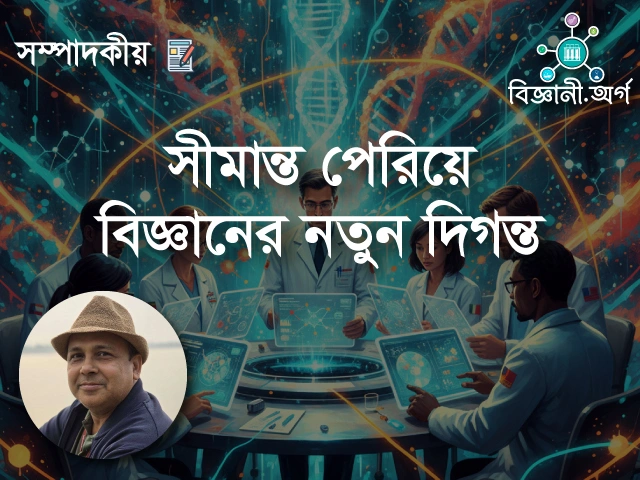
One thing is becoming increasingly clear in the world of modern research—no single discipline alone can solve society’s complex problems. Whether it’s climate change, new disease treatments, or sustainable energy—everywhere we see the limitations of working within a single field. That is why it’s essential now to combine multidisciplinary knowledge and look for new pathways forward. The main theme of a recent discussion arranged by Japan’s Science and Technology Agency was precisely these real-world experiences of international, interdisciplinary collaboration.
The first speaker, Professor Nanba, shared his experience with the bacterial micro-propeller motor. This is a biological system invisible to the naked eye, yet it spins several hundred times per second to keep bacteria moving. He wasn’t alone in unraveling this mysterious motor—he began his work together with researchers from Oxford and Sydney. Knowledge from diverse fields—DNA origami technology, X-ray crystallography, cryo-electron microscopy—all blended into a unique scientific endeavor. From Professor Nanba’s talk, it was clear that breakthroughs are born not just in the lab, but also at conferences, the dinner table, or discussions by the ski-resort lounge. This is the true beauty of working beyond borders.
The next speaker, Professor Kakugo, shared a different experience. He researches “artificial swarms”—using chemical elements to mimic the behavior of fish or bird flocks in nature. His curiosity was sparked by the beauty of swarming in the natural world: why do creatures gather in flocks? What is the benefit? To answer these questions, he joined hands with researchers from physics, chemistry, and even biomedicine. Visiting labs in New York, Israel, and Italy, he discovered that the real strength of collaboration is built through informal conversation. Sometimes, a chat that starts during a coffee break turns into an international project. He even carried out collaborations via video conferences from his hospital bed—proving that scientific curiosity cannot be contained.
These experiences remind us of a fundamental truth—science is not limited to the inside of a laboratory. It is deeply intertwined with social, cultural, and human experiences. International collaboration isn’t just about sharing research papers; it’s about learning new languages with people from different backgrounds, overcoming misunderstandings, and patiently engaging in discussions. Often, language barriers or differing research cultures pose initial obstacles, but genuine interest and mutual respect break through these barriers.
For countries like Bangladesh, these experiences are especially important. Our young researchers often ask—how can we initiate international collaborations? The answer is simple: don’t wait for opportunities, move forward. Attending small conferences, joining discussions online, or simply sharing a cup of coffee with a foreign researcher can be the beginning of a new journey. The courageous steps that seem small today might become the foundation for a groundbreaking discovery tomorrow.
In this era confronting global challenges, Bangladeshi researchers have a tremendous opportunity. In fields like climate change, public health, agriculture, or information technology, the potential for interdisciplinary international collaboration is immense. But this requires open-mindedness, the vision to look beyond borders, and nurturing a culture of cooperation. The diplomacy of research isn’t limited to state-level policy; every researcher’s personal actions are part of this diplomacy.
If we truly want to harness science as a force for social transformation, we must empower our younger generation not only in research skills but also in building relationships. We must not remain confined within borders—rather, we have to reach across them, because the science of tomorrow will be the result of everyone’s joint efforts.
Source:
This article is based on a speech delivered at an event by the Japan Science and Technology Agency