“Will we one day stand on the soil of the Red Planet, leaving Earth’s sky behind? Will Mars truly become humanity’s second home? Or is this just a dream born of science fiction?”—these questions are fuelling curiosity among researchers, scientists, and ordinary people all over the world. In the wake of Earth’s limited resources, growing population, and environmental decline, humanity has begun searching for new habitats. In this search, Mars has emerged as a unique beacon of possibility.
Why Mars?
The Moon may be nearby, but establishing a permanent settlement there is difficult. Mars, while comparatively farther, has a size, day length, and gravity much more similar to Earth. That’s why scientists believe that with the right technology and planning, human survival on Mars is a real possibility. And thus, a vast scientific odyssey is slowly taking shape around Mars.
Looking Back into History
Human fascination with Mars is nothing new. Ancient civilizations viewed this red planet as the symbol of the god of war. In the modern era, NASA’s Mariner 4 spacecraft sent back the first close-up images of Mars in 1965. In 1976, the Viking lander descended onto Martian soil to collect detailed information. Then in 2012, the Curiosity rover discovered that Mars’s environment may once have been suitable for life. Most recently, in 2021, the Perseverance rover demonstrated that it’s possible to generate oxygen from the Martian atmosphere. With each mission, Mars seems to come a little closer.
The Tough Wall of Challenges
Still, the path isn’t easy. Mars has an extremely thin, oxygenless atmosphere. The average temperature is below minus sixty degrees Celsius. Lacking a magnetic field like Earth’s, Mars is bombarded by harmful solar radiation. The distance from Earth to Mars is so great that even with advanced technology, the journey takes six to nine months. Throughout this long trip, everything—fuel, food, medicine, and communication—poses tremendous challenges.
Possible Solutions
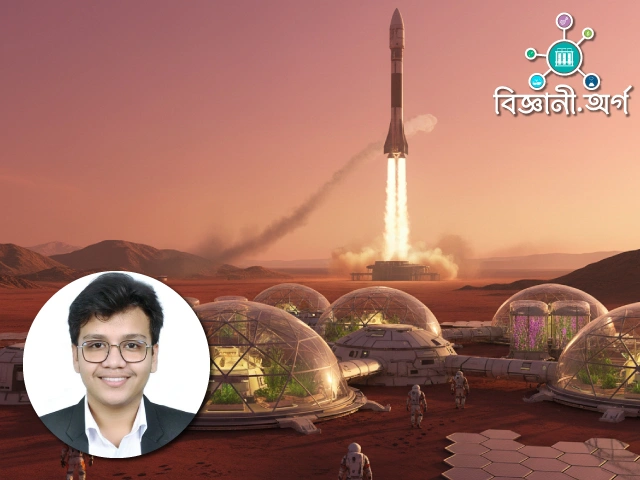
But science hasn’t stood still. NASA’s MOXIE instrument has proven that oxygen can be produced from carbon dioxide. Plans are underway to extract water from ice, which will not only be used for drinking but also to help manufacture rocket fuel. Technologies such as hydroponic farming, genetically modified crops, and even experiments to treat and use Martian soil for agriculture are underway. For shelter, specially designed domes, 3D-printed homes, or underground habitats are being considered. SpaceX has already embarked on its Starship project, aiming to regularly transport humans to Mars.
A Vision of Life on Mars
One can imagine that, one day, people on Mars will look out their windows in the morning and see red, dust-covered horizons, a smaller sun, and a pinkish sky. Venturing outside will always require special suits, and the habitats inside will have to be tightly regulated for oxygen and temperature. Small colonies will offer opportunities for education and research. New schools will be established for children, and scientists will work to discover ways to produce food using local resources. In the beginning, Mars will rely on supplies from Earth, but over time, a self-sustaining economy will develop. Alongside, a new culture will emerge—children born on Mars may grow up with a distinct identity and one day be called “Martians.”
Facing Ethical Questions
But this path also raises serious ethical questions. Do we truly have the right to change another planet for our own needs? If we failed to protect Earth’s environment, will we drive Mars toward a similar fate? Or will this mark a new beginning for humanity’s sense of responsibility, where we learn to live sustainably? These questions are not just scientific—they also provoke us to reflect on the future of humanity.
On the Horizon of the Future
Scientists estimate that the first humans could set foot on Mars as early as the 2030s. By 2050, small colonies may be established there. By century’s end, hundreds of thousands could be living on Mars. Then, Earth and Mars will become two separate centers of human civilization—Earth as the birthplace, and Mars as the dawn of a new chapter.
Even though today, the idea of human settlements on Mars still sounds like a dream, the distance between reality and imagination is shrinking fast. Technology, courage, and human curiosity are coming together to gradually make that dream a reality. Someday, from Earth’s sky, we may see—human lights glittering across the distant Red Planet. At that point, humanity will no longer be bound to Earth—we will become true citizens of the cosmos.
Tahsinur Rayyan,
Eighth-grade student,
Special interest in science and mathematics.
Founder and Director, Rayyan’s Readers Corner.