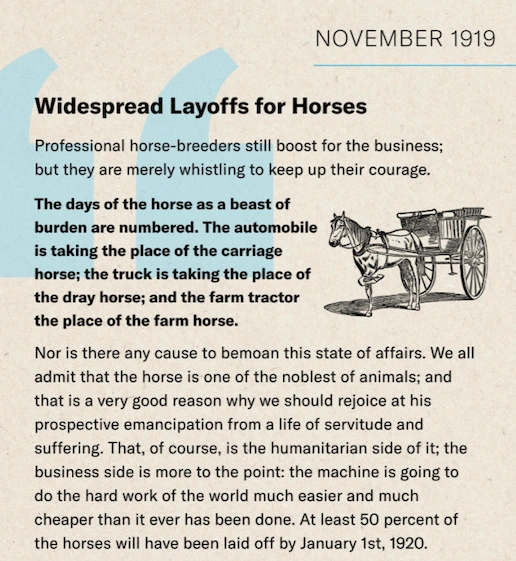
In November 1919, a prophecy appeared in the pages of Scientific American: the working life of the horse was nearing its end. At the time, horses were still the principal source of power—on city streets, farm fields, and for pulling carts. Yet, within just a few years, the arrival of motorcars, trucks, and tractors suddenly began to diminish the necessity of this “noble animal.” As the article stated, “The days of the horse are coming to an end. The car is taking the place of the carriage, trucks are replacing freight horses, and the tractor is making the farm horse obsolete.”
Once, the horse was humanity’s most faithful companion in civilization. From transport to agriculture, even on the battlefield, its contribution was immeasurable. But as technology advanced, people realized that mechanical power wasn’t just faster—it was also cheaper and more efficient. Thus, the idea of being freed from the grueling labor of horses became a topic of discussion. The article noted that, from a humane perspective, this should be welcomed as good news—because horses would no longer be forced into a lifetime of servitude and toil.
Yet, economic realities were the main driving force. Machines could perform tasks many times faster and more efficiently than horses, and at much lower cost. The use of tractors in agriculture changed farming practices within just a few years. The dominance of cars and trucks on city streets soon made horse-drawn vehicles a rare sight. It was predicted at the time that, by January 1920, at least half the horses would be “laid off.”
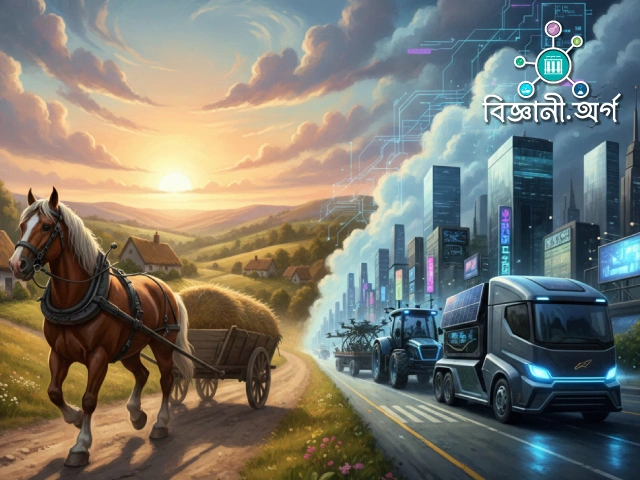
A century later, this article reminds us that technological change is never just the invention of a new machine—it can transform entire social and economic structures. Just as horses became obsolete then, today other professions or skills may stand in that very position. In the age of artificial intelligence and automation, many jobs are on the verge of slipping from human hands. From bank cashiers to drivers and content writers, countless professions now face uncertainty due to the progress of technology.
Still, the story of the horse teaches us another vital lesson. Whenever a new technology replaces the old, it creates a tension between human feelings and reality. Just as we accepted the liberation of horses from hard labor as human progress, so too must we now seek solutions for people replaced by technology. Mechanical power took the place of horses; but for humans, there is need for retraining, skill transformation, and the creation of new employment opportunities.
Reading that 1919 article, it becomes clear that history keeps telling the same story in new forms. The downsizing of horses was, in fact, a pivotal chapter in the relationship between technology and human society. Today, in the age of artificial intelligence, we are witnessing a reflection of that past. Just as modern machines propelled human civilization forward then, AI is now pushing us toward a new horizon. The question is—are we prepared for this change, or will we, too, one day become just a page in history, like the horse?